
What if the loan you’re considering comes with protections you haven’t been told about? If you’re serving on active duty or supporting a family member who is, it can be hard to know whether the Military Lending Act applies, especially when fees and contract terms are involved. Knowing your rights under the Military Lending Act can help you review an offer before you sign.
You deserve clear answers about who qualifies, which loans may be covered, and what the law limits. For covered borrowers and covered credit, the MLA generally caps the Military Annual Percentage Rate (MAPR) at 36%. MAPR includes specified fees and charges, so it can differ from the standard APR.
This guide explains who the MLA protects, which loans may fall within its scope, and what contract terms are prohibited. It also outlines what to review, what records to keep, and where to turn if something seems wrong. QuickCashDirect connects users with a network of lenders. The creditor makes the loan offer, so review its terms carefully and don’t assume every offer is covered by the MLA.
Key Takeaways
- Check both your borrower status and the type of credit. Some transactions, including certain home-secured and purchase-money loans, may be excluded.
- Know your rights under the Military Lending Act, including protections against certain contract terms such as mandatory arbitration and waiving SCRA rights.
- Before signing, identify the creditor and review the disclosures, payment obligations, fees, and contract language. Keep copies of the offer and related records.
- If you believe a covered loan violates the MLA, consider contacting the CFPB or your local Judge Advocate General’s office for assistance.
- Use MLA protections as one part of your decision. Coverage alone doesn’t mean a loan is suitable or affordable for you.
What the Military Lending Act protects, and who may qualify
The Military Lending Act (MLA) is a federal law that limits certain lending costs and contract terms for eligible servicemembers and their dependents. Its protections apply when both the borrower and the consumer credit transaction are covered. The law doesn’t determine whether a loan fits your budget, so compare the amount borrowed, repayment schedule, and total cost as well.
Eligibility isn’t based on a military connection alone. A lender generally needs to determine whether the borrower is covered when credit is extended, and the transaction must fall within the law’s scope. A veteran, a military employee, or a relative of someone who served doesn’t automatically qualify. Your rights under the Military Lending Act depend on both your status and the kind of credit involved.
Who counts as a covered borrower under the MLA?
The MLA generally covers active-duty servicemembers and qualifying dependents. National Guard and Reserve members may qualify while serving on active-duty orders for 30 days or more. Dependent status follows legal definitions, so don’t assume that every relative or household member qualifies.
Creditors can check military status using the Department of Defense’s MLA database. They may also use a consumer report from a nationwide credit bureau as a safe harbor for determining covered-borrower status. If you’re unsure, ask how your status was assessed and review the creditor’s explanation. A status check helps determine potential MLA coverage, but it doesn’t establish that every feature of a loan is covered.
Which types of credit may fall within MLA coverage?
The MLA applies to a broad range of consumer credit, but not every financial product or transaction. Covered categories can include credit cards, payday loans, vehicle title loans, refund anticipation loans, and certain installment loans. The type of credit and how it’s structured matter, so a product’s everyday name alone may not settle the question.
Some transactions are excluded. These include residential mortgages and certain loans to buy a vehicle or other personal property when the loan is secured by the property being purchased. For example, a purchase-money vehicle loan may be treated differently from a separate loan secured by a vehicle title. Don’t assume the same rules apply to both.
Use this quick coverage check before relying on MLA protections:
- Borrower: Were you an active-duty servicemember or qualifying dependent when the creditor extended the credit?
- Credit type: Is the product a form of consumer credit that may be covered?
- Transaction: Does a mortgage or purchase-money exception potentially apply?
These are screening questions, not a final legal determination. For a specific product, compare its terms and structure with current MLA regulations. If the answer remains unclear, seek qualified legal guidance before relying on a protection. This can be especially helpful when a loan combines features that make its category less obvious.
Your core Military Lending Act rights: cost limits and contract protections
For covered borrowers and covered credit, the MLA sets a ceiling on the cost of borrowing and bars certain contract terms. These are legal protections, not a judgment that a loan is affordable or right for you. Before agreeing to an offer, check the total repayment amount and payment schedule.
For covered borrowers using covered credit, the MLA generally limits the Military Annual Percentage Rate (MAPR), a measure of borrowing costs that includes specified charges, to 36%. The limit applies only when the borrower and transaction qualify under the law.
How the 36% MAPR limit differs from APR
APR is a standardized way to express the annual cost of credit, including interest and certain fees. MAPR is a separate MLA measure. It can include interest, fees, credit insurance premiums, and charges for certain add-on products, such as debt cancellation or debt suspension agreements. Because the measures can include different charges, MAPR may be higher than the APR shown in an offer.
Compare both figures, but don’t rely on the APR alone to understand the cost of covered credit. The MLA has specific calculation requirements and exceptions. For example, certain bona fide and reasonable fees on credit card accounts may be excluded from MAPR. The treatment depends on the fee and applicable rules, so don’t assume every charge is counted the same way.
A 36% ceiling is a limit, not a promise of affordability. Check the amount you’ll repay, when payments are due, and what happens if you can’t pay on time. Your rights under the Military Lending Act can set boundaries on covered credit, but they don’t remove valid repayment obligations.
Contract terms the MLA restricts
The MLA also prohibits certain terms in covered transactions. A creditor generally can’t require a covered borrower to submit disputes to mandatory arbitration, waive rights under the Servicemembers Civil Relief Act (SCRA), or create a voluntary military allotment as a condition of getting credit. The law also prohibits prepayment penalties on covered credit.
These restrictions don’t make every clause in a loan agreement invalid. They apply within the MLA’s scope. Read the full contract and flag language about arbitration, waivers, allotments, and early payoff. If a term appears to conflict with these protections, keep a copy of the agreement and seek qualified guidance before relying on an interpretation.
QuickCashDirect connects users with a network of lenders. When you compare offers through a loan referral service, review the creditor, MAPR, fees, and contract terms for the specific offer. Don’t assume a loan is covered or compliant based only on where you found it.
Does the MLA apply to this loan? Check coverage, exceptions, and timing
Military status alone doesn’t bring every credit agreement under the Military Lending Act. Potential coverage depends on two separate questions: whether the borrower qualifies and whether the specific transaction is covered. Check both before relying on MLA protections. A creditor’s status check can help answer the first question, but it doesn’t determine the legal treatment of every product or contract feature.
Use this comparison to organize your review:
- Borrower status: Were you a covered servicemember or qualifying dependent when the credit was extended?
- Transaction type: Is the agreement a form of consumer credit that may fall within MLA coverage, or could an exception apply?
- Timing and records: What status determination and loan disclosures did the creditor provide for this specific agreement?
A “yes” to the first question doesn’t automatically answer the next two. Your rights under the Military Lending Act depend on the full coverage analysis, not simply on your connection to the military.
Common coverage exceptions to understand
Some transactions are excluded from MLA coverage, including residential mortgages and certain purchase-money loans for vehicles or other personal property when the purchased item secures the loan. The details matter. A loan used to buy a vehicle may be treated differently from a separate loan secured by a vehicle title. Don’t assume that two products involving the same item have the same legal status.
Keep the borrower and transaction questions separate. You may meet the covered-borrower definition while a particular transaction falls within an exception. Conversely, a product category that can be covered still requires an eligible borrower and a transaction that meets the rule. Review the agreement’s purpose, security, and structure against current regulations or qualified legal guidance.
Payday-style loans, installment loans, and other consumer credit products need transaction-specific analysis. A label such as “payday loan” or “installment loan” can be a useful starting point, but it doesn’t resolve every coverage question. Read the actual agreement rather than relying on a product name or general description.
Why timing and status checks matter
Creditors determine covered-borrower status in connection with extending credit. They may use the Department of Defense’s MLA database or a nationwide consumer reporting agency’s report under the applicable safe-harbor procedures. A database result addresses the status-check process. It doesn’t, by itself, settle whether the loan’s structure or terms place the transaction within MLA coverage.
Keep a complete, secure record of the offer and signed agreement. Save disclosures, payment schedules, fee details, creditor communications, and any written explanation of the status determination. If a concern arises, these records can help you show what was offered and when. Compare the documents with current official guidance, and seek qualified legal help if the coverage question remains unresolved.
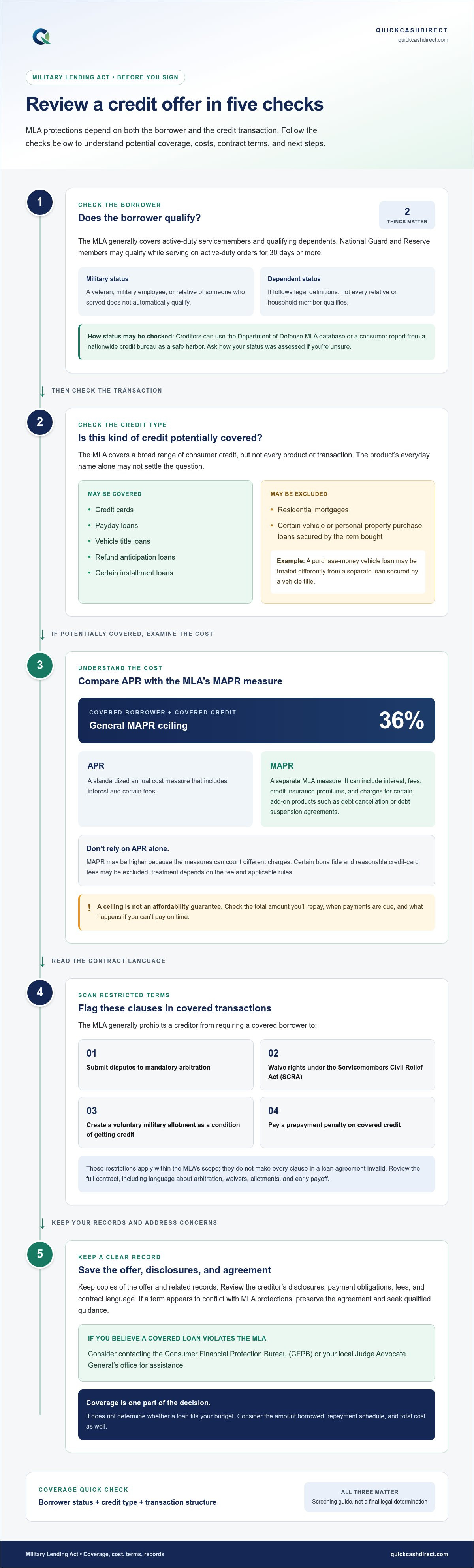
Reviewing Credit Offers and Handling MLA Issues
Use a clear sequence before you sign or raise a concern. The creditor is the party responsible for the loan agreement, even if you found the offer through a referral service. Keep the documents together so you can compare the offer with the final contract.
- Identify the creditor and product. Record the creditor’s legal name and the type of credit. Don’t rely on an advertisement or a platform’s description alone.
- Confirm borrower status. Check whether the creditor assessed your status under the MLA and keep any written determination or related communication.
- Review the disclosures and contract. Compare the MAPR, payment obligations, fees, and terms in the written agreement. Look for arbitration requirements, waivers, or language about military allotments.
- Save your records. Keep the advertisement, application, signed agreement, disclosures, payment history, and relevant messages or letters.
Your first practical step is to compare the written loan terms with the MLA disclosures, then flag any mismatch before signing. If you’ve already signed, make the same comparison using the documents you received and your payment records. Your rights under the Military Lending Act are easier to assess when you can point to the exact term or charge that concerns you.
Documents and disclosures to inspect before signing
For covered credit, MLA disclosures explain the MAPR and the borrower’s payment obligations. The rules also provide for required disclosures in writing and orally, subject to applicable requirements and exceptions. Check the paperwork and any spoken explanation for consistency. The MAPR disclosure should state the cost measure used for the covered transaction, while the payment disclosure should make clear what you must pay under the agreement.
Compare the disclosed MAPR with the contract, then review the payment amount, due dates, fees, and any add-on products. Read sections on dispute resolution and waivers closely. If a disclosure is missing, a figure differs, or the language is hard to understand, pause. Ask the creditor a specific question in writing and keep its response. Seek qualified legal assistance if the conflict remains unresolved.
Where to raise questions or submit a complaint
Start by sending the creditor a concise written question. Identify the loan, quote or attach the term you’re concerned about, and ask for an explanation. Save your message and the response with the loan records. If you believe the issue may involve an MLA violation, you can submit a complaint to the Consumer Financial Protection Bureau (CFPB) or contact your local Judge Advocate General (JAG) office for assistance. These channels can help you understand possible next steps, but they don’t guarantee a particular outcome.
QuickCashDirect connects users with a network of lenders. If you’re reviewing loan options through the service, read the specific creditor’s offer and disclosures carefully. Don’t assume that an offer is covered by the MLA based only on where you found it.
Use your MLA rights before choosing a loan or next step
Before accepting credit, bring the key questions together. Your rights under the Military Lending Act can help you assess whether certain protections may apply, but they can’t decide whether a loan fits your budget. Treat eligibility, coverage, and affordability as separate checks. If any answer is unclear, pause before signing and get qualified help.
Use this final checklist:
- Eligibility: Check whether you meet the MLA’s covered-borrower definition for the relevant time.
- Credit coverage: Review whether the specific transaction may be covered or could fall under an exception.
- MAPR: Read the disclosed rate and understand that the cap doesn’t reveal the full impact of payments on your finances.
- Disclosures: Compare the written disclosures with the agreement, including payment obligations and fees.
- Contract terms: Look for restricted terms, such as mandatory arbitration or a waiver of SCRA rights.
Keep copies of the offer, final agreement, and disclosures. You may need them to ask focused questions or explain a concern later.
A final checklist before accepting covered credit
Check borrower status and transaction coverage independently. Then review the total amount you must repay, the payment schedule, and the consequences of missed payments. Don’t treat a MAPR figure as a complete affordability test. Save every disclosure and the signed agreement. If you can’t tell whether the MLA applies or a contract term concerns you, seek qualified legal assistance before relying on an assumption.
How to continue carefully
This article provides general education, not legal advice or a determination that a particular loan is covered. The facts and contract language matter. QuickCashDirect connects users with a network of lenders and is not a direct lender or the creditor for a loan offer. Coverage and terms must be assessed for the specific transaction.
Review the creditor’s written terms and applicable protections before proceeding. If you want to compare possible offers after that review, you can explore loan options through QuickCashDirect. An offer isn’t a guarantee of MLA coverage, approval, or suitability.
Take your next step with clarity
Before you commit, set a clear pause point. Write down what you understand, what remains uncertain, and what you need answered before moving forward. Using your rights under the Military Lending Act also means giving yourself room to make a considered decision. You can wait until the terms and your budget make sense.
Keep that standard even when money feels urgent. A brief note can help you identify what needs attention, such as a term you don’t understand or a payment you haven’t planned for. If the answer could change your decision, seek qualified guidance rather than guessing. The goal isn’t to move quickly at any cost. It’s to choose your next step with enough clarity to feel confident.
QuickCashDirect connects users with a network of lenders through its referral service. After reviewing your needs and resolving any questions about an offer, explore available loan options. Take the next step on your terms.
Frequently Asked Questions
Does the Military Lending Act apply to every loan a servicemember takes out?
No. Military status alone doesn’t make every loan subject to the MLA. The borrower must meet the covered-borrower definition, and the specific credit transaction must fall within the law’s scope. For example, an eligible borrower’s credit card may be treated differently from a residential mortgage or a loan secured by property being purchased. Check the purpose and structure of the agreement, not only the borrower’s status or the product’s label.
Can a veteran use the Military Lending Act’s protections?
Not solely because they’re a veteran. MLA coverage generally depends on qualifying active-duty status, or on being a qualifying dependent, when the credit is extended. A veteran who is no longer on qualifying active duty doesn’t automatically receive MLA protections for a new loan. If you’re unsure about your status at the relevant time, ask the creditor how it assessed coverage and seek qualified guidance before relying on an assumption.
What does the 36% MAPR limit include?
For covered borrowers and covered credit, the MAPR generally includes interest and specified charges connected to the loan, such as credit insurance premiums and certain add-on products. That’s why it can differ from the APR shown in an offer. Some fees, including certain bona fide and reasonable credit card fees, may receive different treatment under the rules. Compare the disclosed MAPR with the contract and ask for clarification about any charge you don’t understand.
Can a lender require arbitration in a loan covered by the MLA?
No. A creditor generally can’t require a covered borrower to submit disputes to mandatory arbitration in a covered transaction. Read the dispute-resolution section to see whether it says arbitration is required, rather than simply available by agreement after a dispute arises. If the wording seems to require arbitration, keep a copy of the contract and get qualified legal advice. Don’t assume that one concerning clause makes every other term in the agreement invalid.
What should I do if a lender does not provide MLA disclosures?
Save the documents and note which disclosure appears to be missing. Send the creditor a brief written request identifying the agreement and asking for the required information. Keep your message and any reply. If the creditor’s response doesn’t resolve the concern, contact the CFPB or your local Judge Advocate General’s office for guidance. Missing paperwork alone doesn’t determine whether the MLA applies or establish the outcome of a complaint.
Does the Military Lending Act cancel a loan if the lender breaks its rules?
Not automatically in every case. The MLA provides that a credit agreement or contract prohibited by the statute is void from inception, but whether that rule applies depends on the specific conduct and agreement. Other alleged violations may require separate legal analysis. Don’t stop payments or assume a balance has disappeared based only on a suspected violation. Preserve your records and get qualified legal guidance about your situation and possible remedies.
Are MLA protections the same as protections under the Servicemembers Civil Relief Act?
No. The MLA and SCRA provide different protections and apply in different circumstances. The MLA focuses on certain consumer credit extended to covered borrowers, including a MAPR limit and restrictions on contract terms. The SCRA offers broader protections for servicemembers, including a potential interest-rate reduction to 6% on qualifying debt incurred before military service. If a debt began before active duty, ask a qualified legal assistance office whether SCRA protections may apply.