
A low starting rate doesn’t show how a loan’s cost could change. Knowing what to look for in loan terms and conditions starts with the rate adjustment rules: a variable rate may change monthly, quarterly, or annually, depending on the agreement and its benchmark. If the rate rises, your payment could rise too.
It’s reasonable to focus on a payment you can afford now. But the timing of rate changes, the repayment schedule, and your obligations under the agreement also shape what you’ll owe and what you must do as a borrower. Read those terms before committing, not just the headline rate.
This guide explains how variable rates work, what to check in payment schedules, and what borrower representations and warranties mean. These statements about your financial or business information can affect loan funding and what happens if they’re inaccurate. Use the points below to read an agreement more clearly and make an informed borrowing decision.
Key Takeaways
- Find the benchmark and adjustment schedule in a variable-rate agreement to understand what can move your rate.
- Use APR alongside the fee details to assess the borrowing cost, not just the advertised interest rate.
- Look beyond the monthly payment: the repayment structure affects total interest and whether a large final payment is due.
- Read representations and warranties closely. Inaccurate borrower statements may affect whether funds are released.
How often does a variable interest rate change?
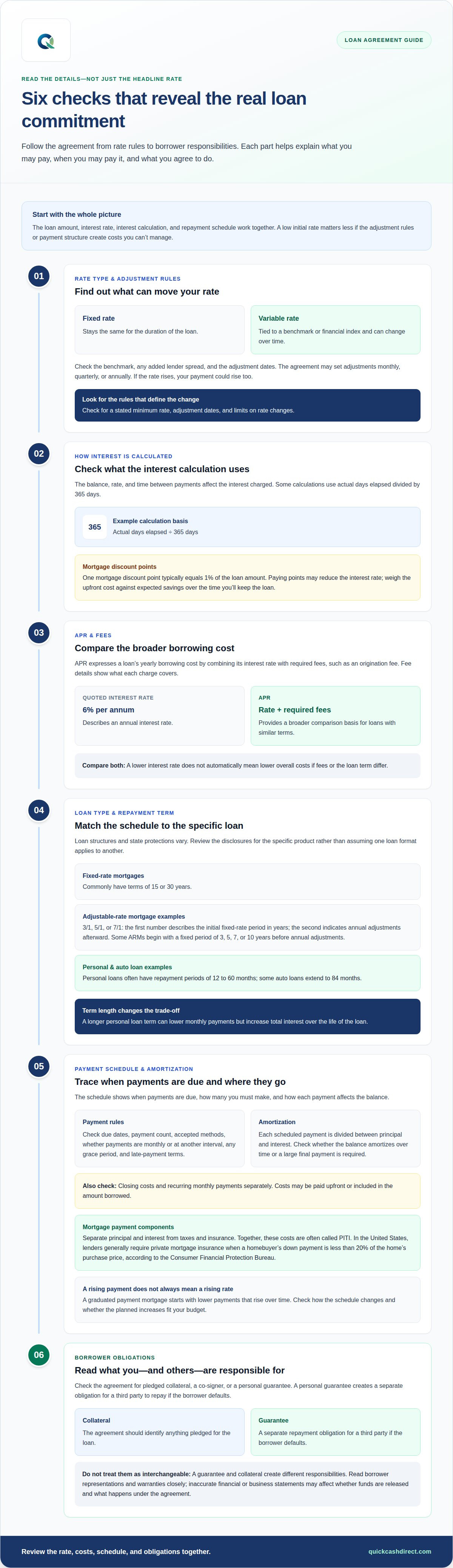
A loan agreement should identify the loan amount, interest rate, how interest is calculated, and the repayment schedule. Together, these terms show how much you borrow, how interest accrues, and when payments are due. Read them together: a low initial rate matters less if the adjustment rules or payment structure create costs you can’t manage.
A fixed interest rate stays the same for the duration of the loan. A variable rate is tied to a benchmark or financial index and can change over time. The agreement states how often it adjusts, which may be monthly, quarterly, or annually. Your payment could increase if the rate rises.
Check the benchmark, any added lender spread, and the adjustment dates in the documents. For example, interest calculations may use actual days elapsed divided by 365 days. The balance, rate, and time between payments affect the interest charged. A repayment schedule then shows how payments apply to principal and interest.
Discount points can change the initial rate. One mortgage discount point typically equals 1% of the loan amount. Paying points may reduce the interest rate, but weigh that upfront cost against the expected savings over the time you’ll keep the loan.
For a mortgage, separate principal and interest from taxes and insurance. Together, these costs are often called PITI. In the United States, lenders generally require private mortgage insurance when a homebuyer’s down payment is less than 20% of the home’s purchase price, according to the Consumer Financial Protection Bureau.
Is the interest rate fixed or variable, and how can it change? The agreement should say whether the rate stays fixed or follows a benchmark, and how often adjustments occur. A variable rate may change monthly, quarterly, or annually, which could increase your payments.
What collateral, co-signer, or personal guarantee does the loan require? The agreement should identify any pledged collateral and the obligations of a co-signer or guarantor. A personal guarantee creates a separate obligation for a third party to repay if the borrower defaults. Don’t confuse a guarantee with collateral: each creates a different responsibility.
What Are Loan Terms?
Loan terms describe the costs, timing, and conditions of borrowing. Focus on the APR and loan type, then check how the agreement sets payments and rate changes.
APR and Borrowing Costs
Annual percentage rate (APR) expresses a loan’s yearly borrowing cost, combining its interest rate with required fees such as an origination fee. APR gives borrowers a broader basis for comparing loans with similar terms, while fee details show what each charge covers. For example, 6% per annum describes an annual interest rate; APR also accounts for required fees. Compare APR with the quoted interest rate, then consider how the repayment term affects monthly payments. Paying a lower interest rate does not automatically mean lower overall costs if fees or the loan term differ.
Loan-Type and State Protections
Loan terms and consumer protections vary by loan type and state. Different products have different contract structures, and state rules can affect which protections apply. A mortgage’s adjustable-rate terms aren’t interchangeable with a personal loan’s APR or repayment schedule. Review the disclosures for the specific loan instead of assuming one format applies to every type.
Mortgage terms can include fixed-rate periods, later adjustments, and repayment lengths. Fixed-rate mortgages commonly have terms of 15 or 30 years. An adjustable-rate mortgage may be structured as 3/1, 5/1, or 7/1: the first number describes the initial fixed-rate period in years, and the second indicates annual adjustments afterward. Some adjustable-rate mortgages begin with a fixed period of 3, 5, 7, or 10 years before annual adjustments.
Read the rate adjustment rules closely. Look for any stated minimum rate, adjustment dates, and limits on changes. These terms show how the rate can move and help explain possible payment changes. The loan documents also set out the payment schedule and conditions that apply throughout the agreement.
If you’re considering loans for bad credit, use APR, fees, and repayment terms to understand the borrowing commitment before choosing.
Loan amortization and payment schedules
The schedule shows when payments are due, how many you must make, and how each payment affects the balance. Read it alongside the loan term and listed costs.
Payment Rules and Late Fees
Payment rules state the due dates, number of payments, accepted methods, and consequences of paying late. These details matter because missing a payment or failing to meet a contract requirement can lead to added interest, fees, and negative effects on your credit score. Check whether payments are monthly or due at another interval, and note any grace period or late-payment terms in the agreement.
Term Length and Total Repayment Cost
Loan term length sets how long repayment lasts; monthly payment size affects how quickly the balance falls. A longer personal loan term can lower monthly payments but increase total interest. Personal loans often have repayment periods of 12 to 60 months, while some auto loans extend to 84 months. How do term length and monthly payment affect total repayment cost? A longer term can ease each payment while increasing interest over the life of the loan.
Amortization explains how each scheduled payment is divided between principal and interest. Check whether the loan amortizes over time or requires a large final payment, since the payment schedule and outstanding balance can differ significantly.
Review closing costs and recurring monthly payments separately. The agreement should show whether costs are paid upfront or included in the amount borrowed. A graduated payment mortgage starts with lower payments that rise over time, so check how the schedule changes and whether the planned increases fit your budget. Rising payments don’t necessarily mean the interest rate changes. Compare each scheduled payment with your expected cash flow before agreeing.
Borrower representations and warranties
Representations and warranties are statements and assurances a borrower makes in the loan agreement. They may cover the accuracy of financial information, legal status, or other facts relevant to lending. Treat each statement as a commitment, not routine wording. A lender may make disbursement conditional on those statements being true and correct, so inaccurate information can affect whether funds are released.
Read any wording about knowledge carefully. The agreement may define whether a statement reflects what the borrower actually knows or what key people should know because of their roles. That definition may be negotiable. For a business loan, consider who holds relevant information and whether the wording accurately reflects their responsibilities. Loan agreements may also define inaccurate representations as an event of default.
Compare total borrowing costs, not just the initial interest rate. The annual percentage rate includes the interest rate and required fees, such as an origination fee. APR can help compare loans with similar terms, but fee details still matter. Review the APR, required charges, repayment schedule, and total payments together. A lower initial rate alone doesn’t show the full cost of lending or a mortgage.
Check the agreement’s prepayment terms before counting on an early payoff to reduce interest. Most lenders allow early repayment without a penalty, but the specific contract governs your obligations. Look for language explaining whether you may repay early and whether a fee applies. Early repayment can affect the total cost if you expect to pay the balance ahead of schedule.
Need borrowing options while reviewing these responsibilities? Explore loan options and consider the repayment terms alongside your commitments.
QuickCashDirect
QuickCashDirect connects borrowers with short-term financial options when an unexpected expense calls for a closer look at borrowing choices. Its offerings include payday loans, cash advances, online payday loans, and loans for bad credit.
Use the terms explained above to assess any option before you proceed. Focus on the rate, payment schedule, total repayment, and borrower obligations. Make sure the agreement fits your circumstances and that you understand what you’ll need to repay. QuickCashDirect can help you explore available borrowing options, including choices for borrowers with bad credit.
To discuss your borrowing options, contact QuickCashDirect.
Make Your Next Borrowing Decision With Clarity
Before moving forward, compare the loan commitment with your actual budget and priorities. A clear way to decide what to look for in loan terms and conditions is to consider how the agreement fits your plans, not just whether the funds address an immediate need. Think about what could change in your finances and whether you could still make the payments.
Keep your questions focused on your own decision. Which obligations are you prepared to accept? What would make you pause or choose a different path? Taking time to answer can help you act with purpose instead of urgency alone. If you want to discuss borrowing options, talk with QuickCashDirect about your options.
Make the choice that fits your needs and your ability to repay. A deliberate next step can help you move forward with confidence.
Frequently Asked Questions
Which loan terms should borrowers review before signing?
Review the amount financed, rate structure, APR, payment dates, total number of payments, fees, and consequences of default. Knowing what to look for in loan terms and conditions also means checking collateral requirements, any co-signer or personal guarantee, and how the agreement can be changed. For example, find out whether a lender’s security interest restricts the sale of pledged property. Keep a copy of the signed documents.
How do interest rates, APR, and loan costs differ?
The interest rate is the charge for borrowing principal, while APR combines the rate with certain required fees to show a broader annual borrowing cost. To decide what to look for in loan terms and conditions, compare the APR and total repayment for loans with similar structures. Fees can make APR higher than the stated interest rate, so review each listed charge.
What fees and closing costs are common for personal, auto, and mortgage loans?
Costs depend on the loan type and agreement. Personal loans may include fees, and auto-loan costs depend on the agreement. Mortgage closing documents may include charges related to completing the property transaction, while property taxes and insurance can affect ongoing payments. Review the itemized disclosure and identify which charges are paid upfront or financed.
Are there prepayment penalties, late fees, or returned-payment fees?
Fees depend on the agreement. Most lenders allow early repayment without a penalty, but the contract determines whether early payoff costs anything. Late-payment and returned-payment fees should be described in the loan documents. Check what triggers each fee, how it is calculated, and whether a grace period applies. Don’t assume a fee is absent just because it wasn’t mentioned earlier.
What are the loan's grace period, payment schedule, and default rules?
The agreement defines when payments are due, whether a grace period applies, and which missed obligations count as default. A grace period concerns payment timing; a cure period may give you time to fix a breach after default. Read both provisions alongside notice requirements. Also check whether inaccurate borrower statements or a breach of another agreement can trigger default.
What happens if a borrower misses payments or defaults on a loan?
A missed payment can lead to added interest, fees, and negative effects on your credit. If the agreement treats the situation as default, the lender may have the right to accelerate the loan, demand immediate repayment, or foreclose on collateral. Consequences depend on the contract and loan type. Contact the lender promptly if you anticipate payment problems, and keep records of notices and payments.