
A pre-approval can look like a green light, but it is not a final loan decision. To understand what pre-approved for a loan means, think of it as an early indication that you may qualify, based on an initial review. The lender may still assess your application and verify your information before deciding on final terms.
Pre-qualification and pre-approval are easy to confuse. Both can give you an early indication of whether you may qualify, but they can involve different reviews and credit checks. Before moving forward, find out what happens to your credit.
This guide explains how the terms differ, when a soft or hard inquiry may occur, and what lenders may consider when assessing eligibility. It also explains why a pre-approved amount is not automatically the right amount to borrow, and what to weigh before accepting an offer. Understand the terms first, then decide whether the loan fits your needs and budget.
Key Takeaways
- Pre-qualification and pre-approval involve different levels of review. Know which credit inquiry may apply before you proceed.
- Lenders may weigh income, savings, debts, credit history, and supporting documents when assessing eligibility.
- Treat a pre-approved amount as an estimate, not a commitment. Review the final terms and make sure the payment fits your budget.
- Mortgage pre-approvals often last a few months, while timing and document requirements vary by lender and application.
- Before applying, gather accurate financial information and consider whether borrowing fits your needs.
Does either pre-qualification or pre-approval impact your credit score?
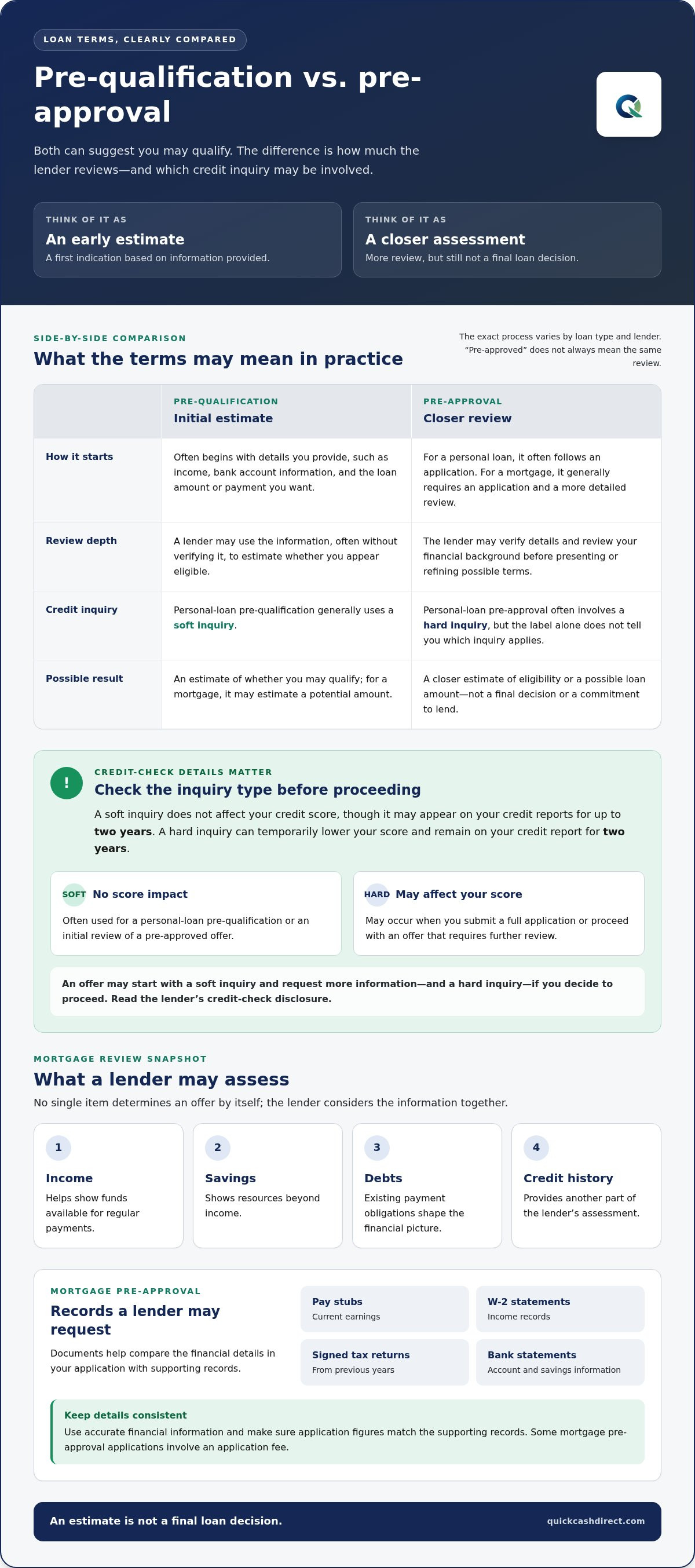
Pre-qualification usually begins with information you provide, such as income, bank account details, and the loan amount or payment you want. A lender may use those details, often without verification, to estimate whether you appear eligible. For personal loans, pre-qualification generally uses a soft credit inquiry. It does not affect your credit score, though it may appear on your credit reports for up to two years.
Pre-approval can involve a closer review, but the term does not always describe the same process. For a personal loan, pre-approval often follows an application and may involve a hard inquiry. A hard inquiry can temporarily lower your credit score and remain on your credit report for two years. The lender may also verify details before presenting final terms.
A formal loan review is different from a pre-approved offer sent to you. An initial review for a pre-approved offer may use a soft inquiry, which does not affect your score. If you decide to proceed, the lender may request more information and make a hard inquiry. Read the offer’s credit-check explanation before submitting a full application.
Think of the difference as an early estimate versus a more detailed assessment. For example, personal-loan pre-qualification might use the income and desired payment you enter online. A formal pre-approval may require a completed application and a closer look at your finances. For a mortgage, pre-qualification can estimate a potential amount, while pre-approval reviews your financial background and may provide a written estimate.
To understand what pre-approved for a loan means for your credit, identify the inquiry type and what step triggers it. Are you reviewing an unsolicited offer, checking whether you might qualify, or submitting a complete application? Those steps can lead to different credit checks. Do not assume “pre-approved” means a hard inquiry has already occurred.
Before moving forward, review the lender’s disclosure to see whether it describes a soft or hard inquiry. A soft inquiry can support an initial eligibility review without changing your score. A hard inquiry may follow when you apply or accept an offer that requires further review. If you are comparing loan options, note which applications involve hard inquiries before submitting them.
Potential loan eligibility requirements
Mortgage lenders assess financial details before deciding whether to issue a pre-approval offer. Some mortgage pre-approval applications involve an application fee.
Eligibility and application requirements
Eligibility describes how a lender evaluates your finances against the requested mortgage. This review matters because income, savings, debts, and credit history can affect the amount a lender may offer.
Mortgage pre-qualification may begin with information you provide about assets, income, and debts, without a mortgage application. Pre-approval generally follows, requires an application, and involves a more detailed review of your financial background. A lender may use that review to estimate a specific loan amount.
Income helps show what funds are available for regular payments, while savings show resources beyond income. Debts matter because existing payment obligations affect your overall financial picture. Credit history gives the lender another part of that picture. No single item determines an offer by itself; the lender assesses the information together.
Keep the requested mortgage amount and your financial information consistent throughout the application. If the application lists one income figure but supporting documents show another, the lender may need to resolve the difference before completing its review. Accurate details help the application reflect your actual finances.
Documents for pre-approval
Pre-approval documents are records a lender uses to verify the financial details in your mortgage application. They matter because documents allow the lender to compare reported income, savings, and other information with your actual records.
A lender may request pay stubs, W-2 statements, and signed tax returns from previous years. Bank statements and tax information may also be requested. These records help support details about income and savings that the lender considers when determining a possible pre-approval amount.
Prepare the requested records as a set. For example, pay stubs show current earnings, while W-2 statements and signed tax returns from previous years provide other income records. Bank statements show account information relevant to savings. Clear, complete documents make it easier to connect the application’s figures with their supporting records.
Mortgage pre-approval involves an application, document review, and lender checks. Keep the details consistent: use the same income information in the application and supporting records, and include the requested tax and bank documents. If the lender requests additional paperwork, it may need that information to assess your financial background and refine its estimate.
Before submitting, identify whether you are seeking pre-qualification or mortgage pre-approval. Pre-qualification may rely on information you provide about assets, income, and debts; pre-approval requires an application and supporting review. Include any application fee in your decision, since some mortgage pre-approval applications involve one.
Meaning of personal loan pre-approval
A personal loan pre-approval is a conditional invitation based on a lender’s initial review of your credit history and financial profile. It suggests you may meet some initial criteria, not that the lender has reached a final decision. The lender uses the information available at that stage to determine whether to invite you to continue. Treat the offer as an early indication, not money you can already borrow.
A personal loan pre-approval often begins with the lender, which may send an invitation by mail, email, or phone. The message may outline an amount or rate for you to consider. Those details are a starting point, not a substitute for a completed application. If you respond, the lender can request more information and review your details before presenting final terms.
Underwriting can change the outcome. Before deciding whether to approve the loan, the lender may verify information in your application and assess your finances more fully. It may also offer different terms from those shown in an initial pre-approval or pre-qualification. For example, an invitation may show a possible amount, while the final decision reflects verified information and the lender’s full review.
You do not have to accept a pre-approved offer, and receiving one does not commit you to a loan. You also do not need to borrow the full amount shown. If an offer lists more than you need, compare the amount you would actually use with a payment that fits your budget. A larger offer is not automatically a better choice, especially if repayment would strain your regular expenses.
Use the offer as a comparison point, not as a decision on its own. A stated rate or amount can help you assess another offer or consider whether borrowing makes sense. First identify the expense the loan would cover, then work out a payment that fits your budget. Financial institutions may send pre-approved offers to people who could benefit from refinancing, consolidating debt, or accessing credit more easily.
Before proceeding, review the offer’s amount, rate, and conditions, then decide whether you need the loan. A pre-approval can help you assess a possible next step, but it does not require you to proceed. Final terms follow the lender’s application review and verification. Decide based on the completed offer and your repayment plan, not the invitation alone.
How long does loan pre-approval last?
Mortgage pre-approvals are usually valid for a set period, often a few months. The end date matters because a pre-approval reflects a lender’s review at a particular point in your home-buying process. Check the letter for its expiration date and any conditions attached to the estimate. Do not treat an older letter as current evidence of your borrowing range.
A mortgage pre-approval can help you focus your home search on a price range that reflects the lender’s review. Use it while it is valid, and keep your purchase plans aligned with the amount shown. The letter is not a final loan commitment. The lender still needs to complete its review before final approval, so the pre-approval period is a planning window, not a promise of funds.
There is no universal time limit for personal loan pre-approval established here. An invitation may present an initial amount or terms, but those details can change after you apply and the lender verifies your information. Read the offer’s stated conditions and timing before acting. If it does not give a clear expiry date, contact the lender named in the offer for clarification.
Keep the information in your application accurate while considering an offer. If your income, savings, or debts change, for example, the details originally reviewed may no longer describe your finances. A lender can review and verify information during the application process, then provide different terms from those initially shown. Treat the original estimate as a snapshot, not a standing approval.
Use a simple timeline to stay organized:
- At receipt: Record the date you received the offer and its stated expiration date.
- Before applying: Review the listed amount, rate, and conditions against your current budget.
- After a change: Update information in your application so the lender can assess your current financial picture.
- Near expiry: Ask the lender whether the existing review remains usable or requires a new application.
For a home purchase, plan around the mortgage letter’s validity period and do not rely on it after expiry. For a personal loan, base your decision on the current offer and the lender’s review, not an old invitation. In both cases, confirm the terms before borrowing and make sure the payment fits your budget. A pre-approval can guide planning, but the lender’s completed review determines the final offer.
How do you get pre-approved for a loan?
The process depends on the loan type. Mortgage pre-approval typically follows pre-qualification and requires an application, financial documents, and lender checks. Personal loan pre-approval may begin differently, with an offer sent by mail, email, or phone.
For a mortgage, gather details about your income, assets, debts, and savings. Mortgage pre-qualification can take place online, in person, or over the phone. It gives you an initial estimate based on information you provide. Some banks may return pre-qualification results in as little as one hour.
Pre-approval requires a fuller review. Complete the mortgage application and provide the documents the lender requests. These may include pay stubs, bank statements, W-2 statements, and signed tax returns from previous years. The lender reviews your financial background and runs checks before estimating a possible loan amount. Some mortgage pre-approval applications involve an application fee, so include that possibility in your planning.
Use this sequence to keep the process organized:
- Choose the loan type. A mortgage purchase and a personal loan can use different pre-approval processes.
- Prepare accurate information. Gather income, asset, debt, and savings details for a mortgage review.
- Complete the application. Mortgage pre-approval requires an application and additional documentation.
- Review the result. Read the estimated amount, rate information, and any conditions in the offer.
- Decide whether to proceed. Compare the possible payment with your budget before accepting an offer.
Timing varies by process. A lender’s pre-approval process may take up to 10 days. That period can include application review, document checks, and follow-up requests. Responding promptly to a request can keep your application moving, while missing or inconsistent information can require further review.
For a personal loan, the lender may initiate pre-approval by sending an offer. Treat the invitation as a starting point. If you want to proceed, the lender may ask for more financial information and review your application before deciding on final terms. The offer itself does not complete the application or commit you to borrowing.
Before accepting an offer, confirm the final amount and terms, then check whether the payment fits your budget. A mortgage estimate can guide a home search, while a personal loan offer can help you assess whether borrowing meets a specific need. Take the next step only after reviewing the full application requirements and resulting terms.
QuickCashDirect: Payday Loans
QuickCashDirect connects borrowers with payday loans, cash advances, and online loan options, including options for people with bad credit. If a pre-approval offer does not match your immediate need, these short-term options may be worth considering. Review the amount you need, the repayment terms, and how the payment fits your budget before deciding. An invitation or initial estimate is not a reason to borrow more than necessary. Focus on the expense you need to cover and choose carefully.
Explore the available options and decide whether one fits your situation. Visit QuickCashDirect to learn more.
Choose Your Next Step With Confidence
If you are asking, “What does pre-approved for a loan mean?” use the answer to make a deliberate borrowing decision, not an automatic one. Focus on the expense, the amount you need, and whether repayment fits your budget. An offer can open a path forward, but you decide whether borrowing is right for you.
If you need another option, QuickCashDirect connects borrowers with payday loans and cash advances online. Compare your needs with the available options and review the terms before moving forward. Keep your decision focused on what you need and what you can repay.
Take the next step at your pace. Contact QuickCashDirect to explore your options.
Frequently Asked Questions
What Is the Difference Between Pre-Qualified and Pre-Approved Loans?
Pre-qualification is usually an early estimate based on details you provide, while pre-approval generally involves a more thorough review. For example, a lender may use your stated income to estimate a possible loan before reviewing documents. A later application can involve verification and additional credit checks. Read the lender’s explanation, since these labels can vary between personal loans, mortgages, and credit offers.
What Does Pre-Approved Mean?
Pre-approved means a lender or financial institution has made an initial assessment and identified you as a potential borrower. It is a preliminary status, not cash in your account or a final loan commitment. For instance, a letter may show an estimated amount, but you still need to decide whether to apply. Review its conditions and use the figure as a planning reference, not a spending target.
What Is a Pre-Approved Offer?
A pre-approved offer is an invitation to consider credit after an initial review of some information about you. A personal loan offer may arrive by mail, email, or phone. Check who sent it, what action it asks you to take, and whether it describes a soft or hard credit inquiry. If you choose to apply, the lender may request more details and assess your application before presenting final terms.
Can You Get Pre-Approved for a Personal Loan?
Yes. A lender may send a personal-loan pre-approval invitation after reviewing parts of your credit history and financial profile. You can consider the offer, then decide whether to submit an application. For example, compare the proposed payment with your monthly budget before proceeding. The application review may include verification, and the lender may present terms that differ from the initial invitation.
Do I Have to Spend the Entire Pre-Approved Amount?
No. A pre-approved amount is an offered maximum or estimate, not a requirement to borrow the full sum. If you need less, base your decision on the actual expense. For example, borrowing only enough to cover a necessary repair can keep the balance and repayment closer to your need. Compare the payment for the amount you plan to borrow with your regular expenses.
Does Getting Pre-Approved Lock Me In?
No. Receiving a pre-approval or pre-qualification does not obligate you to accept a loan. You can decline the invitation or stop before submitting a full application. If the final terms differ from the initial offer, for example, pause and decide whether they still fit your plans. A pre-approval can help you assess options, but the choice to proceed remains yours.
What Does It Mean to Be Pre-Approved for a Loan?
Being pre-approved means an initial review suggests you may qualify for a loan, subject to further application review. It does not mean the lender has transferred money or finalized every term. Use the offer to assess whether borrowing could address a specific need. Before accepting, review the repayment schedule and consider how the payment fits alongside housing, utilities, and other regular costs.
How Does Loan Pre-Approval Work in the United States?
In the United States, the process depends on the credit product. Mortgage pre-approval usually involves an application, financial documents, and lender checks. Personal-loan invitations may begin with an initial review, followed by an application if you choose to continue. For any loan type, read the offer’s conditions and identify what information the lender needs next. A preliminary decision does not replace final review and approval.