
If you’re asking what lenders use Teletrack, you’re right to want clarity before applying. There is no reliable public list showing exactly which lenders use it. Teletrack, a division of Equifax, collects information linked to non-traditional financial products, and some lenders may review it when assessing an application. Its use varies by lender, and a Teletrack check does not guarantee approval or tell you what terms you’ll receive.
Past applications, payment history, or account problems may affect the information in your file. This guide explains what a Teletrack report may contain, why some lenders use this data, and how to request your report. You can get one free report every 12 months and dispute inaccurate information at no cost; investigations must be completed within 30 days. You’ll also learn what to review before applying and how to compare loan terms. QuickCashDirect connects applicants with a network of lenders offering short-term options. Each lender decides whether to use Teletrack and how to evaluate an application.
Key Takeaways
- Teletrack may help lenders assess alternative credit history, but each lender chooses its own screening methods.
- There’s no dependable universal list of lenders that use Teletrack, so treat lender claims as specific to their current practices and products.
- Compare Teletrack with the major credit bureaus by checking what each report covers and how to access it.
- Review your report for unfamiliar accounts, incorrect balances, or payment details, then follow the agency’s dispute process to address errors.
- Before accepting a loan offer, check eligibility, fees, repayment dates, and total repayment in the written agreement.
What Is Teletrack, and Why Might a Lender Check It?
Teletrack is a U.S. consumer reporting resource and a division of Equifax. It collects information connected to non-traditional financial products and may provide consumer reports to businesses evaluating applications. A lender may consider that information as one part of its review, but each lender sets its own screening process. That process can vary by product and application.
Teletrack is not a loan or a lender. It does not approve applications, make lending decisions, or guarantee funding. It supplies report information that a lender may weigh alongside other details. For context, the Fair Credit Reporting Act (FCRA) is the federal law covering consumer reporting agencies and consumer-reporting practices.
What information may appear in a specialty consumer report?
Teletrack focuses on activity involving non-traditional products, such as payday loans, rent-to-own transactions, and short-term installment loans. Depending on what information is reported and on your individual file, a report may include loan amounts, payment history, or defaults. Reports do not all contain the same entries. Available data can differ by source and consumer.
A specialty report has a different focus from reports maintained by Equifax, Experian, and TransUnion, the major nationwide credit bureaus. Those bureaus collect information across traditional credit products, while Teletrack specializes in data associated with alternative financial products. A lender may consider information from more than one source, but one report does not replace the others.
Does Teletrack use mean no credit check?
No. A lender’s use of Teletrack does not establish that it skips other screening. It may review a specialty consumer report, consider credit scores or reports from major bureaus, assess income, and apply its own underwriting criteria. These are separate parts of the decision process. If you receive an application decision and want to understand the screening involved, review the notice and application disclosures.
A lender’s report choice does not predict an approval outcome. If you’re researching what lenders use Teletrack, treat the report as one possible screening input, not a shortcut to knowing whether you’ll qualify. Review the lender’s application disclosures and the terms of any offer before deciding what to do next.
What Lenders Use Teletrack, and Why a Fixed List Can Mislead
There’s no dependable, universal list of lenders that currently use Teletrack unless each lender publicly discloses its screening practices. The Consumer Financial Protection Bureau explains Teletrack reports in its consumer guidance, but that guidance is not a directory of lenders. Be cautious with online lists, especially if they do not identify their sources or when they were updated.
Screening policies can change, and a lender may use different methods for different products or applications. Even a general statement from a lender may not describe every application. The practical way to understand a specific application is to review its disclosures and consumer-report authorization.
How can you verify whether a lender may check Teletrack?
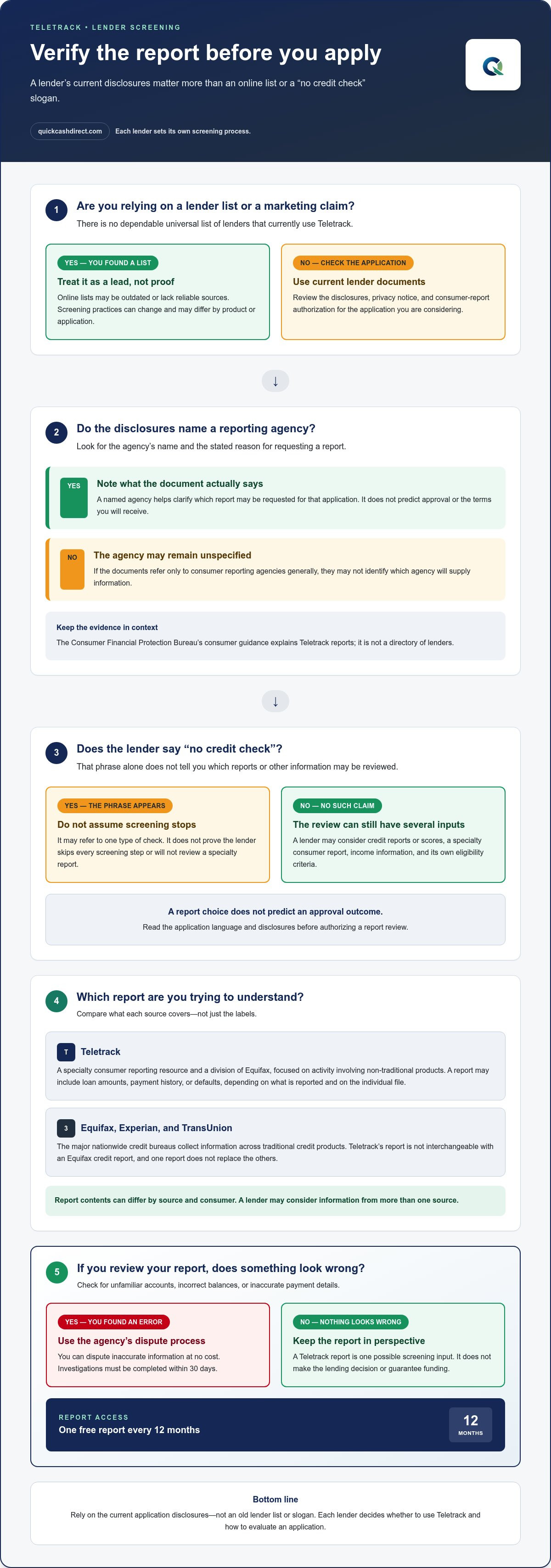
Before submitting an application, review its disclosures, privacy notice, and any consumer-report authorization. Look for the reporting agency’s name and the stated reason for requesting a report. If the documents refer only to consumer reporting agencies generally, they may not identify which agency will supply information for your application. Treat informal lender lists as leads, not authoritative directories, and rely on the lender’s current disclosures for the application you’re considering.
Does “no credit check” mean no report review?
No. A marketing phrase such as “no credit check” does not prove that a lender skips every screening step or will not review a specialty consumer report. It may refer to one type of check, but the phrase alone does not tell you which reports or other information the lender may consider. Read the application language carefully before authorizing a review.
Separate the parts of the decision: a lender may consider a credit score or report, a specialty consumer report, income information, and its own eligibility criteria. Teletrack information may inform underwriting, but it does not determine every lender’s decision. Other application details may matter, too.
A lender’s report choice does not predict approval. When comparing claims about what lenders use Teletrack, focus on the actual application disclosures rather than a slogan or an old list. For more context on “no credit check” claims, review this no credit check loan guidance. QuickCashDirect connects applicants with a network of lenders offering short-term options. You can review available loan options, keeping in mind that the lender makes its own screening and lending decisions.
Teletrack vs. Credit Bureaus: Compare the Reports, Not the Labels
Teletrack and Equifax, Experian, and TransUnion are distinct reporting sources. Teletrack is a specialty consumer reporting agency and a division of Equifax, but its report is not interchangeable with an Equifax credit report. Each source may provide different information, and a lender decides which reports, if any, to consider.
The Fair Credit Reporting Act (FCRA) may apply to consumer reports and the agencies that provide them. Its application depends on the report and how it’s used. The Federal Trade Commission has documented a past enforcement action involving Teletrack and the FCRA, including Teletrack’s agreement to settle Federal Trade Commission charges. Review your own report and follow the agency’s consumer instructions if you need to address information in your file.
| Source | Agency type | Possible role in underwriting | Where to check report access |
|---|---|---|---|
| Teletrack | Specialty consumer reporting agency | A lender may consider relevant alternative financial history, depending on its process and the application. | Review Teletrack’s consumer instructions at consumers.teletrack.com. |
| Equifax | Nationwide credit bureau | May supply a traditional credit report if a lender uses it. | Use Equifax’s official consumer report-access instructions. |
| Experian | Nationwide credit bureau | May supply a traditional credit report if a lender uses it. | Use Experian’s official consumer report-access instructions. |
| TransUnion | Nationwide credit bureau | May supply a traditional credit report if a lender uses it. | Use TransUnion’s official consumer report-access instructions. |
Can a lender check more than one consumer report?
A lender may use more than one reporting source, subject to applicable rules and its own process. It may also consider information beyond consumer reports as part of underwriting. A report inquiry is one input, not the full lending decision. The table shows possible roles, not a checklist every lender follows.
One report check does not reveal every factor a lender may consider. If you’re researching what lenders use Teletrack, focus on the reports you can access and the disclosures for the specific application. Don’t assume every lender checks Teletrack or all three major bureaus, or that specialty reports contain identical data. Review each agency’s report-access steps to understand what appears in each file.
How to Check Your Teletrack Report and Address Errors
If you’re checking what lenders use Teletrack, reviewing your own file can show you what information may be available. Teletrack’s consumer website is consumers.teletrack.com. The report-request phone number is (877) 309-5226. You can also request a report by mail from Teletrack, LLC, P.O. Box 740008, Atlanta, GA 30374. Consumers are entitled to one free report every 12 months upon request.
- Identify the agency. Check the application disclosures or any notice you received to see which consumer reporting agency was involved.
- Request your report. Use Teletrack’s consumer website, phone number, or report-request mailing address. Follow the instructions provided for identity verification.
- Review each entry. Check your identifying details, account information, dates, and activity you don’t recognize. Compare entries with account statements, payment records, and your application history.
- Dispute inaccuracies. Send Teletrack a clear description of each error and copies of records that support your claim.
What should you review when the report arrives?
Look for misspelled or incorrect identifying details, accounts you don’t recognize, and dates or payment information that do not match your records. An unfamiliar entry is not proof of fraud by itself. Compare it with past applications and account documents, then keep a copy of the report and note the specific entry you’re questioning.
What can you do if information is inaccurate?
Submit your dispute to CoreLogic Teletrack, Attention: Consumer Disputes Department, P.O. Box 509124, San Diego, CA 92150. State what you believe is wrong and include relevant supporting documents. Keep copies of everything you send, along with delivery records and any responses. Disputes are free, and the investigation must be completed within 30 days. Save the result and check whether the report was updated.
If a lender takes adverse action based in whole or in part on a consumer report, the notice may identify the reporting agency and explain how to contact it. Review the notice for the specific information provided. The Federal Trade Commission and Consumer Financial Protection Bureau also publish consumer guidance on reports, disputes, and credit decisions.
After reviewing your file, consider each borrowing option on its own terms. For more context, read this guide to loans for bad credit, then explore available loan options through QuickCashDirect’s lender network. Lenders make their own decisions based on the application.
Choose a Loan Option Carefully After Learning About Teletrack
Knowing what lenders use Teletrack can help you understand one part of an application, but the report source shouldn’t be your only concern. Before accepting a short-term loan offer, focus on what you’ll repay, when payments are due, and whether the schedule fits your budget. A lender’s screening method does not tell you whether its terms are right for you.
What should you compare before accepting an offer?
Read the full written agreement before you sign. If you’re considering more than one option, compare these details side by side:
- APR and fees: Review the annual percentage rate where disclosed, along with any other charges described in the agreement.
- Repayment schedule: Confirm each payment date and amount. Compare those dates with expected income and essential expenses.
- Total repayment: Identify the total amount due over the full term, not just the amount you’d receive or the first payment.
- Late-payment terms: Understand what the agreement says may happen if a payment is late or missed.
- Renewal or rollover terms: Check whether the agreement discusses extending or renewing the loan, and what that could mean for repayment.
Don’t rely on a fast-funding claim or approval language to make your decision. The written agreement lets you review the actual terms. If a payment date or fee is unclear, pause and get a clear explanation before accepting.
How can QuickCashDirect help you explore options?
QuickCashDirect is a loan referral service that connects applicants with a network of lenders offering short-term options, including payday loans, cash advances, and installment options. QuickCashDirect is not a direct lender and does not make lender approval decisions. A completed inquiry does not guarantee an offer, approval, or a specific funding time. Screening, available terms, and decisions depend on the individual lender and application.
Use the referral process to explore potential options, then review the specific lender’s written terms before moving forward. Match the repayment schedule against your expected income and essential costs. If the payments don’t fit, don’t accept the offer simply because the application felt quick.
Before deciding, confirm the payment dates and total repayment in the agreement. When you’re ready to review potential matches, explore available loan options through QuickCashDirect’s lender network. Compare each offer carefully before accepting.
Take Your Next Borrowing Step With Clear Information
There’s no dependable public directory showing exactly what lenders use Teletrack, and a lender’s screening choice can’t predict approval. Treat Teletrack as one possible source of information, not a complete picture of how an application will be assessed. If you’re concerned about your report, review it for errors and dispute inaccurate entries through the reporting agency.
Before accepting a loan offer, read the written agreement carefully. Compare the repayment schedule, fees, and total repayment, then make sure the payment dates fit your budget. A careful review can help you make a more informed choice.
It’s a referral service, not a direct lender, so each lender sets its own terms and makes its own decisions. An inquiry doesn’t guarantee an offer or approval. Explore available loan options through QuickCashDirect’s lender network, and review any lender’s terms before accepting.
Frequently Asked Questions
What lenders use Teletrack?
There’s no dependable, complete public list of lenders that currently use Teletrack. Businesses offering non-traditional financial products, such as payday loans or short-term installment loans, may use specialty consumer reports, but each lender chooses its own screening methods. Policies can vary by product and application. Check the lender’s current disclosures and report authorization for the agency’s name. Treat online lists as leads, not confirmed directories.
Is Teletrack a credit bureau?
Teletrack is a specialty consumer reporting agency, not one of the three major nationwide credit bureaus. It focuses on information connected to non-traditional financial products. Teletrack is a division of Equifax, but its report is distinct from an Equifax credit report. Experian and TransUnion are also nationwide credit bureaus. Depending on its process, a lender may use one report, multiple reports, or other application details.
Can I get a loan if I am listed in Teletrack?
Possibly, but being listed in Teletrack doesn’t guarantee approval or automatically prevent it. A lender may consider information in the report alongside other factors, such as income, application details, and its eligibility rules. Each lender makes its own decision, and available terms can differ. Before accepting an offer, review the written agreement, payment dates, fees, and total repayment to decide whether the loan fits your budget.
How do I check my Teletrack report?
Request your report through Teletrack’s consumer website at consumers.teletrack.com, by phone at (877) 309-5226, or by mail to Teletrack, LLC, P.O. Box 740008, Atlanta, GA 30374. You’re entitled to one free report every 12 months upon request. Follow the agency’s instructions, including any identity-verification steps. When the report arrives, compare account details, dates, and payment history with your own records.
Does Teletrack mean a lender does not check my credit?
No. A Teletrack review doesn’t show that a lender skips traditional credit checks or other screening. The lender may review a specialty report, a credit report or score from a major bureau, income information, and other application details. These are separate parts of the assessment. Read the application disclosures to understand which reports the lender may request. A report choice alone can’t tell you whether you’ll qualify.
Can I dispute incorrect information on a Teletrack report?
Yes. You can dispute inaccurate or incomplete information with Teletrack at no cost. Send a clear explanation and include copies of records that support your claim. Teletrack’s dispute mailing address is CoreLogic Teletrack, Attention: Consumer Disputes Department, P.O. Box 509124, San Diego, CA 92150. Keep copies of your dispute and supporting documents. The investigation must be completed within 30 days.
What should I compare when a lender offers me a loan?
Compare the written terms, not just the advertised speed or approval language. Review the APR where disclosed, fees, payment amounts and dates, late-payment consequences, and any renewal or rollover terms. Check the total repayment and make sure the schedule fits your expected income and essential expenses. Before accepting, confirm the dates and amounts due in the agreement. If a term is unclear, pause and get clarification.