
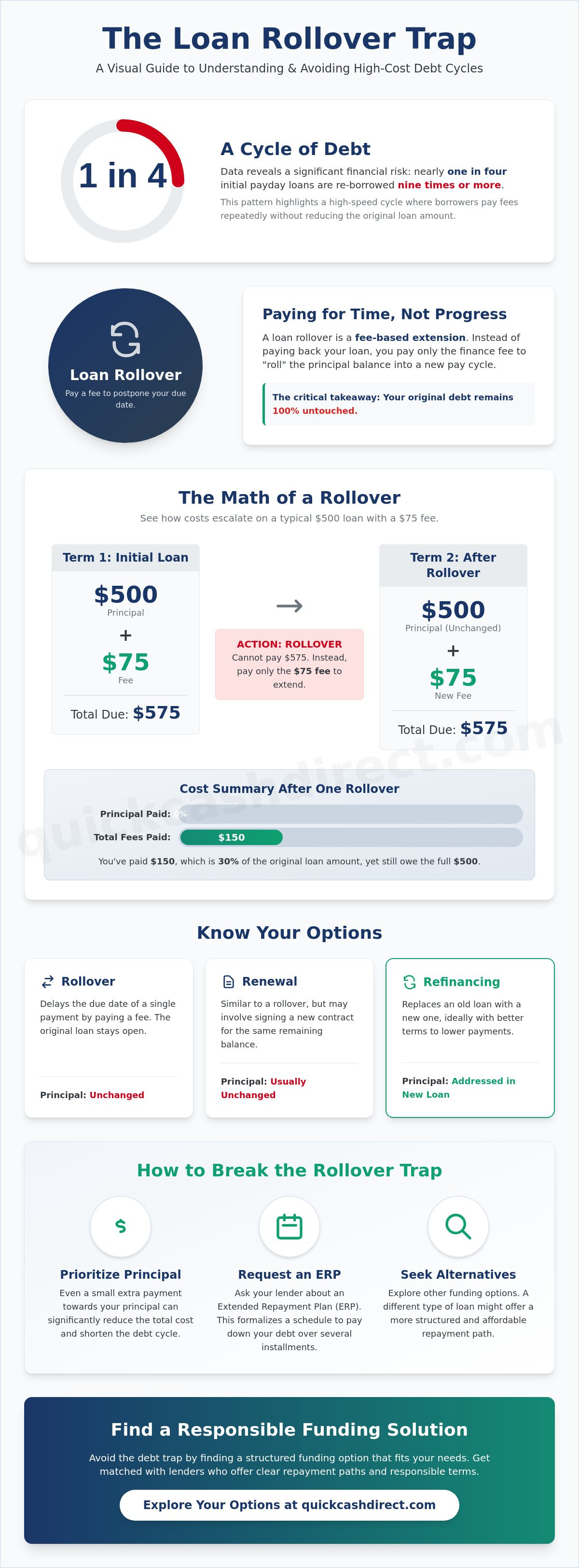
Nearly one in four initial payday loans are re-borrowed nine times or more. This data reveals a high-speed financial cycle that many borrowers enter when cash is tight. You are likely facing an approaching deadline and asking what is a loan rollover and is it bad for your wallet. It's stressful to realize your bank account cannot cover the principal as the due date arrives. You need a fast solution that offers relief without creating a permanent trap.
We understand the pressure of managing short-term funding. This 2026 guide provides the professional reassurance and facts you need right now. Discover exactly how loan rollovers function and why they can become expensive if handled incorrectly. You will learn to identify the true cost of an extension and how to use smart strategies to settle your debt faster. Follow this structured approach to move from immediate stress to a clear resolution. Secure your financial path by mastering these essential funding tools today. Use this information to navigate lender terms with confidence and speed.
Key Takeaways
- Learn exactly what is a loan rollover and is it bad for your budget by understanding how these extensions delay your due date without reducing your principal.
- Identify the true cost of rolling over debt where fees only purchase more time while your original balance remains unchanged.
- Evaluate rollovers as a temporary bridge to avoid more costly consequences like utility shut-offs or bank overdraft penalties.
- Discover how to break the debt cycle by prioritizing principal reduction or requesting an Extended Repayment Plan (ERP).
- Access a network of lenders through an efficient matching service to find structured funding options that fit your immediate resolution needs.
Understanding Loan Rollovers: Definition and Core Mechanics
A loan rollover occurs when a lender allows you to delay your due date by paying only the interest or a flat fee. This process "rolls" the principal balance into a new pay cycle. It essentially creates a new loan without reducing what you originally borrowed. The CFPB has found that more than four out of five payday loans are re-borrowed within a month. This highlights why you must understand what is a loan rollover and is it bad for your specific financial situation before committing to one. Simply put, a rollover is a fee-based extension that preserves the original debt while adding new costs to your total balance.
This mechanism is standard for payday loans and other short-term cash advances. A 2021 survey found that 48% of consumers who took out a payday loan in the previous six months rolled over at least once. When the due date arrives and funds are short, the rollover offers immediate breathing room. However, the principal remains untouched. You are paying for time, not for progress on the debt. To get a foundational view of what a rollover loan is, consider it a bridge that keeps the account active but static.
The Difference Between Rollovers, Renewals, and Refinancing
Industry terms often sound identical, but their mechanics differ. Understanding these distinctions helps you choose the right path to resolution. Here is how they compare:
- Rollovers: You delay the due date of a single payment by paying a specific fee. The original loan stays open, and the principal remains the same.
- Renewals: This is similar to a rollover. It often involves signing a new contract for the same remaining balance, which may trigger additional administrative fees.
- Refinancing: You replace an old loan with an entirely new one. Ideally, this new agreement offers better terms or a longer duration to lower your monthly pressure.
Why Lenders Offer Rollover Options
Lenders provide these options to maintain a functional relationship with the borrower. It's a tool designed for specific outcomes. First, it provides flexibility for borrowers facing a temporary cash flow gap. If an unexpected bill arrives, a rollover prevents a missed payment. Second, it allows lenders to continue earning interest on the same principal balance. The asset remains profitable for the institution without requiring a new underwriting process. Finally, it prevents immediate default. This protects your access to future funding and keeps your record clear of failed payments. When asking what is a loan rollover and is it bad, remember that its value depends on your exit strategy. It's a high-speed tool for a high-speed need.
How Loan Rollovers Work in Practice: A Cost Breakdown
Understanding the financial mechanics of an extension is vital for your recovery. When you first receive funding, the initial fee covers the cost of borrowing for a set period. This term usually lasts between 14 and 30 days. If you cannot repay the full balance by the due date, you might consider a rollover. However, you must realize that when you roll over, that fee is paid, but $0 goes toward the principal balance. You are simply buying more time while the original debt remains unchanged. Reviewing the legal definition of a loan rollover clarifies that this is a specific extension of credit that can impact your overall financial health.
A second fee is applied for the next term once the first extension begins. This effectively doubles the cost of the credit you originally accessed. It's a high-velocity expense that can quickly outpace your initial budget. You should be aware that three rollovers can result in paying more in fees than the original amount borrowed. This realization often leads borrowers to ask what is a loan rollover and is it bad for their long-term stability. The answer lies in the total cost of the transaction over time. If you need a more structured approach, you can explore diverse funding options that prioritize clear repayment paths.
The Math of a Typical $500 Rollover
Let's look at the numbers to see how quickly costs escalate. In Term 1, you have a $500 principal plus a $75 fee, making $575 due. If you pay $75 to roll over, you still owe the original $500. In Term 2, you face the $500 principal plus a new $75 fee, totaling $575 again. The total cost of borrowing has reached $150 in fees alone. This "Static Principal" is the core reason why your debt isn't shrinking despite your payments. You are stuck in a holding pattern while your cash reserves dwindle. Use this data to decide if an extension is the most efficient move for your current situation.
Compounding Fees and the Debt Cycle
Multiple rollovers lead directly to a debt trap. You find yourself paying only for the right to keep the debt active. The psychological impact of seeing the balance remain unchanged after weeks of payments is significant. It creates a sense of stagnation that can be difficult to break. This is why easy loans for bad credit require disciplined repayment to remain effective financial tools. Without a plan to reduce the principal, you are merely moving money without solving the underlying shortage. When evaluating what is a loan rollover and is it bad, consider if the extension provides a genuine solution or just a temporary delay of a larger problem.
The Verdict: Why Rollovers Are Often Labeled 'Bad' and When They Aren't
You face a critical decision when your due date arrives. You must determine if extending your debt is a tactical solution or a strategic setback. Most financial experts label rollovers "bad" because they can trigger a relentless cycle of debt. This happens when high APRs and repeated fees consume your future income. In Missouri, a 2025 survey showed the average interest rate on a payday loan reached 406.26%. This environment makes permanent indebtedness a high-risk reality for those who rely on extensions as a long-term fix.
State governments are increasingly intervening to curb these risks. As of 2026, California and Louisiana strictly prohibit rolling an existing payday loan into a new one. Other states, such as Minnesota and New Mexico, have capped annual interest rates at 36% to prevent cost escalation. These laws exist because regulators recognize that rollovers often mask a borrower's inability to repay. When you ask what is a loan rollover and is it bad, you must first check your local regulations. Your state may have already decided the risk is too high for consumers.
However, a rollover can serve as a functional bridge in specific emergencies. If you face a choice between a $75 rollover fee and a $150 utility reconnection charge, the rollover is the more efficient financial move. It prevents bank "Non-Sufficient Funds" (NSF) fees and protects your immediate access to essential services. The key is to evaluate the rollover against the total cost of default. If the penalty for missing the payment is higher than the extension fee, the rollover becomes a tool for damage control.
When a Rollover Might Be a Tactical Choice
Use a rollover only when you have a guaranteed cash inflow arriving shortly. For example, if your paycheck or a tax refund is confirmed for exactly seven days from now, a one-time extension prevents a bounced check. Compare the rollover fee directly to your bank's overdraft penalties. If the rollover is cheaper, use it. Adopt a strict "One-and-Done" rule. Never use an extension unless you are certain the principal will be cleared in the very next cycle.
The Red Flags of a Dangerous Rollover Cycle
Identify the warning signs of a debt trap before it becomes unmanageable. If you roll over the same debt more than twice in a row, your strategy has failed. Taking out a new loan to cover the rollover fee of an existing debt is a clear indicator of a crisis. You must also track the total amount paid. If you lose count of how much you have spent on fees versus the original principal, stop immediately. When considering what is a loan rollover and is it bad, remember that the danger lies in the repetition, not the individual transaction.
Smart Strategies to Avoid the Rollover Trap
Breaking the cycle requires immediate, decisive action. You already understand what is a loan rollover and is it bad for your long-term finances. Now, you must focus on principal reduction. Even small amounts matter. Paying an extra $20 above the required fee starts to move the needle. This reduces the balance for the next cycle and lowers future interest costs. Don't just pay the minimum to survive the week. Attack the principal to secure your exit strategy.
Request an Extended Repayment Plan (ERP) if you cannot meet the full balance. Many lenders are required by state law or trade associations to offer this no-cost option. A 2022 CFPB report indicated that many borrowers continue to pay for costly rollovers rather than using these available plans. Check your agreement for this provision immediately. If you need a different structure, explore direct deposit loans in minutes that offer installment payments. These allow you to pay down the debt in manageable segments rather than facing a single "balloon" payment that triggers another extension.
Audit your budget today to find "found money." Cancel unused subscriptions or delay non-essential purchases for 30 days. Use this recovered cash for a one-time principal burst. This proactive approach turns a stagnant debt into a shrinking balance. If you are ready to move toward a resolution, secure structured funding now through our network of reliable lenders who prioritize clear terms.
Negotiating with Your Lender
Contact your lender before the due date. Ask for a "payment plan" instead of a "rollover." Transparency often leads to better outcomes because lenders prefer a structured repayment over a total default. Know your rights under the Fair Debt Collection Practices Act (FDCPA). Some states also have specific caps on how many times a lender can attempt to debit your account. Being informed gives you leverage during the call. Don't avoid the phone; lead the conversation to find a solution that fits your current cash flow.
Alternative Funding to Clear the Principal
Consider a "Side Hustle Sprint" to bridge the gap. Use gig work apps to generate the specific amount needed for a principal payment. This temporary effort prevents weeks of future fees. You can also contact local community resources or non-profit credit counselors for emergency assistance. For those needing specific terms, tribal loans can provide a structured alternative to standard payday cycles. These options offer the velocity you require with a clearer path to completion.
Securing Fast Funding Responsibly with QuickCashDirect
QuickCashDirect acts as a bridge between your immediate financial need and a structured solution. You now understand what is a loan rollover and is it bad for your budget. Use this knowledge to choose a funding path that avoids unnecessary cycles. Our platform connects you with a wide network of lenders offering diverse structures. Many of our partners specialize in installment options that allow for gradual repayment. This focus on variety helps you secure loans for bad credit before a temporary shortage becomes a full crisis.
Efficiency is our signature attribute. We prioritize your time and safety above all else. Move from a state of need to a state of resolution in minutes. We believe in total transparency. Understanding the terms of your loan referral is the first step to long-term financial health. Checking your rates through our service will not impact your credit score. This allows you to explore your options without the fear of damaging your record. Our process is designed to minimize friction and deliver results at high velocity.
Why Use a Referral Service Like QuickCashDirect?
Access multiple lender types through a single, secure application. Our network includes providers of payday, tribal, and installment loans. This saves you the stress of searching for individual lenders during an emergency. You also save time by bypassing traditional credit checks that often slow down the funding process. Our partners understand the urgency of your situation. They focus on your current ability to repay rather than just your past credit history. Find lenders who specialize in emergency funding and bad credit situations instantly through our platform.
Your Path to Instant Cash Today
We use a simplified numerical framework to guide you through the process. Follow these three steps to secure your funding with confidence:
- Step 1: Complete our streamlined online form. It takes only a few minutes to provide the essential details we need to match you.
- Step 2: Get connected with a lender in our network instantly. Our system matches your specific request with a provider ready to assist you.
- Step 3: Review your terms and receive funds via direct deposit. Many borrowers see funds in their account the same day.
Take control of your financial transition now. Do not let confusion over what is a loan rollover and is it bad stop you from finding a better way. Secure your future by choosing a path with clear terms and rapid results. Act now to find the relief you require.
Secure your fast funding now with QuickCashDirect
Secure Your Financial Resolution Today
Managing short-term funding requires speed and clarity. You now have the facts to decide what is a loan rollover and is it bad for your current budget. Remember that an extension is a temporary tool. It should only serve as a bridge to your next guaranteed cash inflow. Use the strategies we discussed to prioritize principal reduction and avoid stagnant debt cycles. Knowledge of the true cost of borrowing protects your future stability. You don't have to navigate these urgent situations alone.
QuickCashDirect provides a secure and streamlined 2026 application process. Our extensive network of lenders serves all credit types. We prioritize your velocity. Get connected with a lender and receive your direct deposit in minutes. This efficient referral service turns a state of need into a state of resolution. Secure the support you require without the friction of traditional banking delays. Take control of your financial path today with confidence.
Get the Cash You Need Now—Apply with QuickCashDirect
Frequently Asked Questions
What happens if I can't pay back my payday loan on time?
Contact your lender immediately if you cannot meet your due date. You risk facing late penalties, returned check fees, and potential collection actions. Many borrowers ask what is a loan rollover and is it bad for their finances when they realize they can't pay. An extension can prevent immediate default, but you must act before the deadline. Secure a structured agreement to protect your bank account from failed debit attempts and extra bank charges.
Is a loan rollover the same as a loan extension?
Yes, a rollover is a specific type of fee-based extension for short-term debt. While "extension" is a general term for delaying a payment, a rollover specifically involves paying a fee to push the principal repayment to the next pay cycle. Both terms describe the process of moving your due date further into the future. Always confirm the specific fee structure with your lender to understand the exact cost of this extra time.
Do all lenders offer the option to roll over a loan?
No, lender policies vary based on state regulations and internal company rules. Some states, like California and Louisiana, prohibit rollovers entirely to protect consumers from debt cycles. Other lenders may choose not to offer them to encourage faster principal reduction. Review your loan agreement or contact your lender directly to see if this high-speed tool is available. Never assume an extension is an option without verifying it first.
Can a loan rollover affect my credit score?
A rollover typically does not impact your credit score directly because many short-term lenders do not report to the three major bureaus. However, a default caused by failing to manage your extensions will cause severe damage. Stay in constant communication with your lender to ensure your account remains in good standing. If you are worried about what is a loan rollover and is it bad for your future borrowing, prioritize making every agreed payment on time.
Are there legal limits on how many times I can roll over a loan?
Yes, many states impose strict limits on the number of rollovers allowed to prevent unmanageable fee accumulation. For example, South Dakota limits title loan renewals to four times. Other states ban the practice after a single extension or require a cooling-off period between new loans. These regulations exist to protect your financial health. Check your state's specific 2026 consumer protection laws to understand your rights and the legal limits on debt extensions.
How much does a typical rollover fee cost in 2026?
Rollover fees typically mirror the original finance charge or interest rate of the loan agreement. If your initial contract included a set fee for every amount borrowed, the extension fee will likely match that rate. This payment buys you another term but leaves the principal balance untouched. Review your contract for the exact percentage or flat fee your lender charges. Understanding these costs is essential for maintaining a lean and efficient budget during a crisis.
What is an Extended Repayment Plan (ERP) and how do I get one?
An ERP is a no-cost plan that allows you to repay your loan in smaller installments over a longer period. You typically obtain one by requesting it from your lender at least one business day before your due date. Many lenders belonging to trade associations or operating in regulated states must offer this option upon request. It provides a more sustainable path to resolution compared to a high-cost rollover. Act early to secure this structured relief.
Should I take out a second loan to pay off my first loan's rollover fee?
No, taking out a new loan to cover fees on an existing one creates a dangerous debt spiral. This practice compounds your interest costs and makes it harder to reach a final resolution. Focus on budget audits or temporary gig work to clear the original debt instead. Use referral services to find structured installment options if you need a fresh start with a more manageable and predictable repayment path that fits your income.