
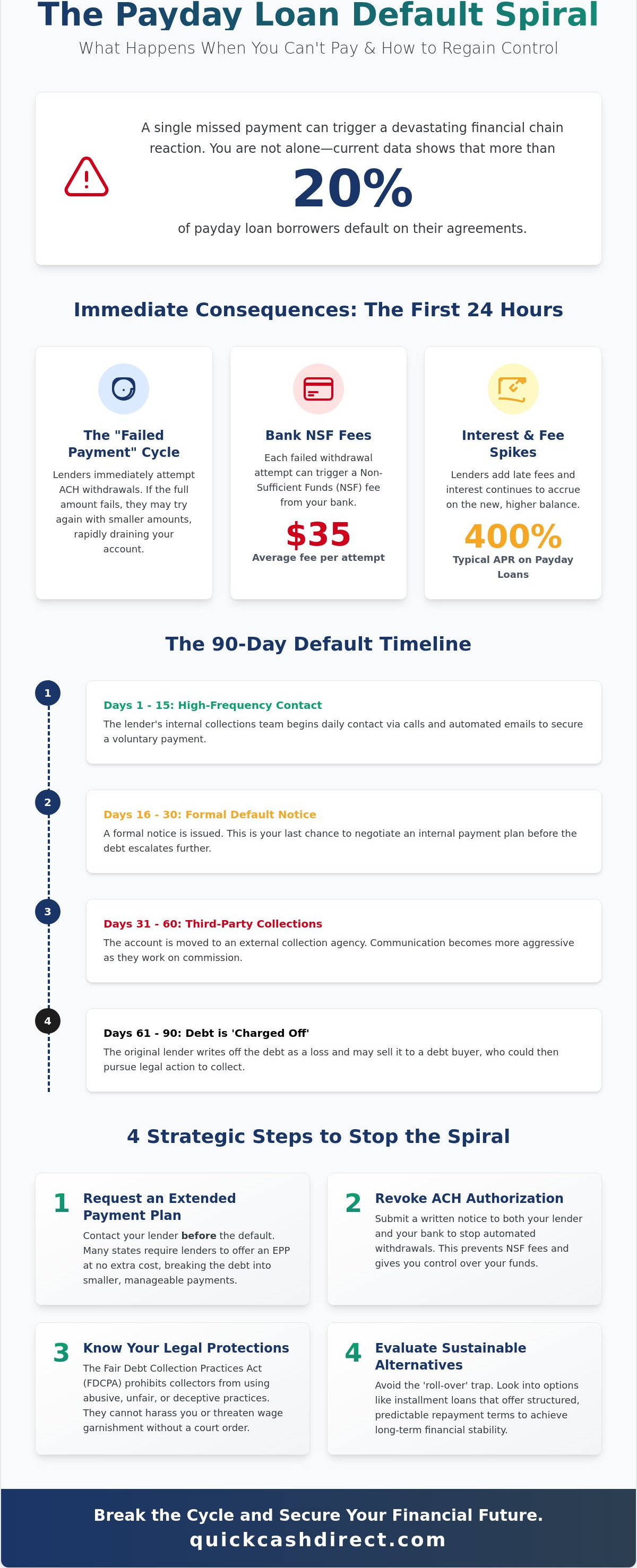
A single missed payment triggers a financial chain reaction that feels impossible to stop. You are likely asking, what happens if I can't pay back a payday loan before the collection calls begin? You aren't alone in this crisis. Current data shows that more than 20% of borrowers nationwide default on these agreements. You feel the constant pressure of rising fees and the fear of bank account garnishment. This anxiety is a natural response to a high-speed problem, but you can choose a different path.
Use this guide to get the immediate, structured relief you need to regain control. Understand the specific consequences of default and learn exactly how to stop the cycle of debt today. We outline the 60 to 90-day timeline before a debt moves to third-party collections. We also explain your legal protections under the Fair Debt Collection Practices Act. Follow these steps to move from a state of urgent need to a state of total resolution. Take decisive action now to secure your bank account and your peace of mind.
Key Takeaways
- Identify the 'Failed Payment' cycle to prevent repeated bank-side NSF fees and multiple unauthorized withdrawal attempts.
- Understand exactly what happens if I can't pay back a payday loan during the critical 90-day window from initial default to third-party collections.
- Differentiate between common debt collection myths and the actual legal requirements for wage garnishment to protect your income.
- Execute strategic steps like requesting an Extended Payment Plan or revoking ACH authorization to freeze the financial spiral immediately.
- Evaluate sustainable alternatives such as instalment loans to avoid the expensive 'roll-over' trap and secure long-term financial stability.
Immediate Consequences: What Happens the Moment You Miss a Payment
Missing a payment deadline starts an automated sequence. You must understand what happens if I can't pay back a payday loan to protect your remaining funds. The moment the clock strikes midnight on your due date, the lender's system begins its recovery protocol. This process is fast, clinical, and expensive. If you are wondering what happens if I can't pay back a payday loan, the first consequence is the loss of control over your bank balance. Lenders do not wait for you to call. They act immediately to secure the funds you owe.
Most lenders attempt to withdraw the full amount via ACH immediately. If that fails, they often try again in smaller increments. This "Failed Payment" cycle can drain your account balance to zero within hours. Each attempt by the lender can trigger a separate fee from your financial institution. Silence is your biggest enemy. Automated collection protocols trigger the moment communication breaks down. Within the first 24 hours, you still have the power to negotiate. After this window, the account often moves to internal collections teams who follow a rigid, high-velocity script. Contact the lender now to stop the automated cycle.
Bank Account Impacts and NSF Fees
Bank-side Non-Sufficient Funds (NSF) fees are the most immediate threat. These fees average $35 per failed attempt according to recent industry data. Because lenders may try to process the payment multiple times, you could face hundreds of dollars in bank penalties in a single day. If your balance remains negative for too long, the bank will close your account. This blocks your next paycheck and stalls your recovery. You can issue a "Stop Payment" order through your bank to block these attempts, though banks typically charge a fee for this service. Do not let these fees compound.
Lender Late Fees and Interest Spikes
Defaulting on a Payday loan triggers immediate internal penalties. Lenders typically add a flat late fee to your balance the day after a missed payment. Interest rates on these products are already high, often reaching APRs of 400%. Once you default, interest continues to accrue on the original principal plus any added fees. This creates a compounding debt trap that grows daily. Follow this structure to understand the costs:
- Late fees: These are applied instantly to the balance after the grace period ends.
- Interest accrual: Daily charges continue on the total amount owed, not just the original principal.
- Principal growth: Unpaid fees are often added to the principal, which increases future interest costs.
Act now to stop this momentum. Call your lender before the 24-hour window closes. Ask for an extension or a payment plan. Every hour of delay increases the total cost of your debt. Professional reassurance comes from taking control of the process rather than letting the automated system dictate your future. Clear communication is the only way to transition from a state of need to a state of resolution.
The Payday Loan Default Timeline: Day 1 to Day 90
Default is a structured process, not a sudden event. Knowing exactly what happens if I can't pay back a payday loan allows you to anticipate lender moves and protect your assets. The sequence follows a predictable 90-day trajectory from the first missed payment to potential legal escalation. Move quickly to resolve the debt while it remains within the lender's internal system. Delay only increases the total cost and the severity of the consequences.
- Days 1-15: The lender initiates high-frequency contact. Expect multiple calls and automated emails daily as they attempt to secure a voluntary payment arrangement.
- Days 16-30: The lender issues a formal default notice. This period represents your final opportunity to negotiate an internal payment plan or an extension before the debt escalates.
- Days 31-60: The account typically moves to a third-party collection agency. Communication becomes more aggressive and frequent as these agencies work to recover the balance for a commission.
- Days 61-90: The original lender 'charges off' the debt. They write the balance off as a loss and often sell the account to a professional debt buyer who may pursue legal action.
If you find yourself trapped in this high-velocity timeline, exploring bad credit loans with structured repayment terms can provide a safe exit strategy before credit reporting begins.
Internal Collections: The First 30 Days
During the first 30 days, the original lender handles all recovery efforts. They utilize automated dialing systems and scripted emails to create a constant sense of urgency. You have specific rights under the Fair Debt Collection Practices Act (FDCPA). Lenders must follow strict guidelines regarding when and how they contact you. Crucially, payday lenders cannot legally threaten you with jail time or criminal prosecution for failing to pay a civil debt. Do not let aggressive language force you into a panic-driven decision.
External Collections and Credit Reporting
After 60 days of non-payment, lenders often sell the debt to external agencies for pennies on the dollar. These third-party collectors then own the legal right to pursue you for the full balance. This transition often triggers a 'Collection' entry on your 2026 credit report. A single default can drop your credit score significantly and remain on your history for seven years. This mark makes it difficult to secure future housing, employment, or traditional financing. Act before Day 30 to prevent this long-term financial damage and keep your credit profile secure.
Legal Realities: Lawsuits, Garnishment, and Tribal Sovereignty
Legal threats often feel like the most terrifying part of the default process. You must understand the difference between a lender's threat and a court's power. If you're worried about what happens if I can't pay back a payday loan, start with this fact: you cannot go to jail for failing to pay a civil debt. Federal law prohibits collectors from using threats of arrest to coerce payment. Debt is a civil matter, not a criminal one. Focus your energy on the actual legal process rather than groundless fears.
Lenders use a cost-benefit analysis when deciding whether to sue. For a typical $375 loan, the legal fees often exceed the potential recovery. However, for larger balances or multiple consolidated loans, the risk of a lawsuit increases. A lawsuit is not an immediate event. It's a slow, documented process that gives you multiple opportunities to respond. Understanding what happens if I can't pay back a payday loan means recognizing that silence in the face of a legal summons is your biggest risk. Professional resolution requires active participation in the legal framework.
The Court Process and Wage Garnishment
A lawsuit begins with a 'Summons and Complaint' delivered to your home or workplace. Do not ignore these papers. If you fail to appear, the court issues a 'Default Judgment' against you. This judgment grants the lender the legal right to garnish your wages. Federal law limits this garnishment to protect your survival. Generally, a lender can take no more than 25% of your disposable weekly earnings or the amount by which your income exceeds 30 times the federal minimum wage. Verify your state's specific caps. At least 20 states plus the District of Columbia have enacted a 36% or lower interest rate cap, which can influence how much a lender can legally claim in court.
Special Considerations for Tribal Loans
Some lenders operate under tribal sovereignty. These tribal loans are unique because they may bypass state-level interest rate caps and consumer protection laws. Because these entities are owned by federally recognized tribes, they follow tribal law and federal regulations rather than state statutes. This makes dispute resolution more complex. You often must follow tribal court procedures to contest a debt or fee. If you face a dispute with a tribal entity, review your original agreement for the specific jurisdictional rules that apply to your case. Always prioritize structured communication to reach a settlement before the case moves to a tribal judicial system.
4 Strategic Steps to Resolve a Payday Loan You Can't Pay
Regain your financial footing through decisive action. You already understand what happens if I can't pay back a payday loan, including the fees, the calls, and the potential credit impact. Now, move toward a resolution. Use these four tactical steps to stop the debt cycle and secure your income. Transitioning from a state of stress to a state of control requires immediate, structured effort.
- Step 1: Request an Extended Payment Plan (EPP). Many states require lenders to offer this by law if you notify them before the due date.
- Step 2: Revoke your Voluntary Wage Assignment and ACH Authorization to stop unauthorized bank withdrawals.
- Step 3: Negotiate a lump-sum settlement once the debt has been in default for at least 60 days.
- Step 4: Contact a non-profit credit counseling agency to build a sustainable repayment sequence.
Negotiating an Extended Payment Plan (EPP)
An EPP is your most powerful tool for avoiding default. Call the lender's customer service line at least 24 hours before your payment is due. Use this specific script: "I am unable to pay the full balance today. I request an Extended Payment Plan as allowed by state regulations." Do not let the representative suggest a "roll-over" or a "loan extension," as these options only add more fees. Demand the new repayment schedule in writing via email before you end the call. This document is your security marker for the new agreement.
If you need fast funding to bridge a financial gap while resolving existing debt, consider applying for payday loans online with transparent repayment terms.
Settling the Debt for Less
When an account moves toward the 60-day default mark, lenders and collectors become more flexible. They often prefer a partial payment over a total loss. Aim to settle the debt for 40% to 60% of the total balance. This lump-sum payment immediately stops interest accrual and halts collection efforts. Always obtain a written "Settlement in Full" agreement before you send any funds. Once the payment clears, keep your "Letter of Satisfaction" as permanent proof that the debt is resolved. This prevents future agencies from attempting to collect on a satisfied account.
Revoking your ACH authorization is the next critical move. Notify your lender in writing that you are withdrawing their access to your bank account. Simultaneously, contact your bank and request a block on all future electronic transfers from that specific lender. This action stops the "Failed Payment" cycle and prevents compounding NSF fees from draining your balance. Take this step to protect your next paycheck and ensure your essential bills are paid first.
Breaking the Debt Cycle: Finding Sustainable Funding in 2026
Breaking the cycle requires a strategy that looks beyond the next two weeks. Many borrowers choose to "roll over" their debt to avoid immediate collection. This is a mistake. A roll-over adds a new finance charge to the existing balance without reducing the principal. It is often more expensive than a default. You already know what happens if I can't pay back a payday loan: fees, calls, and stress. However, a roll-over creates a permanent state of debt. Stop the cycle now by choosing a structured repayment path that actually reduces what you owe.
Use referral services to find lenders with more flexible terms. High-velocity debt thrives on silence and panic. By contrast, sustainable funding relies on transparency and manageable timelines. Transitioning to installment loans offers a safer alternative. These loans provide fixed monthly payments. This structure allows you to budget effectively. Unlike single-payment loans, installment options give you a longer runway for repayment. Use easy loans for bad credit to replace high-velocity debt with a predictable schedule.
Transitioning to Installment Loans
QuickCashDirect acts as an efficient facilitator in this transition. We match you with lenders who offer flexible terms that match your current cash flow requirements. These lenders look at your total financial picture, not just a single credit score. Fixed payments ensure that a portion of every dollar you pay goes toward the principal. This is the only way to end the debt cycle for good. Move from a state of urgent need to a state of resolution by selecting a loan product designed for your long-term success.
Emergency Financial Planning
Start an emergency financial plan today to prevent future crises. Aim for a $500 "mini" emergency fund. Save a small portion of every paycheck until you reach this target. This buffer prevents the need for future high-interest borrowing when unexpected expenses arise. Prioritize your survival bills first: housing, utilities, and food. Then, allocate remaining funds to your structured loan payments. If you are still concerned about what happens if I can't pay back a payday loan, remember that proactive planning is your best defense against aggressive collection tactics.
Rebuild your credit profile strategically after a default. A default may stay on your report, but you can demonstrate new, responsible borrowing habits immediately. Utilize no credit check loans to secure fast funding while you reorganize your finances. These products focus on your current income and ability to pay. Take the final step toward financial safety today. Find a loan that fits your budget now.
Take Control of Your Financial Future Today
You now have a structured roadmap to navigate this crisis. You've learned about the immediate bank impacts and the 90-day collection timeline. Understanding exactly what happens if I can't pay back a payday loan is the first step toward stopping the cycle. Use your legal rights to revoke ACH access and demand an Extended Payment Plan. These actions move you from a state of urgent need to a state of total resolution. Transitioning to a sustainable repayment path is the only way to protect your long-term credit health.
Don't let the pressure of a single payment dictate your financial security. Act now to find a solution that fits your actual budget. Our platform offers a fast online referral in minutes with options for all credit types. We prioritize your safety with a secure 256-bit encrypted application. Secure a manageable loan with flexible terms today. You have the power to break the debt cycle. Start your path to financial stability now and secure the peace of mind you deserve.
Frequently Asked Questions
Can I go to jail for not paying back a payday loan in 2026?
No, you cannot go to jail for failing to pay a civil debt. Federal law protects you from criminal charges for loan default. The Fair Debt Collection Practices Act prohibits lenders from using threats of arrest or prosecution to collect. Focus your energy on civil resolution rather than fear of criminal penalties.
Will a payday lender call my employer if I default?
Lenders have limited rights to contact your workplace. They can call to verify your employment or location, but they cannot legally discuss your debt with your boss or coworkers. If a collector violates these privacy rules, document the call and report them to the Consumer Financial Protection Bureau immediately.
How do I stop a payday lender from taking money out of my bank account?
Revoke your ACH authorization in writing to the lender. You must also notify your bank at least three business days before the next scheduled withdrawal. This stop-payment order acts as a safety marker for your funds and prevents the automated "Failed Payment" cycle from draining your balance.
What is the statute of limitations on payday loan debt?
The statute of limitations varies by state but typically ranges from three to ten years. After this period expires, a lender loses the legal right to sue you for the balance. However, the debt may still appear on your credit report for up to seven years from the date of default.
Can a payday loan lender garnish my wages without a court order?
No lender can garnish your wages without first winning a civil lawsuit and obtaining a specific court judgment. The only exception is a voluntary wage assignment you may have signed in your original contract. Revoke this assignment in writing to your employer and the lender to stop immediate payroll deductions.
How will defaulting on a payday loan affect my credit score?
Defaulting will likely drop your credit score by a significant number of points. This negative entry remains on your credit history for seven years. Understanding what happens if I can't pay back a payday loan helps you anticipate this impact and start rebuilding through structured repayment options or installment loans.
What is an Extended Payment Plan (EPP) and how do I get one?
An EPP is a structured agreement that extends your repayment term without adding new fees or interest. Contact your lender at least 24 hours before your due date and specifically request an EPP. Many states legally require lenders to offer this plan to borrowers who cannot meet their original deadline.
Can I settle a payday loan for less than the original amount?
Yes, most lenders and third-party collectors will accept a lump-sum settlement for 40% to 60% of the total balance. This option usually becomes available after 60 days of non-payment. Knowing what happens if I can't pay back a payday loan allows you to negotiate a settlement that marks the debt as "Satisfied" for a fraction of the cost.