
Tribal sovereign immunity isn’t a blanket shield from every loan dispute. It may affect whether a tribe or tribal lending entity can be sued, but the answer can depend on who issued the loan, which laws apply, and what the agreement says. With tribal lending sovereign immunity explained in plain language, you can understand why the doctrine matters without assuming it removes every borrower protection.
Legal terms can make this subject confusing. A lender’s tribal connection doesn’t automatically determine who may be sued, where a dispute can be heard, or which rules apply. Federal consumer protection laws may still be relevant, and courts can examine the facts behind a lending arrangement.
This guide explains the doctrine, its potential limits, and the role of the loan agreement. You’ll learn what to review, including the named lender, governing law, dispute forum, and arbitration terms. Use these details to assess the legal and financial risks before considering a tribal loan, rather than relying on the phrase “sovereign immunity” alone.
Key Takeaways
- Get tribal lending sovereign immunity explained in plain language, including why immunity concerns legal proceedings rather than the overall quality of a loan.
- Learn why the lender’s identity, entity structure, and type of claim can affect how immunity questions are considered.
- Separate immunity questions from the loan’s contract terms, applicable rules, and dispute procedures.
- Use a focused checklist to review the named lender, repayment schedule, total repayment obligation, and payment authorization before deciding.
- Understand QuickCashDirect’s role as a service that connects consumers with a lender network, not as the lender.
What Does Tribal Lending Sovereign Immunity Mean?
Tribal sovereignty is a federally recognized tribe’s inherent authority to govern itself. Sovereign immunity is a related legal doctrine that can protect a tribe from certain lawsuits unless the tribe consents or Congress authorizes the claim. The protection doesn’t automatically extend to every business connected to a tribe. Whether it applies can depend on the party being sued and the circumstances of the dispute.
Tribal sovereign immunity can affect whether and how a legal claim proceeds, but it doesn’t automatically determine whether a loan is fair, affordable, or suitable for a borrower. Keep these questions separate. Immunity concerns legal proceedings. A loan’s suitability depends on its terms and the rules that apply to it.
That distinction matters because a tribal government and a business associated with a tribe aren’t necessarily the same legal entity. Some tribes conduct commercial activity through separate enterprises. The relationship between an enterprise and its tribe may become relevant if a borrower brings a claim. A general overview of a Tribal Lending Enterprise describes how these businesses may relate to tribal sovereignty, but a particular lender’s status depends on its own structure and the facts.
How Is Tribal Sovereignty Different from Sovereign Immunity?
Sovereignty describes a tribe’s authority to govern itself. Immunity describes a legal protection that may affect whether a claim can be brought against the tribe or a qualifying tribal entity. The concepts are connected, but they aren’t interchangeable: sovereignty is the broader governing status, while immunity concerns a specific legal question. Neither term, by itself, tells a borrower what every loan term means or how a dispute will be resolved.
Why Does the Doctrine Matter in Tribal Lending?
If a dispute arises, the lender’s legal identity may matter. A claim involving a tribal government can raise different questions from one involving a separately organized company, a business partner, or another party. Courts may examine the entity’s relationship to the tribe and the claim being made. Tribal affiliation alone doesn’t settle those questions or establish that every party involved has immunity.
Start with the documents. The loan agreement can identify the lender, describe the repayment obligation, and state which law or process it says applies to disputes. These terms provide important context, but they don’t by themselves resolve whether immunity applies or how a court would interpret them. The facts and governing law matter too.
Keep these questions distinct:
- Who is the lender? Find the legal name in the agreement, not only a website or brand name.
- Who may be involved in a dispute? The lender, a tribal enterprise, and other companies may have different roles.
- What does the agreement say? Review its governing-law and dispute-resolution terms alongside the repayment details.
This is tribal lending sovereign immunity explained as a starting point, not a ruling on a specific loan. Use the doctrine to frame the legal question, then assess the contract and the parties separately. Immunity doesn’t automatically make a loan good or bad, and tribal affiliation alone doesn’t answer every question about a borrower’s options.
When Can Tribal Sovereign Immunity Apply or Be Limited?
Immunity isn’t determined by a lender’s label alone. A court may need to identify the defendant, examine the entity’s relationship with a tribal government, and consider the specific claim. A case against a tribe can raise different questions from one involving a separate business or a nontribal company that helped arrange a loan.
Whether tribal sovereign immunity applies depends on the specific legal and factual context, including who is sued, the entity’s relationship with the tribe, and the claim at issue. A borrower shouldn’t treat tribal affiliation or a contract statement as a complete answer. Legal standards can vary, and courts assess the circumstances before them.
What Is an Arm-of-the-Tribe Analysis?
When a business is separate from a tribal government, a court may consider whether it qualifies as an “arm of the tribe” for immunity purposes. The analysis looks at the entity’s relationship with the tribe rather than assuming that a tribal connection settles the issue. Courts may weigh multiple factors, and results can differ across cases. The Tribal Lending Under CFPB Enforcement paper discusses these legal questions in the context of lending. Any specific legal test or case outcome should be checked against current primary legal sources.
The claim matters too. A court may distinguish between claims against different parties or consider whether the conduct at issue falls within the protection asserted. For a borrower, that means distinguishing the lender named in the agreement from any other company involved. A business relationship alone doesn’t establish that each participant shares the same legal status.
Can Immunity Be Waived or Changed by Congress?
Waiver means a tribe has legally consented to be sued in a defined context. The consent must be valid and apply to the claim and parties involved. A clause in a loan agreement may address dispute procedures or mention immunity, but its wording doesn’t automatically create a legally effective waiver. Read the exact language rather than assuming a general promise resolves the question.
Congressional abrogation is separate. It means Congress has clearly removed immunity through federal law for a particular purpose or proceeding. It isn’t the same as a tribe choosing to consent, and it doesn’t mean every federal law eliminates immunity across all disputes. Whether a statute has that effect depends on its text and how courts interpret it.
Keep the review practical: identify the defendant, note which entity signed the agreement, and preserve the contract and related disclosures. Then consider immunity separately from the contract’s repayment terms and dispute process. This is tribal lending sovereign immunity explained as a framework, not a prediction about a particular case. For general information about potential short-term options, explore lender-network options. QuickCashDirect connects consumers with lenders and isn’t the lender or a legal adviser.
What Sovereign Immunity Does, and Does Not, Answer About a Tribal Loan
Sovereign immunity addresses whether a particular claim can proceed against a particular defendant. It doesn’t, by itself, tell you whether a loan’s cost, repayment schedule, or other terms are acceptable. Keep those questions separate. A loan agreement may name a tribal lending entity, identify a governing law, and set out a dispute process. Each detail may matter, but none alone answers every legal question.
| Question | What to examine |
|---|---|
| Immunity | Who is being sued, that party’s relationship to a tribe, and the type of claim. |
| Contract terms | The named lender, repayment schedule, total repayment obligation, and other promises in the agreement. |
| Applicable rules | Which federal or state requirements may apply to the lender and transaction. Outcomes can depend on the facts and jurisdiction. |
| Dispute procedures | The agreement’s stated forum, governing law, and any arbitration or other dispute-resolution language. |
Does Immunity Automatically Remove Every Borrower Protection?
No. Immunity and regulatory authority are different questions. Whether a lender or related business must follow a particular consumer protection requirement depends on the law, the entity, and the facts. Don’t assume tribal affiliation means every federal or state rule disappears. Don’t assume a rule applies in the same way to every lender, either.
Federal agencies and courts have addressed questions about their authority over tribal lending entities and related businesses. The Supreme Court’s 2023 decision in Lac du Flambeau Band of Lake Superior Chippewa Indians v. Coughlin held that the Bankruptcy Code abrogates tribal sovereign immunity in bankruptcy proceedings. This is a specific statutory context, not a ruling that immunity is removed from every loan dispute. The Supreme Court Ruling on Tribal Sovereign Immunity provides reporting on that decision. Check current primary legal sources for developments and jurisdiction-specific questions.
Why Do Governing-Law and Dispute Clauses Matter?
A loan agreement may identify the law it says governs, name a forum, or require arbitration. These clauses can shape how the parties are expected to handle a disagreement. Read the full provision, including any steps, deadlines, or limits it describes. For example, a clause stating that tribal law applies doesn’t alone resolve whether a court will accept that term in a particular dispute.
Arbitration language also doesn’t automatically answer whether a claim can proceed, where it can be heard, or whether immunity applies. Courts may need to interpret the agreement alongside the relevant law and facts. Don’t treat a clause as a guaranteed outcome.
Use tribal lending sovereign immunity explained as a starting point, not a shortcut. Review the lender’s identity, entity structure, contract terms, and dispute language together. Immunity doesn’t by itself settle whether a loan fits your needs or resolve every question about borrower protections.
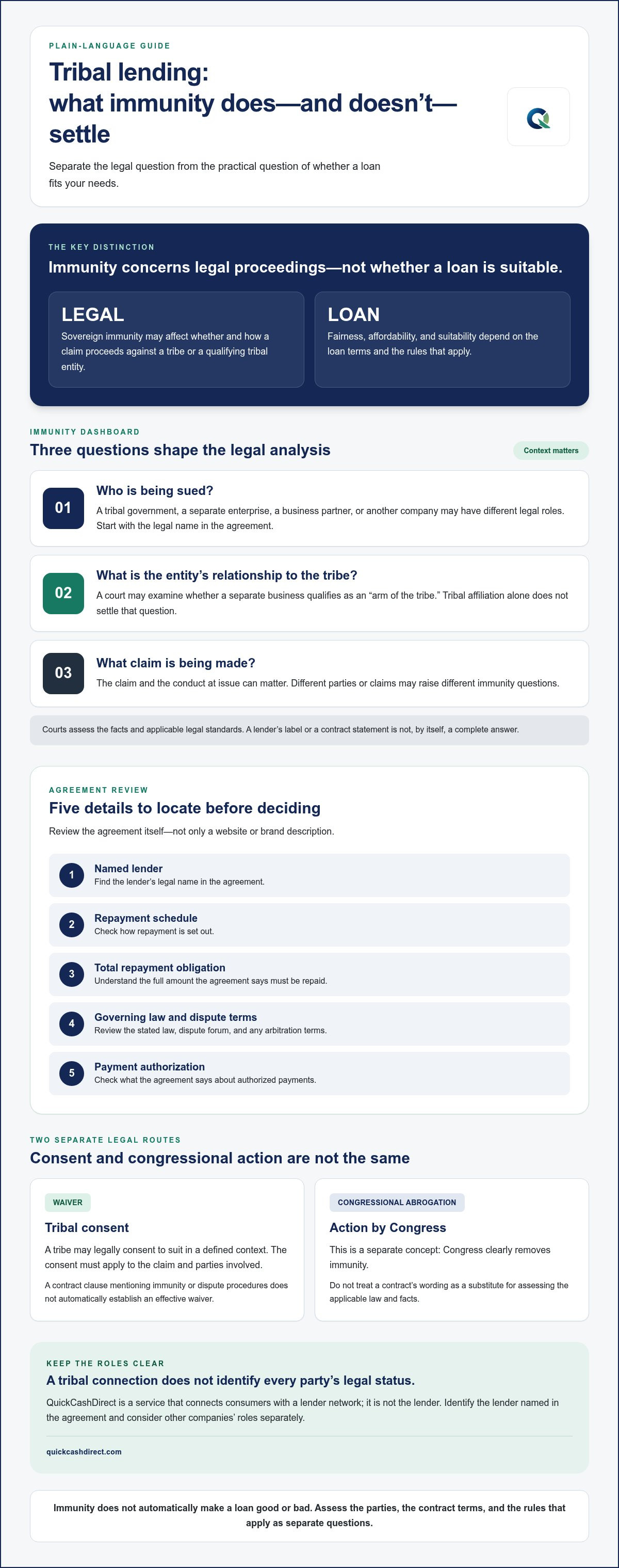
How to Review a Tribal Loan Agreement Before You Decide
Read the written offer before accepting it. First, identify who is lending, what you must repay, when payments are due, and how the lender can collect them. Then review the clauses explaining what happens if there’s a disagreement. This checklist turns the legal background of tribal lending sovereign immunity explained into practical document-review steps. It isn’t legal advice, but it can help you identify terms that need clarification.
Identify the Lender and the Full Repayment Terms
Start with the agreement, not just the website or name on an application page. A platform that connects you with an offer may be different from the lender named in the contract. Record the lender’s full legal name, then compare it with the names in the disclosures and payment authorization.
Next, map out the complete repayment obligation. Look for the amount due, each payment date, fees or finance charges, and the method used to collect payments. Check that the schedule matches the total amount shown elsewhere in the documents. Don’t rely on a summary if the contract contains additional terms.
- Named lender: Find the legal entity identified as the lender and note any other companies named in the documents.
- Payment schedule: Write down due dates, payment amounts, and the number of scheduled payments.
- Total repayment: Locate the full amount you’re expected to repay, including disclosed charges.
- Payment authorization: Review how payments may be taken, which account or method you authorize, and whether the agreement explains how to change or revoke that authorization.
Find the Clauses That Shape Disputes
Use the agreement’s table of contents or search feature to find terms such as “governing law,” “dispute resolution,” “arbitration,” “venue,” or “forum.” Governing-law language identifies which law the contract says applies. A forum-selection clause names where certain disputes are intended to be heard. Arbitration language describes a process for resolving disputes outside a court. Read the full section, including exceptions and required steps.
These clauses matter, but their wording alone may not settle every legal or jurisdictional question. Don’t assume a stated forum guarantees where a claim will proceed or that an arbitration clause predicts an outcome. If the language is unclear or a dispute has already arisen, save the agreement and seek advice from a qualified legal professional familiar with the relevant law.
Keep a complete copy of the agreement, disclosures, payment authorization, and any later changes. Save related messages and payment records with them. This gives you a clear reference for comparing what was offered with what the documents require. Pause if key terms conflict or you can’t determine the total repayment obligation.
After reviewing the documents, you can explore potential loan options through QuickCashDirect’s lender network. QuickCashDirect connects consumers with potential lenders; it isn’t the lender or a legal adviser. Review any offer’s documents before deciding whether it fits your needs.
Next Steps: Make an Informed Decision on Tribal Lending
Use what you’ve learned about tribal lending sovereign immunity explained to guide your review, not to make the decision for you. Immunity is a legal issue. Your borrowing decision also depends on the offer, its full cost, and whether the repayment schedule fits your finances. This explanation isn’t an endorsement of a loan or a legal opinion about a particular lender or agreement.
Take the decision in order: understand who is making the offer, read the terms, then decide whether the commitment works for you. For broader context about how tribal loans may be structured, review this tribal loans overview. Use it alongside the specific documents for any offer you’re considering.
Separate Legal Questions from Your Personal Borrowing Decision
Don’t let a complicated immunity question distract you from the practical test: can you make each payment on time while still covering essential expenses? Check the due dates against your expected income and regular bills. Consider how your budget would change if a payment is larger than expected or an unplanned expense comes up. If the schedule feels difficult to manage, pause before accepting.
Legal protections and personal affordability are separate. Understanding one doesn’t settle the other. If your question concerns your rights or a specific dispute, seek guidance from a qualified legal professional familiar with the relevant law.
Know What a Loan Connection Service Does
QuickCashDirect is a referral service that connects consumers with a network of lenders offering short-term financial options, including tribal loans. It isn’t the lender. A lender may present an offer and its agreement terms, so read those documents to identify who would make the loan and what you would be agreeing to. A connection to a lender isn’t approval or a promise of funding.
If you’re comparing borrowing options, the bad credit loan guide offers related information. Compare the actual terms available to you, not just a product label or general description.
Before deciding, make a short final check:
- Understand the offer: Identify the lender and confirm the amount and repayment schedule.
- Review the agreement: Check the total repayment obligation, payment authorization, and dispute terms.
- Assess fit: Decide whether the payment timing works with your budget and other obligations.
There’s no need to rush past unclear terms. Keep the agreement and disclosures, and get qualified help if legal language or a dispute raises questions. If you’re ready to explore potential offers, explore available funding options through QuickCashDirect’s lender network. Review any offer carefully before deciding whether to proceed.
Take Your Next Step with Confidence
Let clarity guide the decision, not pressure. The phrase tribal lending sovereign immunity explained can help you understand the legal questions, but your next step is personal: decide whether the written offer and payment commitment suit your circumstances. If a term remains unclear, pause and seek qualified legal guidance rather than relying on assumptions about what immunity means.
QuickCashDirect connects consumers with a network of lenders, including options for tribal loans. It isn’t the lender, so review the lender’s own offer and agreement before deciding whether to proceed. The choice is yours.
When you’re ready to explore, explore available funding options through the lender network. Take your time, compare the terms presented, and choose the path that feels manageable for your budget.
Frequently Asked Questions
Is tribal sovereign immunity absolute?
No single answer applies to every situation. Immunity may depend on who is named in a claim, how a business relates to a tribe, and what the claim concerns. A legally effective waiver or congressional action may also affect the analysis. Courts assess the specific facts and applicable legal authority, so a general explanation can’t predict an individual result. If you’re facing an active dispute, preserve relevant records and speak with qualified legal counsel.
Can a tribal government waive sovereign immunity?
Yes, but whether a tribe has waived immunity is a legal question. The consent must be legally effective and apply to the relevant context. Don’t assume ordinary contract language automatically creates a waiver. The wording, the parties covered, and applicable law can all matter. If an agreement appears to address consent to suit, or a dispute has already started, have a qualified legal professional review the complete document before relying on that clause.
Can a tribally owned business claim sovereign immunity?
It may be possible, but tribal ownership alone doesn’t decide whether immunity applies. A court may examine the business’s legal structure, purpose, relationship with the tribal government, and other facts. The factors used and outcomes can vary by jurisdiction and case. For example, a company’s ownership information may not explain how it is governed or connected to the tribe. Treat general information as background, not a legal determination about a specific business.
Does tribal sovereign immunity mean a tribal lender is exempt from every law?
No. Immunity and regulatory compliance are separate legal questions. Tribal lending sovereign immunity explained clearly should not be mistaken for a blanket exemption from federal or state requirements. The answer may depend on the law involved, the regulator, the lender’s structure, and relevant court decisions. These rules can change or differ across jurisdictions. For a specific loan or dispute, verify current legal authority and seek advice from qualified counsel.
Does a tribal loan agreement’s arbitration clause settle where a dispute must be heard?
No. An arbitration clause may describe a process for handling disputes, but its presence alone doesn’t settle every question about jurisdiction, immunity, or whether the clause applies. The full wording and surrounding legal context matter. For example, an agreement may include exceptions or steps that affect how the provision is used. Read the entire clause alongside the rest of the contract, and get qualified legal advice before relying on it to predict an outcome.
Can a borrower challenge a tribal loan agreement?
A borrower may raise questions about an agreement, but whether a particular challenge can proceed depends on the contract, parties, claim, and applicable law. Immunity may affect some proceedings, but it doesn’t automatically answer every contract or regulatory issue. A general explanation can’t establish a remedy or outcome. If you’re dealing with a dispute, keep the signed agreement, disclosures, payment records, and related messages, then consult qualified legal counsel about your situation.