
The biggest tax-refund mistake may be sending every dollar to debt. If you’re asking, “should I use my tax refund to pay off loans,” the answer depends on how much interest you could save and how much cash you may need next. A lower balance can reduce borrowing costs, but an empty emergency cushion can push you back into debt when an unexpected bill arrives. Protect essential expenses first, then weigh the payoff benefit against your need for savings.
Your refund can make a real dent in a loan, but the right move depends on your priorities and the loan’s terms. Compare payoff options with savings and other near-term needs, then choose an allocation that supports your financial stability.
Start by setting aside money for essentials and unexpected costs. Then compare interest rates, minimum payments, and any lump-sum payoff conditions. Before you pay, confirm how your lender will apply the money and whether early-payoff terms affect your plan.
Key Takeaways
- For “should I use my tax refund to pay off loans,” protect essential expenses and near-term cash needs first.
- Compare each loan’s APR, balance, minimum payment, and payoff quote, then calculate how much cash would remain.
- Check whether a refund offset could apply before treating your expected refund as money available for a voluntary loan payment.
- Get a current payoff quote and review payment allocation, prepayment terms, and account status before sending a lump sum.
- Use a step-by-step allocation plan. Don’t take a new loan just to keep your refund without comparing the full repayment cost.
Should you use your tax refund to pay off loans? Start with your immediate needs
Using a tax refund to pay down a loan can make sense, but not if it puts essential near-term expenses at risk. Cover housing, utilities, food, insurance, and bills due soon before deciding what you can safely send to a lender. If your income or expenses may change, leave room for that uncertainty too.
Decision rule: Pay extra toward a loan only after setting aside enough for essential expenses and near-term needs. Compare the loan’s cost and payoff terms with the value of keeping cash accessible.
A voluntary loan payment is money you choose to send to a lender to reduce what you owe. An IRS refund offset is different: it’s an involuntary reduction of a federal tax refund to pay certain eligible past-due debts. Don’t assume an offset will pay the loan you have in mind, or that every debt qualifies. Check current IRS and Treasury Offset Program guidance for eligible debts and rules before counting on receiving a particular refund amount.
A Tax refund is generally money returned after tax payments exceed the amount owed. QuickCashDirect isn’t responsible for the content of external sites. Use them at your own risk.
When paying down a loan with a refund can make sense
An extra payment may reduce principal, the amount you borrowed that remains unpaid. With less principal, you may pay less interest over time or repay the loan sooner, depending on the interest calculation and your agreement. The impact isn’t automatic: payment rules, fees, and whether extra money goes to principal can change the result.
Consider high-cost debt after accounting for essential bills and upcoming obligations. For example, if a refund arrives while a costly loan is accruing interest, putting part of it toward that balance may reduce future borrowing costs. Don’t assume a specific amount of interest savings, though. Get current figures and review how the lender will apply the payment before acting.
When keeping some refund cash may matter more
Cash on hand can help cover irregular bills, an urgent repair, or a gap between paychecks. If you use the entire refund for debt, even a manageable surprise expense could leave you short. You might then need to borrow again, weakening the progress you made.
There’s no single reserve amount that suits every household. Estimate what’s due soon, consider how predictable your income is, and account for expenses that don’t arrive monthly. Then decide what portion, if any, remains available for loan payoff. If the refund amount is uncertain or bills are still pending, pause before making an extra payment. Protect your cash flow first and base your decision on confirmed numbers.
Compare loan payoff, interest savings, and cash reserves before deciding
To answer “should I use my tax refund to pay off loans,” compare each loan’s cost with the cash you’d have left. APR helps you compare borrowing costs across loans, but it doesn’t determine how much cash you need available or which payment best fits your priorities. Use current account details, not a guess based on the original loan amount.
Loan comparison worksheet
Loan: Record the account name for each debt.
APR: Enter the current annual percentage rate.
Remaining balance: Note the latest balance shown by the lender.
Minimum payment: Record the amount due and its due date.
Payoff quote: Request the amount needed to clear the loan, including its valid-through date.
Cash left afterward: Estimate what remains from your refund after the proposed payment and planned expenses.
Label projections as estimates. The balance shown online may differ from the amount required to pay off a loan on a specific date. Don’t claim a precise interest saving unless the lender’s figures and payment terms support it.
Compare two options for each loan: pay it off in full, or make a partial payment and keep the rest of the refund accessible. Full payoff may remove a monthly payment if the lender closes the balance as expected. A partial payment may reduce principal while preserving cash. The better fit depends on the loan terms and how much you need to keep available.
Which loan should receive an extra payment first?
Paying extra toward the highest-rate loan first can reduce the interest charged over time, if the lender applies the payment to principal. Clearing a smaller balance first can simplify monthly debt management by removing an account sooner. Before choosing, check how extra payments are allocated, whether they reduce principal, and whether your agreement includes relevant prepayment terms.
How much of the refund should stay accessible?
List essential expenses due before your next reliable income, then add irregular bills you expect soon. Account for savings you can access without delay. What remains is a possible payoff budget, not a required target. If keeping more cash protects your plan, reduce the extra payment or wait until expenses are clearer.
If you have a separate short-term cash need, QuickCashDirect offers a free loan-introduction service, not direct lending. Checking rates uses a soft check and doesn’t affect your credit score; a hard inquiry occurs only if you accept an offer. Approval isn’t guaranteed. Compare the specific agreement’s APR, payment schedule, total repayment, and early-payoff terms. Borrowing just to preserve refund cash isn’t automatically cheaper than using the refund.
Check loan terms and tax refund offsets before sending a lump-sum payment
Before deciding “should I use my tax refund to pay off loans,” confirm what your lender will accept and how it will handle the payment. The balance on your account may not equal the amount needed to close the loan. Interest or other amounts may accrue between the date you check and the date the payment posts. Request a current payoff quote and note its valid-through date. If that date passes, get an updated quote before sending money.
What to verify in the loan agreement
Review your agreement and account details before paying. Check for prepayment penalties, required payoff instructions, and lender-specific rules for submitting a lump sum. Early payoff is generally allowed without penalty for loans connected through QuickCashDirect, but review your specific agreement. Don’t assume the same terms apply to every loan.
Confirm how the lender will allocate the payment. Depending on the agreement and payment instructions, a lump sum may be applied among principal, accrued interest, fees, or other amounts due. Check whether an extra payment reduces principal or changes only the next scheduled payment. Review your account status too, since a pending payment, overdue amount, or other balance may affect the payoff figure or how funds are applied.
Use this quick pre-payment check:
- Match the payoff quote to the correct account and confirm its valid-through date.
- Follow the lender’s specified payment method and include any required account details.
- Save the payment receipt or confirmation number.
- Review the next account statement to confirm the payment posted correctly and the remaining balance reflects the transaction.
Keep these records together. If the balance doesn’t update as expected, your quote and confirmation can help you identify what to resolve with the lender.
What a tax refund offset means
A voluntary payment is one you choose to send to a lender. A tax refund offset is different: the federal government may reduce an eligible refund to cover certain past-due debts. Under 2026 Treasury Offset Program guidance, categories can include past-due child support, federal agency nontax debts such as defaulted federal student loans, state income tax obligations, and certain unemployment compensation debts. That doesn’t mean every loan qualifies, or that a private lender can claim your refund through this program.
Rules and eligible debt categories can change. Check current IRS and Treasury guidance before relying on an expected refund, and review any offset notice for the debt and agency involved. An offset may reduce the amount you receive, while a voluntary payment is a separate decision you control. Keep the two processes distinct: first determine what refund will actually reach you, then use confirmed figures and the lender’s current payoff terms to decide whether to pay a lump sum.
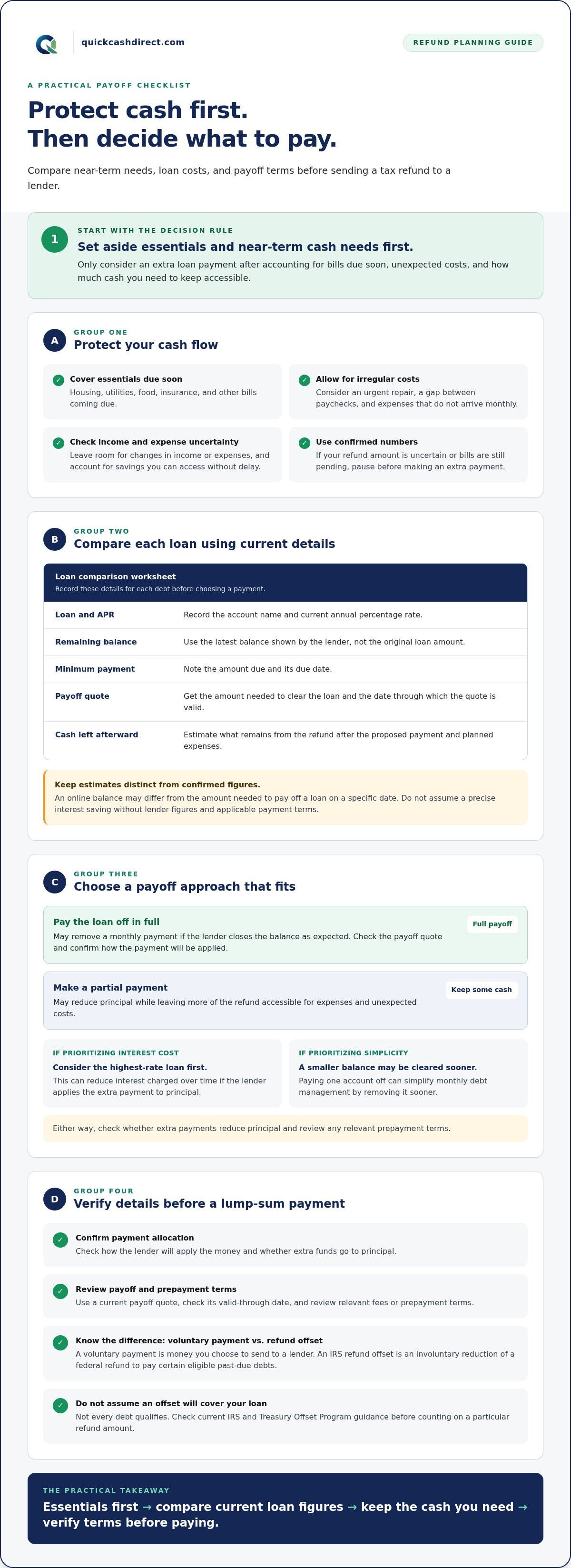
Step-by-step plan to allocate your tax refund
Use a clear sequence to decide what your refund can do without leaving essential costs uncovered. If you’re asking, “should I use my tax refund to pay off loans,” work from confirmed income, bills, savings, and loan terms. Don’t set a payoff target before you know what needs to stay available.
A practical five-step refund decision
- Cover essentials first. List housing, utilities, food, transportation, insurance, and other necessary costs due before your next reliable income. Include scheduled bills, not just expenses you remember offhand.
- Review accessible savings. Check what cash you can use quickly. Add near-term costs that don’t appear in your monthly budget, such as a planned repair, annual bill, or medical expense. Consider whether your income is steady or may change.
- Compare debts. For each loan, note its APR, remaining balance, minimum payment, and current payoff quote. Read the agreement for early-payment terms and confirm how extra funds will be applied. Prioritize based on cost and your circumstances, not APR alone.
- Set a safe payment amount. Subtract planned expenses and the cash you want to retain from the refund you expect to receive. The remainder is a possible payoff budget, not an amount you must spend. You could use part of it for a principal payment and keep the rest accessible.
- Send and document the payment. Follow the lender’s instructions, save the confirmation, and review your account afterward. Check that the payment posted and the balance changed as expected.
Pause before step four if the refund amount is uncertain, bills are pending, or your income may change. Wait until you have reliable figures rather than committing money you may need for essentials. If you can’t cover everything at once, keep required payments and near-term needs in view before choosing any extra payment.
What to do if the refund cannot cover everything
A full payoff isn’t the only option. A partial payment may still help, but first confirm how the lender allocates it and whether it reduces principal. You might direct some refund money to one loan while retaining cash for upcoming expenses, or wait until an uncertain bill is resolved. Don’t treat new borrowing as the automatic answer to a shortfall. A new loan adds repayment obligations and may cost more than the debt you’re trying to manage.
If you have a separate short-term cash need, review cash advance options and considerations as a separate decision, not as a way to fund a loan payoff. QuickCashDirect is a free loan-introduction service, not a lender. Checking rates uses a soft check and doesn’t affect your credit score; a hard inquiry occurs only if you accept an offer, and approval isn’t guaranteed. Review QuickCashDirect’s loan-introduction service only if borrowing fits that separate need.
Consider borrowing only for a separate cash need, not as an automatic refund-payoff strategy
Taking out a new loan to keep your tax refund in savings is not automatically cheaper or safer. You could preserve cash now but take on another balance, scheduled payments, and borrowing costs. Compare the new loan’s total repayment with the interest or other costs you expect to avoid by using the refund on existing debt. If the numbers and your budget don’t support borrowing, don’t treat a new loan as a shortcut to paying off another one.
Compare the total repayment before considering a loan
Review the specific lender’s agreement, not just an advertised rate or estimated payment. Compare the APR, payment schedule, any fees disclosed in the agreement, and the total amount you’d repay. Make sure each payment fits your budget alongside existing obligations. A lower monthly payment can still mean a higher total repayment if the term is longer.
QuickCashDirect connects applicants with lenders for loans of $300 to $3,000, with terms of 3 to 36 months and a stated APR range of 5.99% to 35.99% for qualified consumers. The actual offer depends on lender criteria, including income and ability to repay. Approval isn’t guaranteed.
Checking rates through QuickCashDirect uses a soft check and doesn’t affect your credit score. A hard inquiry occurs only if you accept an offer. For general background on how payday loans work and funding considerations, read this payday loan funding information. Use it to understand the topic, not as a recommendation to borrow.
Keep the loan decision separate from the refund decision
First decide how much of your refund you can safely put toward existing debt while covering planned expenses. Then assess any separate cash need on its own. Don’t borrow simply to avoid using refund money if that means replacing one debt with another at a higher total cost. If you consider an offer, review the lender’s agreement carefully, including payment dates, total repayment, and how extra payments are handled.
Early payoff is generally allowed without penalty for loans connected through QuickCashDirect, but terms can vary, so review your specific agreement. Check whether paying early reduces the amount you owe and follow the lender’s instructions. Keep a copy of the agreement and payment records.
If you have a distinct cash need and want to review lender offers, see QuickCashDirect’s loan-introduction service. Compare any offer with your budget and existing debt before deciding. A rate check isn’t a commitment, and a loan is only worth considering if its repayment terms fit your circumstances.
Make your next money move with confidence
Your refund plan doesn’t need to solve every financial goal at once. It needs to fit the bills and obligations in front of you, while leaving room to adjust if your circumstances change. Before you commit, ask yourself, “should I use my tax refund to pay off loans,” based on the cash you can safely spare, not pressure to make the largest possible payment.
If a separate short-term cash need leads you to consider borrowing, compare the actual repayment terms with your budget. Checking rates uses a soft check and doesn’t affect your credit score. Early payoff is generally allowed without penalty, but review your specific agreement for its terms.
QuickCashDirect is a free loan-introduction service, not a lender. The site is provided “as is,” without express or implied warranties, and the company makes no warranties about the accuracy, completeness, or correctness of its information. Check local laws for any restrictions on excluding implied warranties. Any dispute must be resolved individually, and class-action arbitration is waived. Liability is limited to the amount paid for site access, if any. Site material is for personal, non-commercial use only; don’t reproduce or exploit it commercially, and don’t use site images without permission. No one will contact borrowers to request money or a product purchase before loan funds are received.
Review QuickCashDirect’s loan-introduction service if you have a separate cash need and want to consider potential lender offers. Take your time, compare the terms with your budget, and choose a plan you can manage.
Frequently Asked Questions
Should I use my whole tax refund to pay off loans?
Don’t commit the entire refund until you’ve checked what cash you’ll need next. If you’re asking, “should I use my tax refund to pay off loans,” compare a full payoff with a partial payment and keeping the balance available. For example, a loan might be nearly paid off, but using the full refund could leave you without cash for a bill due before payday. Choose the option that fits your actual budget.
Which loan should I pay off first with my tax refund?
Start by comparing the loans’ costs and the effect each payment would have on your monthly budget. Paying extra toward the highest-rate debt may reduce interest over time; clearing a smaller balance may free up a payment sooner. If two loans have similar rates, consider whether eliminating one account would make your monthly finances easier to manage. Confirm how your lender applies extra money before choosing.
Is it better to pay off debt or save my tax refund?
Neither choice is automatically best; weigh the loan’s cost against your need for accessible cash. If an upcoming expense could force you to borrow again, keeping part of the refund may protect your budget. If your essential costs are covered and a loan is expensive, paying some down may be a stronger fit. You can divide the refund between savings and debt rather than treating the choice as all or nothing.
Can I pay off a loan early with my tax refund?
Often, yes, but the terms in your specific agreement determine how an early payment works. Before sending money, get a payoff amount that applies to your intended payment date. Check whether any penalty applies and whether the lender will treat extra money as principal or as future scheduled payments. Early payoff is generally allowed without penalty for loans introduced through QuickCashDirect, but review your lender agreement.
Can the IRS take my tax refund to pay my loans?
Sometimes, but only certain debts may qualify for a federal refund offset. Eligible categories can include past-due child support, federal agency nontax debts, state income tax obligations, and certain unemployment compensation debts. An ordinary private loan doesn’t automatically qualify. Check current IRS and Treasury Offset Program guidance before relying on a refund to make a payment. An offset is separate from choosing to send money to a lender yourself.
Should I take out a loan to keep my tax refund?
Only consider borrowing for a distinct cash need after comparing the full cost and repayment schedule with your budget. A rate check uses a soft credit check and doesn’t affect your credit score, but lender approval isn’t guaranteed and depends on lender criteria. If you receive an offer, review its APR, payment dates, total repayment, and any lender fees disclosed in the agreement before accepting. Keeping refund cash isn’t automatically worth taking on new debt. For a separate need, explore QuickCashDirect’s loan-introduction service and compare any offer carefully before deciding.