
Could another loan make repayment easier, or add one more due date to manage? When bills land on different days, it’s easy to lose track of balances and feel pressure to act quickly. Before considering short term installment loans online, get a clear picture of what you owe and what your budget can handle.
It’s sensible to question whether new borrowing will help. A payment that looks manageable on its own can strain a budget already covering several debts. Start by listing each balance, due date, payment amount, and disclosed borrowing cost. Then compare repayment approaches and alternatives before deciding whether another loan makes sense.
This guide walks you through building a debt overview, comparing options, and assessing affordability using the loan’s actual terms. It also explains QuickCashDirect’s online referral process: the service connects applicants with a network of lenders, while participating lenders decide eligibility, terms, and funding. Approval and funding times aren’t guaranteed. Use the steps ahead to make a measured decision, not a rushed one.
Key Takeaways
- Build a complete debt inventory with balances, payment amounts, and due dates before choosing your next step.
- Compare highest-interest-first and smallest-balance-first repayment strategies to see which fits your priorities and budget.
- Evaluate short term installment loans online against your current repayment plan and other options using disclosed costs and terms.
- Set a payment limit and review loan disclosures before applying so a new payment doesn't crowd out essential bills.
- Understand that QuickCashDirect connects applicants with a network of lenders, while participating lenders decide eligibility, terms, and funding.
Managing Multiple Debts Starts With a Clear View of What You Owe
Start with the facts, not another application. One list of balances, payments, and due dates shows where your money is already going and which deadlines need attention. It gives you a firmer basis for comparing repayment strategies or deciding whether short term installment loans online could fit your budget.
An online short-term installment loan is applied for online and repaid through scheduled payments over an agreed term. The schedule, term, rate, fees, and other conditions can vary by lender, so don’t assume every offer works the same way. In general, an installment loan is repaid through scheduled payments over an agreed term.
What to record for every loan and bill
Make an inventory before choosing what to pay down or whether to borrow. Use recent statements or account records, and note when you checked each balance. For every debt, capture:
- Creditor or account name and remaining balance
- Required minimum payment and due date
- Disclosed interest rate and any fees relevant to repayment
- Current status, such as current, past due, or subject to an upcoming deadline
Keep loans and other debts distinct from recurring household bills. Rent, utilities, insurance, and phone service may not be loans, but they still affect the cash available for payments. Include them in a separate section of the same monthly view. Flag past-due accounts and near-term due dates so they stay visible. Don’t assume one repayment tactic will suit every obligation.
For example, a debt with a high disclosed rate may deserve attention in a repayment comparison, while a past-due account may need prompt review of its payment status and consequences. The inventory helps you see those differences instead of treating every balance as interchangeable.
How to calculate a realistic monthly repayment amount
Use take-home income, not gross pay, as your starting point. Estimate what remains after essential expenses and required minimum payments. Then account for costs that don’t arrive monthly, such as annual bills, seasonal expenses, or necessary repairs. Keep a modest emergency buffer rather than assigning every remaining dollar to debt repayment.
Affordable repayment depends on income, essential costs, and every existing obligation. Use your calculation as a ceiling, not a target to stretch past. If income changes from month to month, base the plan on a cautious estimate and check whether payments still fit during a lower-income period. A proposed loan payment should fit alongside current obligations without relying on missed bills, skipped essentials, or hoped-for extra income.
With the inventory and monthly amount in hand, you can compare repayment approaches against a realistic picture of your cash flow. Keep the list current as balances change or due dates pass. A reliable snapshot makes the next decision more deliberate.
Choose a Debt Repayment Strategy Before Adding Another Loan
Once you can see each obligation and its place in your monthly budget, choose a repayment plan before taking on another payment. A new loan doesn’t automatically consolidate existing debts or reduce what you’ll repay overall. Compare the alternatives against your current obligations, including the payments, costs, and terms that would continue or change.
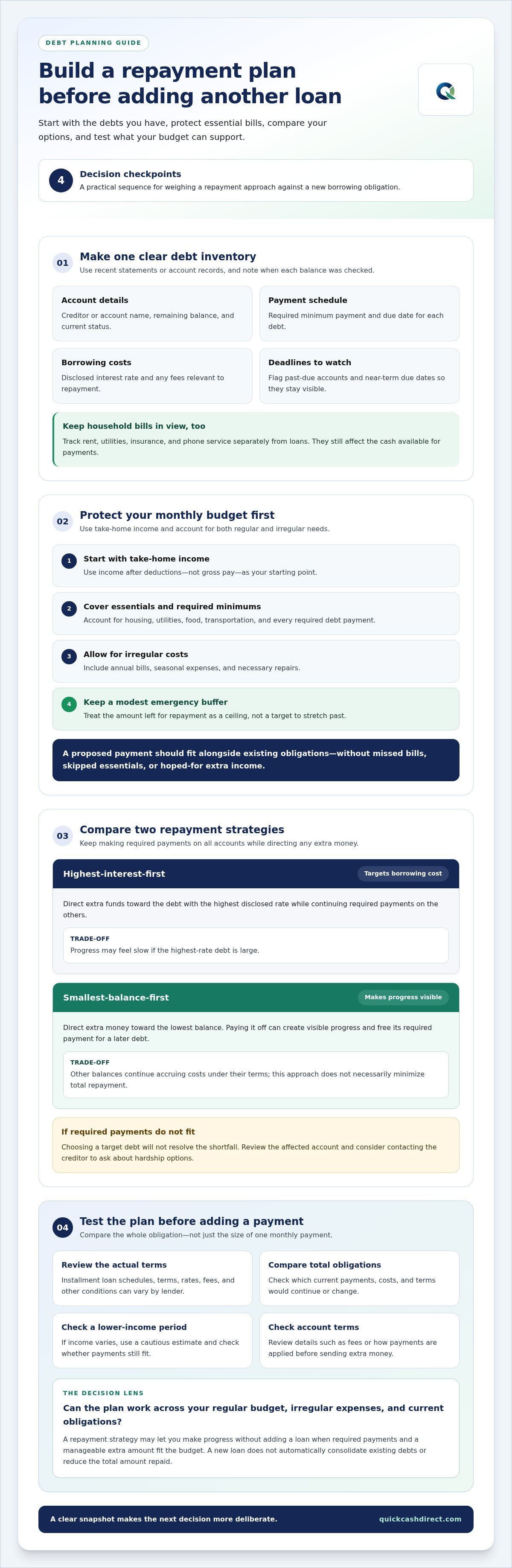
Use this four-step process to make the decision in order:
- List your debts. Record balances, required payments, due dates, disclosed rates or fees, and account status from your account information.
- Protect essential bills. Account for housing, utilities, food, transportation, and other necessary expenses before assigning extra money to debt.
- Compare repayment strategies. Decide how to direct any extra payment after accounting for required minimums and account terms.
- Test affordability. Check whether the plan works across your regular budget, including irregular expenses, before adding a new obligation.
Compare highest-interest-first and smallest-balance-first
Highest-interest-first directs extra funds toward the debt with the highest disclosed rate while you continue making required payments on the others. It targets the costliest balance, but progress may feel slow if that debt is large.
Smallest-balance-first directs extra money toward the lowest balance. Paying it off can create visible progress and free up that required payment for a later debt. However, other balances continue accruing costs under their terms, so this approach doesn’t necessarily minimize total repayment.
Both strategies depend on maintaining required payments across accounts. Before sending extra money, review account terms for details that could affect your plan, such as fees or how payments are applied. If you can’t cover every required payment, choosing a target debt won’t resolve the shortfall. Review the affected account and available next steps.
When a repayment plan may be safer than borrowing
If your budget can cover required payments and a manageable extra amount, a repayment strategy may let you make progress without adding a loan. If cash flow falls short, contact an existing creditor to ask about hardship options. Understanding the options on your current account can help you assess your next move before applying for credit.
Compare total repayment obligations, not just the size of one monthly payment. A lower payment can stretch repayment over a longer term or come with costs that change the total. Compare the full schedule and disclosed fees with the debts you would keep, pay off, or replace. Don’t treat short term installment loans online as automatic consolidation or guaranteed savings. The actual terms and lender decision determine what an offer would mean for your budget.
If borrowing remains an option after this comparison, review online installment loan options as one possibility, not as a substitute for checking affordability. QuickCashDirect connects applicants with a network of lenders; participating lenders make eligibility and loan decisions.
Compare Online Short-Term Installment Loans With Other Debt Options
Compare a new loan with what you already owe, not just with the stress of several due dates. A lower monthly payment may come from extending repayment over a longer term, which can change the total amount paid. Review the full schedule and disclosed costs before deciding whether short term installment loans online fit your situation.
Use statements and written offer terms to complete this comparison. “Total repayment” means the amount you expect to pay over the full schedule, based on the available disclosures.
| Option | Total repayment and fees | Payment schedule and term | If a payment is missed |
|---|---|---|---|
| Continue current repayment | Add the remaining scheduled payments and any disclosed costs under each account’s terms. | Record each payment amount and due date. Terms stay tied to each existing account. | Review each account’s disclosures for possible fees or other consequences. |
| Lender-approved consolidation option | Compare the new offer’s full repayment and fees with the balances and costs it would replace. Include any debts left outside the consolidation. | Check the new payment amount, due dates, and term, plus how the option handles the accounts being consolidated. | Read the new agreement and any terms that still apply to debts not included. |
| Installment loan used toward debt | Review the APR, finance charges, fees, and total repayment disclosed by the lender. Account for existing debts that won’t be paid off. | Compare the payment amount, number of payments, and agreed term with your budget and current due dates. | Check the lender’s disclosed terms for late or missed payments before accepting. |
What to compare in an installment loan offer
Read the full offer, not just the headline payment. Check the APR, finance charges, fees, payment amount, number of payments, and total repayment. Place the proposed due dates beside your other obligations. Lender terms and eligibility can vary, so use the actual disclosures for the offer in front of you. Don’t estimate missing costs or assume every lender uses the same schedule.
Test the payment against your budget after essentials and current required payments. If the offer pays off only some balances, include the remaining payments in your calculation. A smaller monthly amount may feel easier, but a longer term can mean paying for longer. Your comparison should show both the near-term cash-flow effect and the full repayment obligation.
Warning signs that another loan may worsen the debt cycle
Pause if your plan depends on borrowing again to make the next scheduled payment, or if repayment would displace essentials or other required bills. A fast application or smaller payment doesn’t establish affordability. Compare the complete schedule and costs first. If the budget only works when nothing unexpected happens, adding another obligation may leave too little room to manage existing debts.
After weighing the options and checking affordability, you can review online loan options as one possible route. QuickCashDirect connects applicants with a network of lenders; participating lenders determine eligibility, terms, and funding decisions.
Apply for an Online Installment Loan With a Clear Affordability Check
Pause before submitting an application. First update your debt inventory, set the maximum payment your budget can support, and read the lender’s disclosures. This helps you assess short term installment loans online against your real obligations, not just the payment shown in an offer.
Use this pre-application check:
- Update your numbers. Refresh balances, minimum payments, due dates, and account status. Include debts that a proposed loan would not pay off.
- Set a payment limit. Decide what you could pay each month after essential costs and existing required payments, while leaving room for irregular expenses.
- Review the terms. Read the lender’s disclosures and compare the proposed schedule and full repayment obligation with your budget before proceeding.
Check payment fit before submitting an application
Add the proposed loan payment to your current minimums and essential monthly costs. Check that the remaining amount can cover normal variable expenses, too. Then stress-test the plan: Would payments still fit if your income dropped or an unexpected expense came up? If the budget works only under ideal conditions, reconsider. Don’t proceed if you would need another loan to make a scheduled payment.
Keep the payment limit realistic. Don’t use money assigned to rent, utilities, food, transportation, or other required obligations to make a new loan seem affordable. A payment that fits on paper but forces you to delay another bill can create a new problem rather than resolve one.
Read the lender’s disclosures and protect your information
Review who the lender is and read the offer’s APR, fees, repayment schedule, late-payment terms, and privacy disclosures. Confirm the number and timing of payments, the total repayment amount, and what the lender says may happen if a payment is late or missed. Review the lender’s disclosures for state availability and application details. Terms and eligibility can vary.
A lender may request details to assess an application, such as identity, income, employment, and bank-account information. Requests depend on the lender and application. Use the lender’s stated secure application process. Don’t send sensitive details through unsolicited emails, texts, or calls. If an unexpected message asks for personal or financial information, pause and access the application through a channel you know is legitimate.
Approval and funding depend on lender review, applicable law, and individual circumstances. Submitting an application doesn’t guarantee approval, particular terms, or funding. QuickCashDirect connects applicants with a network of lenders; participating lenders make eligibility, terms, and funding decisions.
Once your affordability check is complete, review online installment loan options with the disclosures in hand. Compare any offer with your payment limit before deciding whether to proceed.
How QuickCashDirect Connects Borrowers With Online Lenders
QuickCashDirect is an online referral service, not a direct lender. It connects applicants with a network of lenders and short-term financial options, including installment loans. QuickCashDirect provides the connection, while participating lenders decide whether to approve an application and what terms, if any, to offer.
Products, eligibility requirements, and availability can vary by lender and applicable state law. Applying for short term installment loans online through a referral platform doesn’t guarantee a lender will make an offer, approve an application, or provide funding. Review each lender’s disclosures for its specific terms and process.
What happens after you submit information
After you submit information through the referral process, QuickCashDirect connects you with participating lenders. A lender may review the information and determine whether to present its own offer. The lender, not the referral platform, decides eligibility, approval, loan terms, and funding.
If you receive an offer, pause before accepting. Read the lender’s disclosures and check the details that affect your budget:
- The lender’s identity and eligibility requirements
- APR, fees, payment amount, number of payments, and total repayment
- Payment dates, loan term, and disclosed consequences of late or missed payments
- Any privacy information explaining how application details are handled
Compare those terms with your current repayment plan. Don’t assume an offer will pay off every debt or lower your total costs. The disclosures show what that particular lender is offering.
Make the next decision with your full debt picture
Return to your budget and debt inventory before accepting a loan. Add the proposed payment to existing obligations and essential costs. Then compare the offer’s total repayment with what you would pay by continuing your current plan. Include any debts the loan wouldn’t replace, since those payments would remain due.
Make a decision only when you understand the payment schedule and full amount owed, and the payment appears manageable within your budget. If the offer leaves too little for essentials, depends on future borrowing, or has terms you can’t explain clearly, pause. You can decline to proceed while reassessing the alternatives.
For a clearer view of the referral process, explore online loan options. Review any lender offer carefully and decide based on its disclosed terms and your complete financial picture.
Choose a Next Step You Can Sustain
Choose a next step you can maintain, not one that only eases this month’s pressure. Before acting, decide what you need the payment to accomplish and what monthly amount leaves room for essentials and changing expenses. If the numbers don’t work without relying on another loan, pause and revisit your plan. A careful delay can protect your options and give you time to make a sound choice.
If you’re considering short term installment loans online, use the lender’s written disclosures to judge whether the repayment schedule fits your current budget. QuickCashDirect connects applicants with a network of lenders as a referral service, not a direct lender. Participating lenders set eligibility and terms, so review any offer on its own details and don’t treat an application as a promise of approval or funding.
When you’re ready to explore a possible option, Explore online loan options. Move forward only when the payment is clear, manageable, and grounded in your full financial picture.
Frequently Asked Questions
Is a short-term installment loan online a good way to consolidate multiple debts?
It depends on the specific offer and your full budget. Compare the loan’s APR, fees, payment dates, and total repayment with the costs of the debts it would pay off and any accounts you’d still owe. Replacing several due dates with one may simplify scheduling, but it doesn’t prove the loan costs less. Avoid borrowing if you’d need another loan to make future payments.
Can applying for an online installment loan affect my credit?
It may, depending on the lender and application stage. Some lenders may use a soft inquiry for an initial review, while a formal application may involve a hard inquiry. Check the lender’s disclosures before applying, including information about credit reporting and credit checks. Don’t assume an inquiry, an offer, or later payment activity affects your credit the same way with every lender.
What happens if I miss an installment loan payment?
The consequences depend on your agreement and applicable law. A missed payment may lead to fees, additional interest, collection activity, or credit reporting, but the exact outcome varies. Review the late-payment section of your loan disclosures so you know what applies. If you expect to miss a due date, contact the lender promptly to ask about available options. Don’t assume taking another loan will safely resolve the missed payment.
Can a lender approve me if I already have several loans?
A lender may consider existing debt, income, account information, and other eligibility factors. Having several loans doesn’t automatically mean you’ll be approved or rejected. The lender makes that decision and sets any offered terms. Before applying, consider whether you could still cover a new payment alongside current obligations if an expense arrived earlier than expected. This practical check can help you judge affordability, regardless of the lender’s decision.
Are short-term installment loans online available in every state?
No single answer applies to every lender or loan product. Availability, eligibility requirements, and terms can vary with the borrower’s state and applicable law. Review the current disclosures for the specific lender and offer rather than relying on a general online claim. QuickCashDirect is a referral service that connects applicants with participating lenders; those lenders determine which products they may offer in each location.
Can I pay off an installment loan early?
That depends on your loan agreement and applicable law. Review the disclosures for early-payment rules, any applicable fees, and how additional payments are applied. Before sending extra money, use the lender’s stated process to get a current payoff amount. Then consider whether paying early would leave enough for essential expenses and required payments on other debts. Don’t assume an extra payment automatically reduces costs in a particular way.
Should I use a new loan to make payments on my existing loans?
Usually, treat this as a warning sign, not a dependable repayment plan. A new loan can add debt and another due date without resolving the underlying budget shortfall. Before considering short term installment loans online for this purpose, compare the full repayment terms with your income, essentials, and current obligations. If the plan depends on borrowing again or would leave required bills unpaid, pause and review other next steps.