
A full calendar of client work doesn’t always make a loan application straightforward. Proving income as a freelancer for a loan means showing more than strong gross revenue: lenders may also review tax returns, business records, and bank deposits to understand what you earn.
That can be challenging when payments vary from month to month, clients pay late, or deductible expenses reduce the income shown on your tax return. The goal is to present records that tell one clear, consistent story without overstating your earnings.
This guide explains which documents to gather, what lenders may review, and how to organize your income information before applying. You’ll also learn why taxable income can differ from business revenue and how to handle missing paperwork or records that don’t match. Preparing a clear packet can make it easier to respond to document requests and reduce avoidable delays.
Key Takeaways
- Proving income as a freelancer for a loan means showing the amount, source, and consistency of your earnings with records that support one another.
- Gather relevant tax returns, bank statements, client payment records, and any other documents requested for your application.
- Match the document period to the instructions, then organize and review your records for gaps or inconsistencies.
- Variable income doesn’t automatically make you ineligible; lenders may assess your income history and other application information.
- Submit accurate information and requested records. QuickCashDirect connects applicants with lenders, and each lender makes its own decisions.
Proof of Income for Freelance Loan Applications
Income verification is the evidence a lender uses to understand how much you earn, where the money comes from, and whether your earnings show a consistent pattern. Freelance income may come from contract fees, project payments, retainers, or recurring client work. Your records should make these sources easy to identify and reconcile.
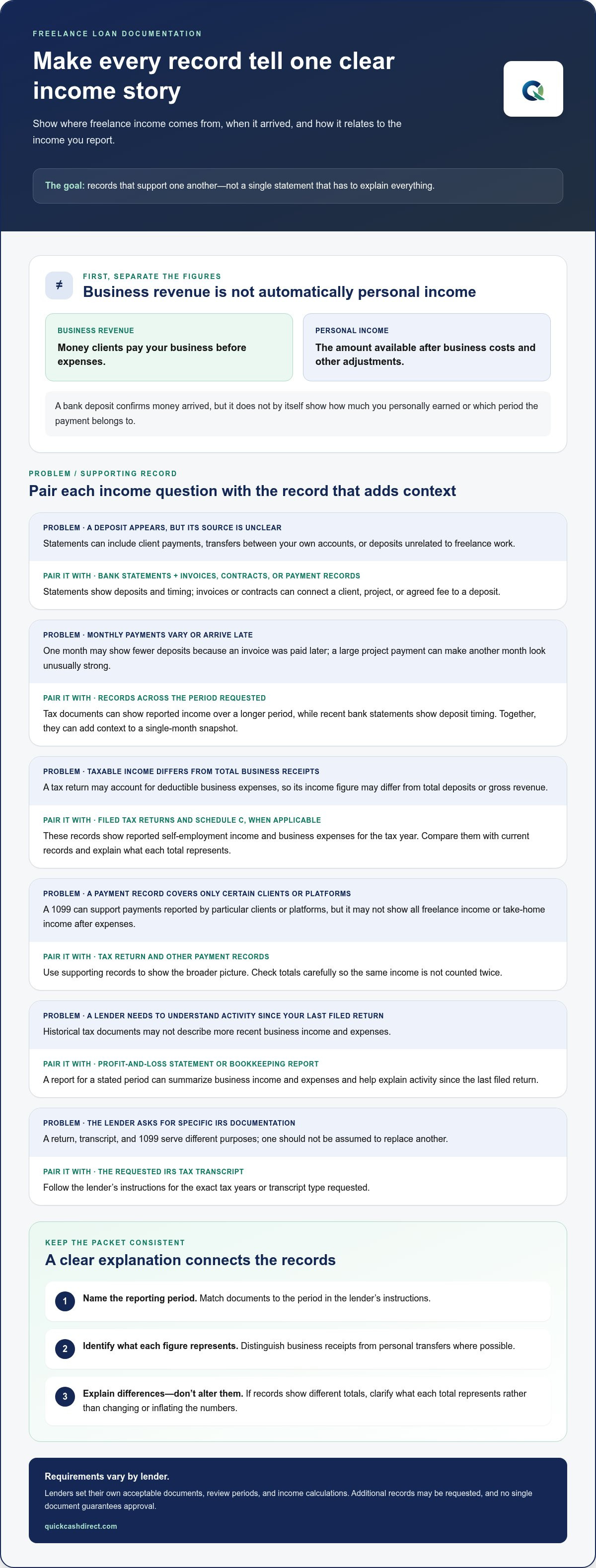
Business revenue is the money clients pay your business before expenses; personal income is the amount available to you after business costs and other adjustments. This distinction matters. A bank deposit shows that money arrived, but it doesn’t automatically show how much you earned personally or which period the payment belongs to.
Freelance work takes different forms and generates income in different ways. The Freelancer Wikipedia article offers broader background on freelance work and compensation, but loan documentation focuses on your own records. Lenders set their own acceptable documents, review periods, and income calculations. Don’t assume one lender’s requirements apply to another, or that one document will be enough on its own.
Why freelancers may need more than one income record
Client payments don’t always arrive on a predictable schedule. A statement covering one month may show fewer deposits because an invoice was paid later, while a large project payment can make another month look unusually strong. A single snapshot may not represent your overall earnings.
Use records that add context. Tax documents can show reported income over a longer period, while recent bank statements show deposits and payment timing. Contracts, invoices, or client payment records can help explain the source of specific deposits if requested. Together, these records can clarify the difference between a slow payment month and a longer-term change in income. No single document guarantees approval; the lender reviews the information under its own criteria.
Gross revenue, business expenses, and reported income
Start by separating what clients paid from what remained after business costs. Gross revenue is the total collected or earned from freelance work before expenses. Business expenses are costs tied to operating that work. Reported income on a tax return may therefore differ from the total deposits shown in your account.
For example, a bank statement may include client payments, transfers between your own accounts, or deposits unrelated to freelance work. A tax return may account for deductible business expenses and report a different income figure. Don’t label every deposit as earnings, and don’t present gross revenue as take-home income. If a lender requests a particular figure, provide the figure that matches the request and its supporting record.
Keep your explanation direct. Identify the reporting period, distinguish business receipts from personal transfers where possible, and make sure the figures you provide agree with your documents. If two records show different totals, explain what each total represents rather than changing or inflating the numbers. Clear, accurate records give the lender a more dependable picture of your freelance income.
Which documents can prove freelance income to a lender?
No single record tells the whole story. Use documents that show how clients pay you and how you report freelance earnings. The list below can help you match each record to the information it supports. Treat it as a preparation guide, not a fixed lender checklist. Lenders set their own document requirements and review periods, and may request additional records.
- Personal or business bank statements: Show deposits, payment dates, and patterns over the period requested. Business statements can make client receipts easier to distinguish from personal transactions.
- Filed tax returns and Schedule C: Show reported self-employment income and business expenses for the tax year. Compare them with current records to explain differences in totals or timing.
- 1099 forms: Support payments reported by particular clients or platforms. They don’t necessarily show all freelance income or your take-home amount after expenses.
- Invoices, contracts, and payment records: Connect a client, project, or agreed fee with a payment shown in your statements.
- Profit-and-loss statements or bookkeeping reports: Summarize business income and expenses for a stated period, helping explain activity since your last filed return.
- IRS tax transcripts: Provide tax-return information when a lender specifically requests a transcript.
Tax returns, 1099 forms, and tax transcripts
Filed returns provide a historical view of what you reported, including eligible business expenses. Schedule C, when applicable, can help show how business income and costs contribute to the return. The IRS Self-Employed Individuals Tax Center explains tax reporting for self-employed people. A 1099 is a supporting record for certain payments, not a complete calculation of personal income. Don’t add 1099 totals to a return without checking whether that would count the same income twice.
Provide an IRS transcript when requested, and follow the instructions for the exact tax years or transcript type. A transcript, return, or 1099 can support an application, but none guarantees a particular lending decision.
Bank statements, invoices, and bookkeeping records
Recent statements can show when deposits arrived, while invoices and contracts can help identify the client or work behind them. For example, if an invoice and deposit match in amount and timing, together they can connect a payment to a specific project. A profit-and-loss statement can summarize the broader business picture, including costs.
Keep names, dates, amounts, and reporting periods consistent across records. Don’t alter documents to make totals appear stronger. Redact unrelated sensitive details only if the lender’s instructions allow it; otherwise, submit records as requested and use the lender’s secure submission process.
Once you’ve identified the records you can provide, you can submit information through QuickCashDirect’s lender referral platform for potential consideration. QuickCashDirect connects applicants with a network of lenders. Each participating lender sets its own requirements and makes its own decision.
How to assemble a clear freelance-income document packet
A well-organized packet helps a lender review your income without having to guess what each file shows. Follow the lender’s instructions first. Applications can use different document lists and review periods. Keep your packet accurate and easy to scan, and make sure every income figure you state can be traced to a supporting record.
- Read the requirements. Note which documents the lender requests, the dates the records must cover, and how to submit them. Identify any instruction you don’t understand before preparing files.
- Select matching records. Choose documents that cover the requested period and support the income sources you report. If a record doesn’t cover the full period, don’t present it as if it does.
- Organize the files. Group related records together and label each file by document type and date. For example, use “Bank statement, March to May” or “Tax return, tax year” rather than a vague name like “income papers.”
- Review before sending. Check that files open, pages are legible, and names, dates, and figures are consistent. Keep a copy of the packet and note what you submitted.
Choose records that match the lender’s request
Build your packet from the lender’s stated list, not from a generic checklist. Match the requested time frame to the records you select. If the lender asks for a specific period, don’t substitute a different one because it’s easier to gather. Use original, readable statements and tax documents. Don’t edit financial records, remove pages, or change figures. If you need to clarify a record, add a separate factual note instead of altering the file.
Keep the packet focused. Include documents that support the income sources you listed, such as client payments or recurring contract work. Avoid adding unrelated files that make the reviewer search for relevant information. If the lender later requests another record or period, respond to that specific request rather than assuming your initial packet must cover every possible requirement.
Check dates, names, and income figures before submitting
Compare the income you report with the documents that support it. A deposit may appear after the invoice date because a client paid late, or a tax record may cover a different period than a bank statement. Those differences can have ordinary explanations. Prepare a short, factual note that identifies the dates and records involved. Keep it specific, and don’t use estimates to fill gaps.
Check that your name and any relevant account details are visible and consistent. Make sure each document’s date range can be read. Redact information only if the lender’s instructions allow it; otherwise, preserve the original record and follow the requested submission process.
Use this final test: every stated income figure should have traceable supporting records. That simple check can make proving income as a freelancer for a loan clearer and reduce avoidable follow-up caused by mismatched dates, unclear labels, or unsupported totals.
Managing Irregular Freelance Income or Missing Docs
Uneven earnings don’t automatically make you ineligible for a loan. Lenders may assess freelance income differently, using the records and review period that fit their process. They may also consider income history and other application information rather than relying on a single deposit. The best next step is to explain what your documents show clearly, not to make irregular earnings look fixed or guaranteed.
If a record is missing, other documents may help provide context. A current bookkeeping summary, invoices, contracts, or client payment records can support the picture of your income. Whether a lender accepts a substitute depends on its requirements. Use the documents that meet the application instructions, and submit only accurate records you can support.
How to explain seasonal or changing earnings
Describe the change plainly and use dated records. For example, if project work slows between busy seasons, show the relevant contracts, invoices, and payment deposits that document the timing. A short note can identify the period covered and explain why payments arrived unevenly. Keep it factual. Don’t present expected contract work, unpaid invoices, or income projections as money you’ve already received.
Use the same dates and figures across your explanation and supporting records. If a client paid after the work was completed, connect the invoice date to the deposit date where possible. This helps distinguish a timing difference from income that hasn’t been earned or paid.
How to handle missing tax forms or incomplete records
Start with the source of the missing document. If a client-issued tax form hasn’t arrived, contact the issuer to request a copy. If you need a tax record, use official records or follow the relevant agency’s process. For incomplete bookkeeping, gather available invoices, contracts, deposit records, and a current summary that clearly states its dates and basis.
Use substitute documentation only when it fits the lender’s requirements. Requirements vary, so don’t assume an invoice or bookkeeping report can replace a requested tax document. Never edit a statement or form to fill a gap. Don’t report an income figure you can’t substantiate. If a requested record is unavailable, state that plainly and follow the instructions for your application.
For proving income as a freelancer for a loan, consistency matters more than trying to make every month look the same. Share the documents you have, explain gaps without speculation, and follow the application instructions. QuickCashDirect connects applicants with a network of lenders for potential consideration; each lender sets its own requirements and makes its own decision. Explore available loan options.
How to submit freelance income information with a loan application
Submit your information in a clear sequence. Keep your income details consistent with the records you’ve prepared, and read each lender’s instructions before uploading anything. A complete application can make review more straightforward, but it doesn’t guarantee approval or funding.
- Review the application and disclosures. Understand what information the application requests and which documents you’ll need. Read the lender’s terms carefully before accepting any offer.
- Complete each field accurately. Use figures that match your supporting records. Don’t count projected payments as income already received or describe gross revenue as take-home income.
- Upload the requested records. Follow file, format, and submission instructions. Check that each document is readable and covers the period requested.
- Monitor for updates. Watch for messages or requests for clarification. If the lender asks for another record, respond with accurate information and follow its instructions.
Clear details matter when proving income as a freelancer for a loan. If a figure needs context, explain it briefly and factually rather than changing a document or guessing at a total.
What to review before accepting a loan offer
Before you agree, check the total repayment obligation, payment schedule, fees, due dates, and what the lender’s disclosures say about missed payments. Compare the required payments with your budget and expected cash flow, including periods when client work may be slower. Don’t focus only on how quickly an application is processed. Fast processing, an application referral, or a lender response is not approval or a guarantee of funding.
Take time to understand the full cost and timing of repayment. If any term is unclear, get an explanation before accepting. A payment that fits during a strong earnings month may be harder to manage during a quiet period, so assess the schedule against your real cash flow.
How QuickCashDirect fits into the application process
QuickCashDirect is a referral service that connects applicants with a network of lenders. It isn’t a direct lender. Applicants can submit information for potential consideration, while participating lenders set their own requirements and make their own decisions. Document preferences, application steps, and timing can vary by lender, so follow the instructions and disclosures presented for your application.
If you’re also comparing online options, the guide Easy Loans for Bad Credit: Your Guide to Fast Online Funding in 2026 provides related context. Keep your expectations grounded: submitting an application through a referral platform doesn’t mean a lender will approve it or provide funds.
After reviewing your records and the terms to consider, explore loan options through QuickCashDirect for potential lender consideration.
Take the Next Step With a Clear Plan
Before moving forward, decide what amount, payment schedule, and repayment commitment fit your finances, including months when freelance work may be lighter. Keep that limit in mind as you review any response or offer. A loan should address a need without creating a repayment strain you can’t manage.
QuickCashDirect connects applicants with a network of lenders for potential consideration. QuickCashDirect is a referral service, not a direct lender, and each lender makes its own decision. Submitting information doesn’t guarantee an offer or approval.
Explore loan options through QuickCashDirect when you’re ready to take the next step. Clear records and a realistic repayment plan can make proving income as a freelancer for a loan more manageable. Move forward carefully and confidently.
Frequently Asked Questions
What documents can freelancers use to prove income for a loan?
Freelancers can use tax returns, relevant 1099 forms, bank statements, invoices, contracts, and bookkeeping summaries, depending on the lender’s requirements. Choose records that support the same income story. For example, a signed contract can show the agreed work, an invoice can show what you billed, and a deposit record can show when a payment arrived. Submit documents that apply to your work and the period requested.
Can I get a loan as a freelancer without pay stubs?
A lender may consider other records because freelancers often don’t receive employee pay stubs. Options may include tax documents, statements showing business deposits, client contracts, or a bookkeeping report. Requirements vary by lender, so a substitute record isn’t guaranteed to meet its needs. Before applying, identify how you’ll document your income if you don’t have pay stubs, and keep the figures consistent across your application.
How many months of bank statements do lenders require from freelancers?
There’s no single statement period that applies to every loan application. A lender may request a specific number of months based on its process and the type of review. Don’t send an assumed standard period if the instructions specify something different. Check the requested start and end dates, and make sure the statements cover them in full. If a statement is unavailable, follow the application instructions for required records.
Do 1099 forms count as proof of income for a loan?
Yes, 1099 forms can support a loan application by documenting certain payments made to you. They may not show every client payment or reflect business expenses, so lenders may consider them alongside other records. For example, if a client’s 1099 amount differs from your records, check whether the payment period or reporting details explain the difference. Don’t treat a 1099 total as your take-home income without accounting for relevant costs.
Can I use bank deposits to prove freelance income?
Yes, deposits can help show that money reached your account, but not every deposit is freelance earnings. A transfer between your own accounts, a refund, or a personal deposit could be mistaken for client income if it isn’t identified. Keep transaction details available and connect work-related deposits to invoices or client records where possible. Follow the lender’s instructions about which accounts and statement periods to provide.
What happens if my freelance income changes from month to month?
Changing income doesn’t automatically rule out an application. A lender may assess your income using its own method and consider the broader information in your application, rather than relying on one unusually high or low month. Be prepared to distinguish a one-off project payment from recurring work. Report what you actually earned, and avoid presenting a strong month as if it were your typical monthly income.
Can I apply for a loan if I have not filed a tax return yet?
You may be able to submit an application, but a lender may require filed returns or other records to evaluate self-employment income. If a return isn’t available, the lender’s application instructions will determine which alternatives may be considered, such as current bookkeeping or client payment records. Don’t describe an unfiled return as filed or guess at figures. Tax filing questions are separate from loan eligibility, so consult official tax guidance or a qualified tax professional if needed.