
What if the loan that looks easiest to get is the hardest to repay? If past credit problems have you searching for loans for people with poor financial history, remember that a low credit score doesn’t tell the whole story. Some lenders may consider information beyond your score, but requirements and offers vary.
It’s understandable to want money quickly when a bill can’t wait. Before you apply, focus on whether the repayment plan fits your budget, not just whether you might qualify. Compare the APR, fees, total amount due, payment dates, and what happens if you can’t pay on time. A payday loan may be due in one lump sum within weeks, while an installment loan is repaid over a series of payments. Those schedules can affect your budget in very different ways.
This guide explains options that may suit different circumstances, terms to check, and warning signs of unaffordable debt. You’ll also learn what to verify about lender requirements and availability where you live before submitting an application. QuickCashDirect is a referral service, not a direct lender. A potential lender match doesn’t guarantee approval or funding. Compare any offer with your budget and other available options before deciding.
Key Takeaways
- “Poor financial history” can describe different situations, from negative credit report items to a thin file or changing income. Identify what applies to you before comparing offers.
- Compare loans for people with poor financial history by how repayment fits your budget, not by approval language alone.
- Check the full repayment obligation, payment frequency, and late-payment terms to spot costs or timing that may strain your finances.
- Use a pre-application checklist: confirm your need, set a repayment limit, compare terms, and verify lender requirements.
- Tribal lending can involve distinct lender and legal considerations. Review the specific offer and its availability where you live before deciding.
What Loans for People with Poor Financial History Can Mean
“Poor financial history” is a broad description of past or current financial circumstances, not a standardized lender decision or a guarantee that an applicant will qualify for a loan. It can refer to a low credit score, late or missed payments on a credit report, a limited credit record, changing income, or existing debt that affects repayment capacity. These factors can occur separately or together.
The phrase may overlap with subprime lending, but lenders set their own criteria and may assess different parts of an application. Loans for people with poor financial history aren’t one uniform category with shared approval rules. Check each lender’s requirements and offer rather than assuming a label predicts the outcome.
Which financial-history factors may matter to a lender?
Lenders may review payment history and reported debts when assessing an application. They may also consider income and whether the proposed payments appear manageable based on the information provided. Criteria differ, and lenders don’t all weigh each factor the same way.
A past setback can matter, but it doesn’t determine the terms or outcome of a future application on its own. For example, a late payment is only one part of a broader financial picture. A lender’s decision may also depend on other details it requests and how those details fit its criteria.
Is poor credit the same as no credit history?
No. Poor credit usually means a credit record contains negative information, such as missed payments. No credit history, or a thin file, means there’s limited information available for a lender to review. A person with little credit history may not have the same record as someone with missed payments, but that doesn’t guarantee approval or particular terms.
In the United States, Equifax, Experian, and TransUnion are the three major credit-reporting entities. Before applying, check your reports for accuracy through AnnualCreditReport.com. Look for unfamiliar accounts, incorrect balances, or payment details you believe are wrong. Reviewing your reports can help you understand what lenders may see and identify information to question before you submit an application.
Compare Loan Options for Poor Financial History by Repayment Fit
Start with the payment schedule, not the product label. Payday loans, cash advances, and installment options can differ in when repayment is due and how payments are collected. The lender’s written offer controls the details. Review the legal definition of a subprime loan for context, but don’t treat a label as a guarantee of approval, eligibility, or a particular cost.
How do payday loans, cash advances, and installment options differ?
A payday loan is generally due in a lump sum within weeks. An installment option generally spreads repayment across scheduled payments. “Cash advance” can describe different arrangements, so check exactly what the lender means. Labels alone don’t show the full cost or eligibility requirements. Read the written disclosures for payment dates, total repayment, fees, and terms for late or missed payments.
| Option | Repayment structure to check | Verify with the lender |
|---|---|---|
| Payday loan | Whether repayment is due as a lump sum and when | Total amount due, fees, payment date, and late-payment terms |
| Cash advance | How the advance is repaid and whether payments repeat | What the lender means by “cash advance,” full cost, and due dates |
| Installment option | Number and timing of scheduled payments | Total repayment, fees, payment frequency, and missed-payment terms |
| Tribal lending | Specific schedule stated in the offer | Lender identity, applicable terms, and availability where you live |
Tribal lending can involve distinct lender and legal considerations. Don’t assume the same rules or terms apply to every lender. Verify the specific lender, offer, and applicable availability where you live before proceeding. For more detail on one option, read this payday loans guide.
When should you consider alternatives to borrowing?
Before taking on debt, ask the biller whether it offers a payment plan, a due-date change, or a hardship arrangement. You could also research employer advances or nonprofit credit counseling, but availability and requirements vary. Compare the timing and conditions of each alternative, then check how it fits your household budget. A delay or different payment arrangement may be less disruptive than adding a new repayment obligation.
For loans for people with poor financial history, repayment fit matters more than a quick approval claim. QuickCashDirect is one referral service that connects applicants with a lender network, not a direct lender. Its potential short-term loan matches are not guaranteed, and availability may vary. Review any offer against your budget before deciding. You can explore available loan options to see what may be available.
Look Beyond Approval Claims: Check the Full Cost and Risks
A weak credit profile doesn’t guarantee approval, and approval doesn’t mean a loan fits your budget. For loans for people with poor financial history, compare the full written offer, not only the advertised speed or approval language. Check the APR, which expresses the yearly cost of credit and can include interest and certain fees. Then confirm the total repayment amount, payment frequency, due dates, and charges that may apply if you pay late or miss a payment.
Test the schedule against your real expenses before accepting. Set each proposed payment beside rent or mortgage costs, utilities, food, transport, and existing debt payments. If the payment leaves too little for essentials, depends on borrowing again, or could cause you to miss another bill, the offer may not be manageable. Experian’s How to Get a Loan With Bad Credit offers additional general guidance on comparing borrowing options.
What should you verify in a loan offer?
Confirm the lender’s identity and review all disclosures before agreeing. Match the stated amount, APR, fees, payment dates, total repayment, and late-payment terms against the offer you received. Check whether payments use ACH, an electronic transfer from your bank account, and read what you’re authorizing, including the payment amount and timing. Verify current lender availability and applicable requirements where you live. Terms and access can vary.
How can you spot pressure tactics or misleading promises?
Pause if someone promises guaranteed approval or pressures you to act before you can review the terms. Treat a request to pay upfront to secure a loan as a warning sign to investigate carefully. Don’t share sensitive information until you can identify the lender and review the offer in writing. General consumer guidance is available from the Consumer Financial Protection Bureau and the Federal Trade Commission. These resources don’t endorse a lender or specific offer.
Before you commit, evaluate the complete written offer, not just the advertised speed or approval language. Confirm that the payment schedule works alongside your essential bills and existing obligations. If a key term is missing or unclear, ask the lender for an explanation before proceeding.
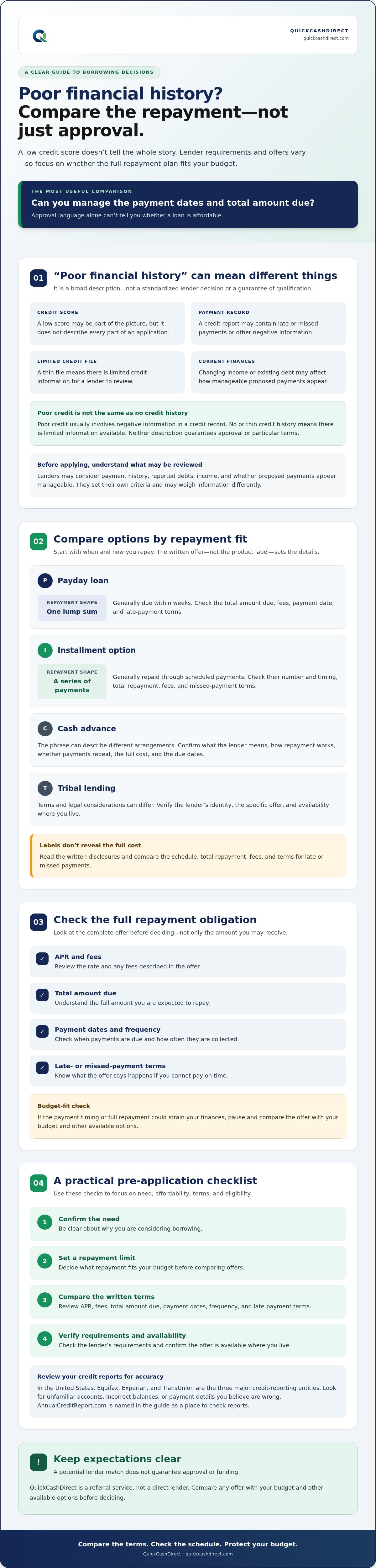
Use This Checklist Before Applying for a Loan
Take these steps before submitting an application for loans for people with poor financial history. A short review can help you avoid sharing information too soon or agreeing to payments that don’t fit your budget.
- Assess the need. Confirm what the money must cover and whether you can address the expense another way.
- Set a repayment limit. Use your take-home income, essential bills, and existing debt payments to decide what you can realistically repay.
- Compare offers. Review the APR, fees, payment schedule, total repayment, and late-payment terms in writing.
- Verify the lender. Confirm who would make the loan, review the disclosures, and check lender availability and applicable requirements where you live.
- Decide without pressure. Apply only if the terms are clear and the repayment plan fits your budget.
How can you set a safe repayment limit?
Start with take-home income. Subtract essentials such as housing, utilities, food, transportation, and existing debt payments. Then test the proposed loan payment against your budget for every scheduled due date, not just the first one. If repayment depends on taking another loan or skipping an essential bill, pause and explore alternatives before applying.
What should you prepare before submitting an application?
Requirements vary by lender. First, check your credit reports for errors and review the lender’s stated application requirements. Prepare accurate personal, income, banking, or identity details only if the lender requests them. Before sharing information, read the privacy notice and consent language so you understand what you’re authorizing and with whom your information may be shared. Save the lender’s disclosures and contact details to review before accepting an offer.
For related guidance on how credit information may factor into borrowing, read this loans for bad credit guide.
QuickCashDirect connects applicants with a lender network and doesn’t lend directly. A potential match doesn’t guarantee approval or funding, and any offer should be reviewed carefully before deciding. Review potential loan options to explore possible matches.
Explore Potential Loan Matches Through QuickCashDirect
QuickCashDirect is a referral service, not a direct lender. It connects applicants with a network of lenders offering short-term options, which may include payday loans, cash advances, tribal loans, and installment options. A referral can help you explore potential matches, but it doesn’t guarantee that a lender will make an offer, approve an application, or provide funding. Participating lenders and options may vary by state.
What happens after you use a loan referral platform?
Information you submit may be used to identify potential lender matches, subject to the disclosures and consent you provide. A lender that receives a referral may ask for additional information or present its own offer. The lender sets its eligibility criteria, checks, terms, approval decision, and any funding timeline. Read the platform’s notices before submitting details, then review the lender’s complete written offer before deciding whether to proceed.
Lenders can use different criteria and checks. A “no credit check” label doesn’t tell you by itself what information a lender will review or what terms it may offer. See this no credit check loans guide for more context, and verify the specific lender’s requirements directly in its disclosures.
How do you make a careful final decision?
Compare the written offer with the budget and alternatives you considered earlier. Check the lender’s identity, repayment dates, total repayment, applicable fees, and late-payment terms. Make sure the scheduled payments leave room for essential expenses and existing obligations. If the lender identity, cost, or payment schedule is unclear, don’t proceed until you have clear answers. You can decline an offer that doesn’t fit.
Loans for people with poor financial history can differ by lender, so focus on the actual offer rather than assuming a referral means approval or affordable terms. Take time to read every disclosure, confirm that the lender and option are available where you live, and choose only if the repayment plan works for you.
QuickCashDirect offers a way to explore potential lender matches, but exploring options does not guarantee approval or funding. Any offer still needs to be compared with your budget before you decide.
Choose the Option That Fits Your Budget
Past financial problems don’t automatically rule out every option, but they don’t guarantee approval either. For loans for people with poor financial history, compare the full written terms, including total repayment, payment dates, fees, and late-payment conditions. Then test each payment against your essential bills and existing obligations. If the schedule doesn’t fit, pause and consider alternatives.
QuickCashDirect connects applicants with a network of lenders. It isn’t a direct lender. The platform lists short-term options, including payday loans, cash advances, tribal loans, and installment options. Lenders set their own eligibility criteria, terms, approval decisions, and funding timelines. A potential match isn’t a promise of approval or funding, so review the lender’s disclosures and confirm availability where you live.
Ready to compare possible matches? Review potential loan options through QuickCashDirect, then decide only if a lender’s terms are clear and the repayment plan works for you. A careful choice can help you address a pressing need without losing sight of your financial stability.
Frequently Asked Questions
Can I get a loan with a poor financial history?
Possibly, but no lender or referral service can guarantee approval for every applicant. Lenders set their own eligibility rules and may consider income, existing obligations, credit information, and other application details. Before applying, confirm the lender and offer are available to you. Review the written repayment terms and compare each payment with your budget. Don’t borrow if repayment could put essential bills at risk.
What loan options may be available to people with poor financial history?
Options may include payday loans, cash advances, or installment loans, depending on lender criteria and availability. These products can differ in payment schedule, fees, and total amount due. Compare the full written terms rather than relying on a product label. Before taking on new debt, consider asking creditors about payment arrangements or researching alternatives. Check that any option fits your household budget before proceeding.
Do loans for people with poor financial history require a credit check?
Requirements vary by lender and product. Some providers may review credit information, while others may consider additional application details or use different assessment methods. An advertised “no credit check” option doesn’t necessarily mean there’s no eligibility review, cost, or approval requirement. Read the lender’s disclosures and privacy terms before applying. They should explain what information may be requested and how it may be used.
How can I compare loan offers if my credit history is poor?
Compare the total repayment obligation, APR and fees, payment amounts and dates, late-payment terms, and lender identity. Then check whether each payment fits your budget after essential expenses and current debt payments. Ask whether the terms are fixed or depend on conditions. A clear written offer gives you more useful information than an advertised speed or approval claim. Don’t accept terms you can’t understand or afford.
Are loans for people with poor financial history guaranteed?
No. Approval, loan terms, and funding depend on the individual lender and its requirements. A referral platform may connect applicants with potential lenders, but it doesn’t decide whether an application is approved. Treat guaranteed-approval language cautiously. Verify the lender and review all disclosures before sharing sensitive information or accepting an offer. If a key term is unclear, ask for an explanation before you decide.
What should I check before accepting an online loan offer?
Verify the lender’s name and contact information, then review the complete written terms. Check the APR, fees, repayment dates, late-payment consequences, payment authorization, and any conditions that could change the offer. Read the privacy and consent disclosures before submitting sensitive information. Confirm the payment schedule works with your budget. If a term is unclear or the payment could strain your finances, pause and seek clarification.
Can a loan referral service guarantee that I will receive funds today?
No. A referral service can connect an applicant with potential lenders, but it can’t guarantee approval or funding time. Each lender controls its review, decision, and disbursement process, and timing may depend on lender procedures and other factors. QuickCashDirect connects applicants with a lender network; it isn’t a direct lender. Verify any timing claim in the lender’s disclosures before relying on funds for an urgent bill.