
Past-due bills don’t automatically rule out an emergency loan. Lenders usually assess your income, existing debt, and ability to repay, and most prefer a debt-to-income ratio below 40% to 50%. Loans for people with past due bills may still be an option when you can show how you’ll manage the payments.
It’s stressful to face a bill that’s already late while an urgent expense is still waiting. Focus first on what lenders may consider and what information can help you apply.
This guide covers common qualification factors, application details, funding methods, and options that may help with overdue bills or emergency costs. You’ll also learn how to compare repayment terms with your budget before deciding whether to borrow.
Key Takeaways
- Review your income, existing debts, and repayment capacity before applying for emergency funds.
- Prepare identification, income details, and bank information to make the application process more straightforward.
- Compare debit card, direct deposit, and check delivery to understand how loan funds may reach you.
- Explore how credit checks and different loan options can affect your choices when bills are overdue.
- Match the loan amount and repayment schedule to the bills you need to cover and your budget.
How do I qualify for an emergency loan, and what do I need to apply?
Lenders may review income, existing debts, credit history, and whether the payments fit your budget. Before choosing an amount, compare the APR, total repayment, payment schedule, and funding method.
Approval with Past-Due Bills or Collections
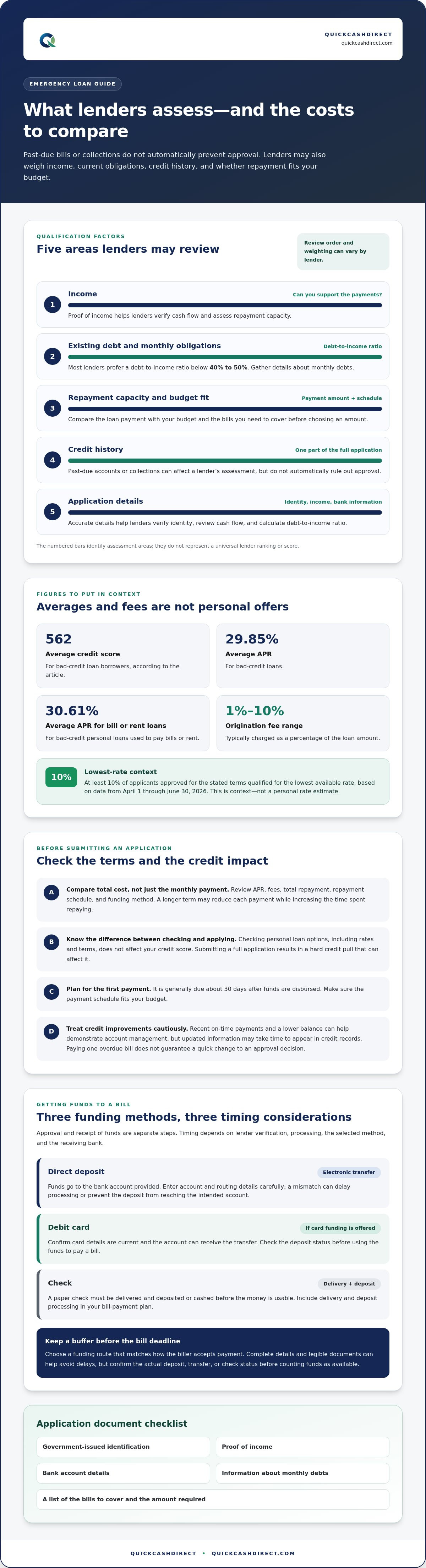
Past-due bills or accounts in collections can affect your credit history and a lender’s assessment, but they don’t automatically prevent approval. Lenders also weigh income, current obligations, and repayment capacity. The average credit score for bad-credit loan borrowers is 562, and the average APR for bad-credit loans is 29.85%.
Paying a past-due bill may improve your financial profile, but its effect on a loan decision depends on your full application. Recent on-time payments and a lower balance can help demonstrate account management, though updated information may take time to appear in credit records. Compare loan terms rather than assuming that paying one bill will quickly change an approval decision.
Application Documents and Steps
Gather government-issued identification, proof of income, bank account details, and information about monthly debts. Lenders use these details to verify identity, assess cash flow, and calculate debt-to-income ratio. Most prefer a ratio below 40% to 50%. List the bills you need to cover and the amount required before applying.
Next, review the APR, fees, repayment schedule, and funding method. Checking personal loan options, including rates and terms, does not affect your credit score, but submitting a full application results in a hard credit pull that can affect it. The first payment is generally due about 30 days after funds are disbursed.
Origination fees typically range from 1% to 10% of the loan amount. A longer term may reduce each payment while increasing the time spent repaying, so compare the total cost as well as the monthly amount.
Bad-credit borrowers face higher costs on average. The average APR for bad-credit personal loans used to pay bills or rent is 30.61%. At least 10% of applicants approved for the stated terms qualified for the lowest available rate, based on data from April 1 through June 30, 2026. Treat that as context, not a personal rate estimate.
Interest-rate and fee rules vary by loan type and state law. Review the offer’s APR, fees, and repayment schedule, and make sure the terms comply with applicable rules where you live before accepting.
A personal loan may be used to consolidate eligible debts if the lender allows it. One scheduled payment can replace several due dates, but the new payment still needs to fit your budget. Check whether funds go to you or directly to creditors, and whether the agreement limits how you can use the money.
Funding speed and delivery depend on the lender’s process and the selected method, such as direct deposit, debit card, or check. Confirm the delivery method and timing before relying on funds for a bill deadline. A 401(k) hardship withdrawal may incur a tax penalty if taken before age 59½, unless the person qualifies for an IRS exemption, according to the Internal Revenue Service.
Debit card, direct deposit, and check funding
Funding method affects how you receive approved money and when it becomes usable. Compare debit card, direct deposit, and check options before submitting an application, especially if a bill has a fixed due date.
The process generally involves submitting accurate application details and any required documents, then waiting for the lender to review and verify them. If approved, the lender sends funds using the selected method. Approval and receipt are separate steps, so an approval notice does not mean the money is already available.
- Direct deposit: Funds are sent electronically to the bank account provided. Enter the account and routing details carefully. A mismatch can delay processing or prevent the deposit from reaching the intended account.
- Debit card: If card funding is offered, confirm that the card details are current and that the account can receive the transfer. Review the deposit status in your account before using it to pay a bill.
- Check: A paper check must be delivered and deposited or cashed before you can use the funds. Include delivery and deposit processing in your bill-payment plan.
Funding speed depends on verification, the lender’s processing schedule, the selected method, and the receiving bank. Complete details and legible documents can help avoid delays caused by missing information or incorrect account numbers. Processing cutoffs may also affect timing. Leave a buffer between expected funding and the bill’s deadline.
Funding speed does not determine whether a loan is affordable. Before accepting an offer, review the APR, fees, repayment dates, and payment amounts. An unsecured loan requires no collateral, but you still owe every scheduled payment. Check whether the agreement sends money to your account or directly to a biller, since that affects how you can use the funds.
Use this short checklist before applying:
- Choose the funding method that matches how you pay the bill.
- Gather the documents needed to verify identity, income, and account ownership.
- Check every account digit and the delivery information before submitting.
- Read the funding and repayment terms, then plan for the first payment.
- Track the deposit, card transfer, or check before counting the funds as available.
For an urgent bill, start by matching the funding route to the payment method the biller accepts. Review direct deposit loan information as you compare how electronic funding works, then base your deadline plan on the actual deposit status, not just the application submission.
Are there hardship loans with no credit check?
“No credit check” can describe a lender’s screening approach, but it doesn’t mean approval without review. Lenders can still assess income, existing debts, bank activity, and ability to repay. Some lenders consider applicants with a credit score of 500, while online lenders often work with hardship-loan applicants whose scores are between 580 and 669.
Checking rates through QuickCashDirect does not affect your credit score. A hard inquiry may occur if you accept an offer, as described in the lender’s application and agreement. Read the wording before submitting your information so you understand whether you’re checking options or accepting a loan.
Gather documents that verify your identity, income, and deposit account before applying. Organizing clear, accurate information can make the application easier to complete. Common items include:
- Identity: A current government-issued photo ID and accurate personal details.
- Income: Recent pay stubs, employer details, or other records showing regular income.
- Alternative income: Benefit statements, pension records, contract invoices, or bank statements showing deposits.
- Banking: Account and routing details, plus statements that show deposits and regular expenses.
- Housing and debts: Current housing costs and monthly obligations, including overdue accounts.
Alternative income records can help explain your cash flow when standard pay stubs do not show the full picture. A self-employed applicant, for example, might organize invoices and bank statements showing customer deposits. Someone receiving benefits might gather a current award notice and account records. Choose documents that show the source and consistency of income, not just a balance on one day.
Before applying, compare the requested amount with your verified income and existing payments. Fill in each field accurately, upload legible documents, and review the authorization before submitting. Inconsistent figures between your application and bank statements may lead to follow-up questions and delay review. Keep copies of the submitted details and loan terms for your records.
A no-credit-check option can still carry a high borrowing cost. Payday alternative loans have a maximum APR of 28%, and some U.S. credit unions offer these small-dollar, short-term loans up to $2,000. Compare the APR, due dates, and total payments with other offers. A lender’s screening method alone doesn’t show whether the repayment schedule fits your budget.
Treat credit history as one part of a loan decision, not the only factor. A past-due account may be considered alongside current income, the requested amount, and your ability to repay. Gather your documents, understand whether accepting an offer may trigger a hard inquiry, and review the full cost before agreeing.
Using personal loans to cover bills and unexpected expenses
A personal loan may combine several overdue balances into one payment or cover a single urgent expense. Before borrowing, list each bill, its deadline, and the consequences of missing payment. Borrow only what you need to address the immediate expense, rather than every competing cost.
The qualifying hardship must have occurred within the six months before the loan application. A few months of on-time payments may help improve a borrower’s chances of qualifying. Keep records that show what happened and how it affected income or essential expenses.
Lender criteria vary. Traditional banks and credit unions typically look for a credit score of 670 or higher for a hardship loan. Online lenders often work with applicants whose scores are between 580 and 669, and some lenders consider applicants with a score of 500. Income, current debt, and the ability to make scheduled payments also shape the decision.
Consider a personal loan for consolidation only after comparing its payment and total repayment cost with your existing debts. Consolidation can simplify due dates, but it does not erase what you owe. If you keep using paid-down credit accounts, you may add new balances on top of the loan. Set a repayment plan and do not treat available credit as extra income.
Borrowing to pay overdue bills can increase your total debt through interest and fees. A hard credit inquiry or missed loan payment can also affect your credit history. A new loan adds a required payment, leaving less room for rent, food, or future emergencies. Before accepting an offer, compare the payment with your dependable income and essential expenses.
Compare alternatives before committing. Some U.S. credit unions offer payday alternative loans of up to $2,000, with a maximum APR of 28%. Ask a bill issuer about a payment arrangement, or prioritize expenses by urgency and consequences. For medical bills, review the balance and available payment options before borrowing to cover the full amount.
Choose an option that addresses the immediate problem without creating an unmanageable payment. Compare APR, fees, due dates, and the amount left for essential costs. If loan payments would leave too little for groceries or utilities, consider a smaller amount or another approach. A clear budget helps you weigh a loan’s speed against its longer-term cost.
Financial assistance loans for past-due bills
Make a bill-by-bill plan before applying. Record each creditor, overdue balance, next due date, and minimum amount needed to address the account. Separate urgent bills from expenses that can wait. This gives you a specific borrowing target instead of an estimate that exceeds your immediate need.
Compare a hardship personal loan with other available borrowing options. Review the APR, repayment schedule, fees, and total payments together. Payday loans can approach 400% APR or more, so compare their full borrowing cost against alternatives. A smaller loan can still strain your budget if its due date falls before your next dependable income deposit.
Check whether a loan is secured. An unsecured loan does not require collateral; a secured loan uses an asset as security. Under the agreement, missed payments on a secured loan could put that asset at risk. Weigh the collateral risk against the amount you need for overdue bills before choosing.
Contact each biller with a specific request, such as a payment arrangement, a revised due date, or the amount needed to bring the account current. Note any instructions and agreed dates. A direct arrangement may reduce how much you need to borrow, but keep the bill in your budget until the agreement is clear.
For a credit union loan, membership can affect eligibility. Payday alternative loans from some U.S. credit unions are small-dollar, short-term loans of up to $2,000, with a maximum APR of 28%. Compare the repayment schedule with the bill deadlines. Treat the loan as one possible tool, not as extra income.
Before you submit an application, use this sequence:
- Confirm the exact amount needed for the past-due accounts.
- List current income and existing monthly debt payments.
- Compare APR, fees, due dates, and total repayment amounts.
- Check whether the lender sends funds to you or directly to creditors.
- Keep enough income available for essential costs and the new payment.
Loans for people with past due bills may help cover a short-term cash gap, but they add a new payment obligation. If repayment would leave too little for essentials, consider a smaller amount or a payment arrangement with the biller first. Choose an option that addresses the most urgent account while keeping future payments manageable.
If borrowing still fits your budget, review emergency loan options and compare the terms against your bill plan before applying.
QuickCashDirect: Payday Loans
QuickCashDirect offers Payday Loans, Cash Advance, Payday Loans Online, and Loans for bad credit for people facing urgent expenses. Consider these options when a past-due bill needs attention and you’ve reviewed how repayment fits your budget.
Before applying, identify the bill amount and deadline. Compare the loan’s APR, payment schedule, and total repayment. A short-term loan may not fit if its payments leave too little for essential costs or other bills.
Use the application process to review the available details and decide whether borrowing suits your situation. For a possible next step, visit QuickCashDirect online.
Choose a Next Step You Can Manage
Decide what to address before an overdue bill sets the pace. Write down the account that needs attention first, the amount required, and the date you need to act. Then compare that need with the payment you can manage after essential expenses. This keeps the decision focused on a specific cash gap rather than borrowing more than necessary.
Loans for people with past due bills are one possible option, but the repayment plan must work after the immediate emergency. If a new payment would put housing, food, or utilities at risk, reconsider the amount or timing. Address the bill without moving the crisis to your next pay period.
QuickCashDirect offers Payday Loans, Cash Advance, and Payday Loans Online. If one may fit your situation, review its terms before moving forward. Contact QuickCashDirect to explore your next step. A clear plan can help you move forward with more control.
Frequently Asked Questions
Is there a grace period for late payments?
It depends on the bill or loan agreement. Utility accounts, credit cards, and personal loans can have different payment terms. Check the statement or agreement for the due date, any grace period, and possible late charges. A grace period may affect when a late fee applies, but does not automatically change the original due date. Contact the biller promptly if you cannot pay on time.
What are emergency loans?
An emergency loan is borrowed money for an urgent expense, such as a medical bill, car repair, or overdue utility account. Options can include personal loans, payday loans, and credit union payday alternative loans. Compare repayment schedules and total costs before choosing. For example, a fixed-payment personal loan may fit a planned budget, while a short-term loan may require repayment sooner.
What credit score and income do lenders require for borrowers with past-due bills?
There’s no single credit score or income threshold used by every lender. Some lenders consider applicants with a credit score of 500, while traditional banks and credit unions typically look for 670 or higher for hardship loans. Lenders also review income, existing debts, and ability to make payments. Prepare clear income records and a realistic budget, even if collections appear in your credit history.
What types of loans are available for people with overdue bills and bad credit?
Options can include bad-credit personal loans, payday loans, installment loans, and credit union payday alternative loans. Loans for people with past due bills may differ in repayment length, cost, and whether funds go to you or directly to creditors. Some credit unions offer payday alternative loans up to $2,000, with a maximum APR of 28%. Compare the full repayment obligation before selecting an option.
What are typical APRs, fees, and loan amounts for bad-credit personal loans?
The average APR for bad-credit loans is 29.85%, while personal loan origination fees typically range from 1% to 10% of the loan amount. Review the disclosed APR and fees for each offer, then compare total repayment costs rather than focusing only on the monthly payment.
Are payday loans or title loans safe options for paying past-due bills?
They can carry substantial costs and repayment risks, so compare terms carefully. Payday loans can approach 400% APR or more, while car title loan APRs can reach 300% or more, with rates varying widely by state. A title loan also puts the vehicle at risk under the loan agreement. Consider whether the scheduled repayment leaves enough for essential expenses before borrowing.
How can I compare lenders and identify loan scams or predatory lending?
Compare each offer’s APR, fees, payment dates, total repayment, and rules for late or early payoff. Most lenders allow early payoff without a penalty, but review the specific agreement. Read the agreement before sharing sensitive details or accepting funds. Pressure to act immediately, unclear terms, or a request for payment before loan funds arrive are warning signs. Check that the lender’s name and contact details match the application and agreement, and never provide account passwords or verification codes.