
If your loan payment stays the same, why does the amount going to interest keep changing? That split can make a loan statement hard to read, but the balance tells the story. With a fixed-rate amortizing loan, interest generally takes a larger share early on, while more of each later payment goes toward principal. Loan amortization explained simply means following that changing split as the amount you owe shrinks.
You might assume a steady payment means the same amount always goes to interest. It doesn’t. Each payment covers interest due, then reduces principal. The next interest charge is calculated on the remaining balance, so the payment can stay level while its parts shift.
This guide shows how each payment works and how to read the key columns in an amortization schedule. You’ll see what the schedule reveals about your balance over time, compare shorter and longer repayment terms, and identify the APR, payment amount, term, and total repayment to review before accepting an offer. Track the balance, and the numbers become easier to understand.
Key Takeaways
- Loan amortization explained simply: each scheduled payment is applied under the loan agreement, then the remaining balance is updated.
- Use an amortization schedule’s payment number, amount, interest, principal, and balance columns to track repayment progress.
- Compare scheduled amortizing payments with balloon balances and revolving debt to understand how repayment structures differ.
- Review the payment, term, APR, total repayment, and agreement together before accepting an offer.
- QuickCashDirect is a free loan-introduction service that connects applicants with lenders. Approval depends on lender criteria.
What Does Loan Amortization Mean in Plain English?
Loan amortization is repaying a loan through scheduled payments that reduce the amount you owe over an agreed period. A payment may cover interest, reduce principal, or do both, depending on the loan terms and how the payment is applied. The basic idea behind loan amortization explained simply is to follow the remaining balance, not just the payment amount.
Loan amortization is the repayment process; your loan balance is the amount still unpaid after payments and other agreed charges are accounted for. The payment is what you send on its due date. The balance is what remains owed. They’re related, but they’re not the same thing.
The word “amortization” also appears in accounting, where it can describe spreading the cost of an intangible asset over time. Here, the focus is borrowing: how scheduled payments address a loan balance. For a broader overview of loan structure, see What is an Amortizing Loan? This external link is provided for reference; QuickCashDirect is not responsible for its content, and you use it at your own risk.
Principal, interest, and the balance you still owe
These three terms explain where your money goes and what remains:
- Principal: The borrowed amount that remains unpaid. It isn’t always the original amount, because payments may already have reduced it.
- Interest: The charge for borrowing, calculated according to the loan’s terms. The agreement explains the rate and how interest is calculated.
- Remaining balance: The amount still owed at a given point in repayment, based on the agreement and payments applied.
A payment can cover interest due and reduce principal. If some of the payment goes toward interest, only the portion applied to principal lowers the amount borrowed. The exact allocation depends on the agreement, so don’t assume the full payment cuts the balance by the same amount.
What makes a loan payment amortizing?
An amortizing loan uses scheduled payments intended to repay the balance over an agreed term. Each payment is applied under the contract, and the remaining balance is recalculated as repayment continues. The structure gives you a timeline for paying down what you owe, but the details vary by loan.
Check the agreement for the payment amount, due dates, rate, and interest calculation method. Payment frequency and rate type can differ. Some loans may have a fixed rate; others may use a rate that can change under the contract. Those terms affect how much each payment covers and how the balance changes.
Keep the distinction clear: an amortizing payment follows the loan’s repayment schedule, while the balance shows what remains after payments are applied. That check helps you understand a statement without mistaking a steady payment for a steady interest charge.
How Does Each Loan Payment Reduce the Balance?
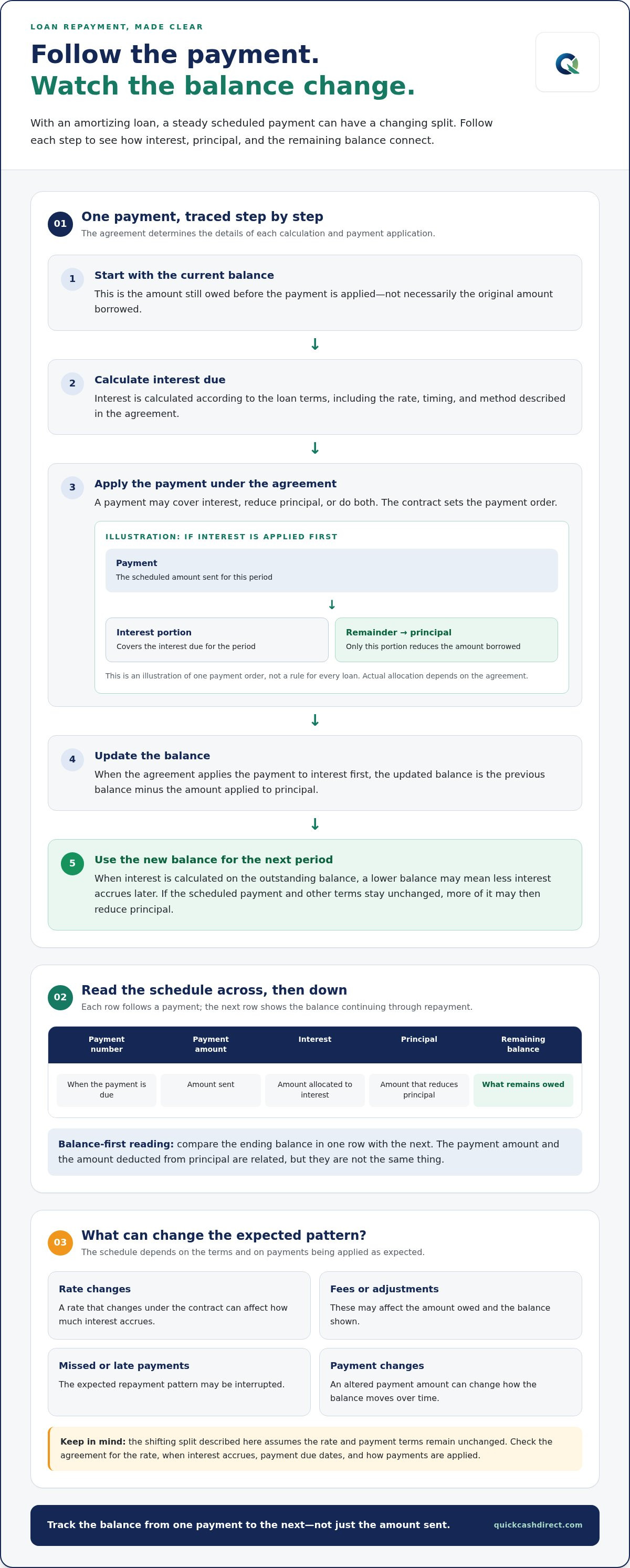
To see how a payment changes what you owe, follow the balance through one repayment period. The lender calculates interest under the agreement, applies your payment according to its terms, and updates the balance. This balance-first view makes loan amortization explained simply: the amount sent is not necessarily the amount deducted from principal.
Follow one payment through the calculation
Illustration only: In a loan where the agreement applies payments to interest first, the lender calculates the interest due for the period, applies that portion of the payment to interest, and uses the remainder to reduce principal. The updated balance is the previous balance minus the amount applied to principal.
This shows the basic movement: payment minus interest equals the amount applied to principal when the agreement uses this payment order. Actual calculations depend on the rate, period length, payment timing, and contract terms. Fees or other adjustments may also affect the amount owed.
Why the payment split changes over time
For a loan where interest is calculated on the outstanding balance, a smaller balance can mean less interest accrues in a later period. If the scheduled payment and other terms remain unchanged, more of the payment may then be available to reduce principal. The payment amount can stay level while its interest and principal portions shift.
As the interest-bearing balance falls, the interest due for a later period may fall too, allowing more of an unchanged payment to reduce principal. This pattern depends on the agreement and assumes the rate and payment terms don’t change. A changing rate, added fees, missed or late payments, or altered payment amounts can affect the balance and interrupt the expected pattern.
Use the agreement as your reference point. Check how it defines the rate, when interest accrues, when payments are due, and how payments are applied. Then compare those terms with the schedule instead of assuming every loan divides payments the same way. The schedule should help you trace each payment from one balance to the next.
Understanding the calculation can help you assess a repayment schedule before borrowing. If you’re considering an online personal loan, connect with lenders through QuickCashDirect, a free loan-introduction service, not a lender. Approval depends on lender criteria.
How to Read an Amortization Schedule and Compare Repayment Types
An amortization schedule turns a loan’s terms into a payment-by-payment view. It shows when payments are due, how each payment is allocated, and what balance remains afterward. To keep loan amortization explained simply, read across one row first, then compare its ending balance with the next row’s opening balance.
Find the important numbers in a schedule
Look for these columns. Names and layouts can vary, so use the lender’s schedule and agreement as the reference for actual payment details.
- Payment date or number: Identifies when a payment is due or where it falls in the schedule.
- Payment amount: Shows the scheduled amount for that period. Check the agreement for how it may change.
- Interest: Shows the borrowing charge assigned to that payment period.
- Principal: Shows how much of the payment is applied to the amount borrowed.
- Remaining balance: Shows what is still owed after the payment is applied.
Trace the balance from one row to the next. The previous period’s ending balance generally becomes the next period’s starting point, subject to the contract’s calculation and applicable adjustments. If a row shows an ending balance lower than its opening balance, principal was reduced. If the balance doesn’t change as expected, review the interest, payment allocation, and agreement terms rather than guessing at the reason.
Amortizing loans versus other repayment structures
These structures can differ in how payments are set and how the balance is handled. The exact terms depend on the agreement, so treat this as a guide to broad distinctions, not a description of every loan.
- Scheduled amortizing payments: A schedule lays out payments intended to repay the balance over an agreed term. Rows show how payments are allocated and how the balance changes.
- Balloon balance: Payments may be structured so a larger remaining balance is due at a specified point. Look for that amount and due date in the agreement.
- Revolving debt: Borrowing and repayment can follow a different structure from a fixed installment schedule. The balance and required payment may depend on account activity and terms.
Short-term borrowing and installment repayment shouldn’t be treated as interchangeable. Review the payday loan guide for context on payday loans, and the cash advance guide for an overview of cash advances. Compare each product’s repayment terms; the label alone doesn’t tell you how a balance will change.
Before relying on a schedule, match its payment dates, amounts, and balance figures against the agreement. That quick check helps you identify the repayment structure and spot any large balance due later.
How to Use Amortization When Reviewing a Loan Offer
An amortization schedule can help you judge whether a loan fits your budget, but don’t stop at the scheduled payment. Put the payment, repayment term, APR, total repayment, and agreement side by side. Together, these details show what you’re expected to pay, for how long, and under what terms. That’s loan amortization explained simply as a borrowing decision: look at both the regular payment and the full commitment.
Compare payment, term, APR, and total repayment
Review each part of the offer before deciding:
- Payment amount: Confirm what is due each period and whether the amount can change under the agreement.
- Term: Note how long repayment is scheduled to take. A longer term can come with a lower scheduled payment, but it may also mean paying over more periods.
- APR: Compare this annualized measure of borrowing cost alongside the payment and term. APR is not the same as a payment schedule, so use it with the schedule and agreement rather than in place of them.
- Total repayment: Check the total amount scheduled to be repaid. This shows the overall commitment beyond the size of each payment.
- Agreement: Read the terms that explain how payments are calculated and applied, as well as any fees and conditions.
A representative example is a $1,000 loan over 12 months with a 29.82% APR and $1,134.72 total repayment. Treat these figures as an illustration of one loan offer, not a universal quote or a prediction of your schedule. Actual offers depend on lender criteria and the specific agreement. Compare the figures in the offer you receive, not just an example.
Compare the full repayment terms, not just the first payment amount. A payment that appears easier to manage may come with a longer repayment period. Look at the total repayment and term together before deciding what works for your budget.
Check early-payoff terms before making extra payments
If you plan to pay more than the scheduled amount, first read how the agreement handles extra payments. Check how the lender applies them and whether they change the balance, future payments, or payoff process. Don’t assume an additional payment works the same way across all loans.
Early payoff is generally allowed without penalty, but review your specific lender agreement for the terms that apply. The timing and allocation of extra payments can affect how the balance is handled. Avoid relying on a guessed savings amount or payoff date; those depend on the actual loan terms and payment history.
After reviewing the offer and schedule, you can use QuickCashDirect, a free loan-introduction service, to connect with lenders offering online personal loans. Explore lender connections. Approval isn’t guaranteed and depends on lender criteria.
Next Steps: Apply Amortization to Your Borrowing Decision
You’ve seen how a payment schedule tracks repayment. Now use it to make a clear decision. Review the offer, inspect the schedule, and read the agreement before accepting. This final check puts loan amortization explained simply into practice by connecting the payment pattern to the commitment you’re considering.
- Review the offer. Note the scheduled payment, repayment term, APR, and total repayment. Check whether the payment fits your budget across the full term, not just now. A payment that looks manageable by itself may feel different when you consider how long you’ll make it.
- Inspect the schedule. Follow the balance and payment details across the full repayment period. Look for any change in payment amount or a larger amount due at a particular point. Compare the schedule with the APR and total repayment shown in the offer.
- Read the agreement. Review how the lender calculates and applies payments, how extra payments or early payoff are handled, and whether any lender-specific fees apply. Pause before accepting if a payment, calculation, or term is unclear.
Use the schedule to make a clear decision
Think beyond the first due date. Check whether each scheduled payment remains realistic throughout the term, and consider the total repayment alongside your other financial commitments. The schedule shows how the balance is expected to change; the agreement explains the conditions behind that projection. Use both, and don’t rely on an estimate if the actual offer’s terms differ.
Explore an optional lender introduction
QuickCashDirect is a free loan-introduction service. It connects applicants with lenders offering online personal loans, but it doesn’t lend money or make lending decisions. Its primary offering is $300 to $3,000, with terms of 3 to 36 months and an APR range of 5.99% to 35.99% for qualified consumers. Actual offers and approval depend on lender criteria and your circumstances.
Checking rates through QuickCashDirect uses a soft check and doesn’t affect your credit score. If you proceed, review the lender’s actual offer and agreement carefully. Confirm the payment schedule, APR, total repayment, and any applicable lender-specific fees before accepting.
To explore online loan options, visit QuickCashDirect. Approval isn’t guaranteed and depends on lender criteria. Review the full repayment terms before deciding whether an offer works for you.
Make Your Next Borrowing Decision With Confidence
Understanding loan amortization explained simply can help you move from uncertainty to a more deliberate choice. Before accepting an offer, take time to check that the repayment commitment fits your plans, not only your immediate need. If a term or figure doesn’t make sense, pause and clarify it using the agreement before moving forward.
QuickCashDirect is a free loan-introduction service, not a lender. Checking rates uses a soft check and doesn’t affect your credit score. A lender makes the decision on any application, and approval isn’t guaranteed.
Explore your online loan options when you’re ready. Take the next step at your own pace, with the repayment details in view and a clear understanding of what you’re agreeing to.
Frequently Asked Questions
What is loan amortization in simple terms?
Loan amortization is a planned way to repay a loan through scheduled payments over time. Each payment may cover interest and reduce the principal balance, depending on the agreement. A schedule helps you see what remains after a payment. For loan amortization explained simply, think of it as a repayment path: the schedule tracks progress, while the agreement sets the rules. Use the lender’s schedule for the specific offer you’re reviewing.
How does an amortization schedule work?
An amortization schedule organizes loan repayment by period and shows how the lender applies each scheduled payment. Check that due dates match your expectations and that each period’s ending balance carries into the next one as shown. If a figure differs from your offer, compare the schedule with the agreement and disclosures. Rate changes, payment timing, fees, or other contract conditions may affect the displayed amounts.
Does an amortized loan have the same payment every month?
Not always. Some amortizing loans have equal scheduled payments, but the contract determines whether yours stay the same. Check the schedule for the amount due in each period, then look in the agreement for provisions that could change it, such as a variable rate or fees. Also confirm the payment frequency and due dates. Don’t assume a monthly payment pattern unless the specific offer lays it out.
Why do early loan payments go more toward interest?
Early payments may have a larger interest portion because interest can be calculated on the outstanding balance under the loan’s terms. If that balance is higher at the start, the interest due for a period may also be higher. As principal is repaid, later interest charges may decline. The exact split depends on the calculation method and contract, so check the schedule to see how the lender allocates each payment.
Can I pay off an amortized loan early?
Early payoff is generally allowed without penalty for loans connected through QuickCashDirect, but your specific lender agreement controls. Before sending extra money, check how the lender applies additional payments and whether the agreement sets conditions for payoff. Don’t assume an extra payment automatically changes your required payment or payoff date. Use the lender’s stated process and figures to understand how early payoff would be handled.
Does loan amortization include fees?
A schedule may show scheduled payments, interest, principal, and the remaining balance, while fees may appear separately or be handled according to the agreement. Review the lender’s disclosures and total repayment information to understand what you may owe. QuickCashDirect is a free loan-introduction service, not a lender. Any lender-specific fees depend on the lender and are disclosed in the loan agreement.
QuickCashDirect makes no warranties about the accuracy, completeness, or correctness of site information. The site is provided as is, without express or implied warranties. Liability is limited to the amount paid for site access, if any. Check local laws for restrictions on excluding implied warranties. Any dispute must be resolved individually through arbitration, and class-action arbitration is waived. Site materials are for personal, non-commercial use only. Do not reproduce them or use site images without permission. QuickCashDirect will not contact borrowers to request money or the purchase of products before loan funds are received.