
Nearly 22% of borrowers take out seven or more loans in a sequence, creating a cycle that feels impossible to escape. Learning how to manage payday loan payments is the first step to stopping this constant drain on your finances. You're likely tired of automatic withdrawals causing overdraft fees and high interest rates that make your balance feel impossible to clear. It's stressful to deal with aggressive collection calls while trying to keep your head above water. You need a solution that works as fast as the debt accumulates.
You can break this cycle today. We'll show you professional strategies to regain control of your financial schedule and protect your primary bank account from unauthorized access. This guide provides a clear, step by step framework to create a predictable repayment plan and stop the need for constant re-borrowing. Follow these structured steps to move from financial stress to a state of resolution. We focus on efficiency and safety to ensure you reach a manageable outcome quickly. Stop the cycle now and start your path toward a predictable financial future.
Key Takeaways
- Analyze your loan anatomy. Understand how principal, fees, and ACH authorizations impact your bank balance immediately.
- Take action to protect your account. Learn the specific steps to stop automatic withdrawals by revoking authorization before your next payday.
- Implement a strategic priority framework. Discover exactly how to manage payday loan payments by focusing on high-interest debt to stop the cycle of re-borrowing.
- Eliminate the rollover trap. Identify the high costs of loan flipping and stop paying interest-only fees that never reduce your principal.
- Secure a predictable future. Compare short-term options with installment loans to find a sustainable path toward total debt resolution.
Understanding Your Payday Loan Obligations
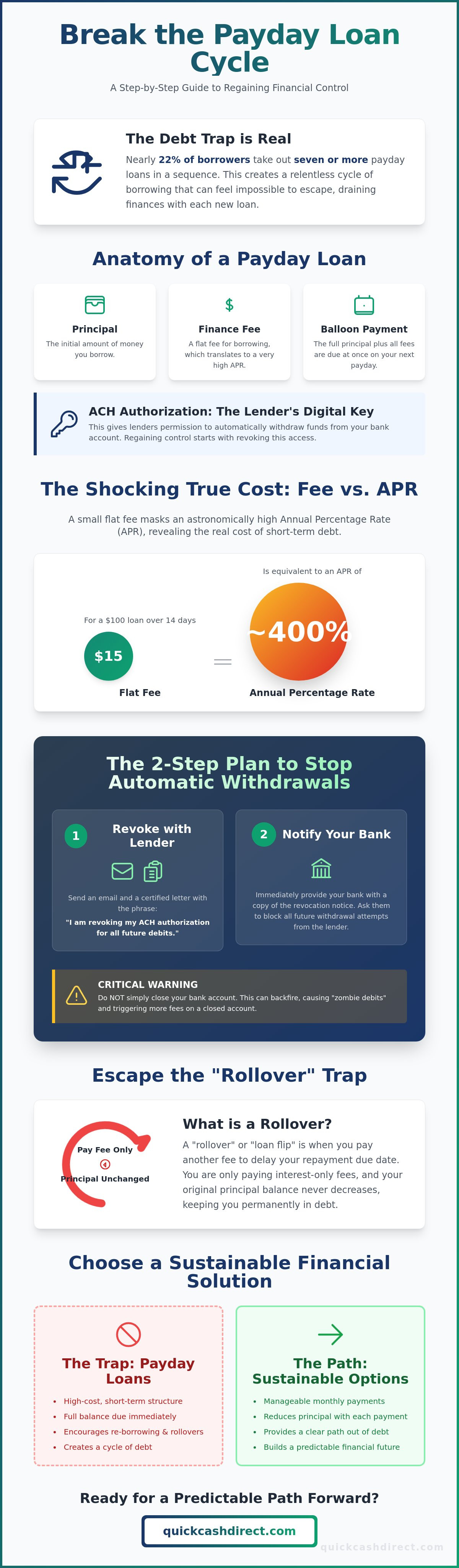
Mastering your finances starts with total transparency. To learn how to manage payday loan payments, you must first dissect the structure of the debt itself. Every loan consists of three core components: the principal, the flat finance fee, and the "balloon" payment. Unlike traditional loans where you pay back a small portion over time, payday loans require the full balance plus fees on your next payday. This structure creates immediate pressure on your next paycheck.
Most lenders require an ACH (Automated Clearing House) authorization. This digital key gives the lender permission to withdraw funds directly from your bank account the moment your paycheck arrives. While convenient for some, this passive management style is exactly what fuels the debt cycle. It removes your control over the timing of the payment. Transitioning from passive withdrawals to proactive oversight is a strategic financial decision. It's not a sign of failure; it's a commitment to resolution.
The Math of Short-Term Debt
APR represents the annual cost, but payday lenders usually quote a flat fee. For example, a $15 fee on a $100 loan over 14 days sounds small, but it equates to an APR of nearly 400%. Missing a single due date causes the balance to spiral as new fees are added to the existing total. To calculate the true cost of a 14-day extension, use this formula: (Extension Fee / Principal) x (365 / 14) x 100. Understanding Payday Loans and their mathematical structure helps you prioritize which debts to settle first. This percentage reveals the true velocity of the debt you're facing.
Your Rights as a Borrower
Know your legal standing immediately. Payday loan debt is a civil matter. It's not a criminal offense. You cannot go to jail for being unable to repay a loan. This is a common myth used by aggressive collectors, but the Fair Debt Collection Practices Act (FDCPA) prohibits such threats. Collectors must follow strict rules regarding how and when they contact you. Additionally, distinguish between your lenders. Direct lenders operate under state regulations, while sovereign tribal lenders follow tribal laws. Both types require a structured approach to repayment. Protect your peace of mind by acting on facts, not fear. Take charge by understanding the legal framework that protects your bank account and your rights.
How to Stop Automatic Bank Withdrawals Safely
Protecting your primary bank account is the first step toward stability. Many borrowers struggle with how to manage payday loan payments because lenders have direct access to their funds. You must interrupt this access to regain control. Understand the difference between a "Stop Payment" order and "Revoking Authorization." A stop payment tells your bank to block one specific transaction. Revoking authorization legally removes the lender's permission to touch your account at all. It's a more permanent solution for securing your paycheck.
Act now. You must notify both the lender and your bank at least three business days before your next payday. If you wait, the ACH process may already be in motion. Don't close your bank account as a shortcut. This often backfires. Lenders can still attempt debits, resulting in "zombie" debits that trigger overdraft fees even on closed accounts. Be aware that stopping the withdrawal doesn't eliminate the debt. It simply moves you from a passive position to an active one where you decide when and how to pay. This transition is essential for avoiding the debt trap.
Step 1: Revoke Authorization with the Lender
Use a formal approach. Send an email to the lender’s customer service department. Follow this with a certified letter through the mail. Use this specific phrasing: "I am revoking my ACH authorization for all future debits." This language is legally significant and clear. Keep a digital paper trail of every interaction. If you're looking for a more structured way to handle urgent needs, explore payday loans online that prioritize transparency. Documenting your request ensures you have proof if the lender ignores your command. It acts as your primary security marker in the repayment process.
Step 2: Notify Your Financial Institution
Contact your bank immediately after emailing the lender. Give them a copy of your revocation notice. Most banks will place a stop payment on the lender's name for a fee. This cost is usually much lower than the $35 or $40 charged for a single bounced payment. Monitor your transaction history every morning. Some lenders try to re-submit debits using slightly different business names to bypass blocks. Understanding payday loan basics helps you spot these tactics and report them to your bank instantly. This proactive stance is the only way to safeguard your paycheck and ensure your money stays where it belongs. Stay vigilant to maintain your financial velocity.
Strategic Repayment: The Payday Loan Priority Framework
Once you secure your bank account, you must shift from defense to offense. Learning how to manage payday loan payments requires a structured priority framework. You cannot treat all debts as equal when dealing with triple-digit APRs. If you have multiple loans, use the "Avalanche" method. Target the loan with the highest daily fee or interest rate first while paying the bare minimum on others. This reduces the total velocity of your debt growth. Alternatively, the "Snowball" method focuses on paying off the smallest balance first to build momentum. Choose the path that keeps you moving forward without hesitation.
Consistency is your best tool for resolution. Allocate your available funds strategically. Don't send small, random amounts to every lender. This often results in your money being swallowed by fees without touching the principal. Instead, focus your resources on one "target" loan. Before you send a single dollar, ensure you have taken the necessary steps to stop automatic bank withdrawals. This ensures you maintain control over the payment timing. Act with speed and precision to minimize the total cost of your debt. This proactive approach turns a chaotic situation into a manageable sequence.
The Extended Payment Plan (EPP) Option
Ask your lender for an Extended Payment Plan (EPP) immediately. An EPP is a formal agreement that allows you to repay the loan in smaller installments over a longer period. In many states, lenders are legally required to offer this if you request it before your due date. The primary benefit is that EPPs typically freeze the accrual of additional interest and fees. This creates the breathing room you need to settle the balance. You usually have a narrow window of opportunity to apply; often by the end of the last business day before the loan is due. Don't wait until you've already missed a payment. Act before the deadline to lock in these protections.
Negotiating a Settlement
Settlement is a viable exit strategy if you have a lump sum of cash available. Contact the lender and offer to pay a percentage of the total balance to close the account forever. Start your offer at 50% and be prepared to negotiate. Always get the settlement agreement in writing before you send any money. Ensure the document states the debt is "settled in full" and that no further collections will occur. Be aware that a "settled for less" status may appear on your credit report, but this is often better than an active, mounting debt. Clear the path to a zero balance with clinical efficiency. Focus on the final resolution to protect your financial future.
Avoiding the Rollover and Refinance Trap
Understanding how to manage payday loan payments means recognizing the danger of the rollover. A rollover occurs when you pay a fee to delay your due date by another two weeks. Loan flipping is a similar tactic where you take out a new loan to pay off the old one. Both methods keep the principal balance alive while you pay constant fees. You are essentially renting your own debt without ever owning your financial freedom. This cycle is the primary reason borrowers remain stuck in high-interest situations for months.
Paying only the interest or fees every two weeks has a devastating compounding effect. Your principal remains untouched while the total amount paid out grows exponentially. Identify the red flags of a predatory extension immediately. If a lender pushes an extension as "easy" or "affordable" without mentioning principal reduction, they are prioritizing their profit over your resolution. Use this checklist to evaluate any offer:
- Does this specific payment reduce my principal balance by at least 10%?
- What is the total dollar amount I will have paid by the end of this extension?
- Is there a definitive, fixed end date for this debt?
- Could I find a more stable cash advance or installment option elsewhere?
The Cost of a Single Rollover
A $500 loan can quickly cost you $1,500 in total fees and principal after just three rollovers. This cost is significantly higher than a standard installment loan, which features a fixed repayment schedule and declining balance. Lenders prefer rollovers because they generate pure profit without reducing the lender's risk. Every extension fee you pay is money lost to the cycle. Move toward a full repayment as fast as possible to stop this drain on your resources.
Breaking the Cycle of Re-Borrowing
Implement the 24-hour rule today. Never take out a new loan to pay an old one within the same 24-hour window. This creates a false sense of security while deepening the debt trap. Look for alternative sources of emergency cash immediately. Local charities, employer payroll advances, or selling unused household items can provide the small injection of capital needed to break the cycle. Adjust your monthly budget to create a "repayment buffer" by cutting all non-essential spending for 30 days. This temporary sacrifice provides the velocity needed to settle your high-interest balances for good. If you need a more structured solution for your immediate requirements, consider bad credit loans that offer clear terms and predictable schedules. Focus on the transition from a state of need to a state of total resolution.
Transitioning to Sustainable Financial Solutions
Regaining your financial footing requires a shift in strategy. While you've learned how to manage payday loan payments by stopping withdrawals and prioritizing high-interest debt, the final step is moving toward sustainable credit. Short-term payday loans provide speed, but they lack the structure needed for long-term recovery. Transitioning to installment loans allows you to consolidate high-interest debts into a single, predictable monthly payment. This larger, longer-term approach provides the breathing room necessary to settle balances without the constant threat of a two-week deadline.
Rebuilding your foundation is a deliberate process. Specialized bad credit loans act as a bridge between a state of need and a state of total resolution. These options focus on your ability to pay over time rather than just your past credit history. By utilizing a referral service like QuickCashDirect, you can access a network of lenders quickly. This efficiency ensures you find competitive rates without wasting time on multiple applications. Speed and safety are the foundation of this transition.
The Benefits of Installment Loans
Fixed monthly payments simplify your budgeting instantly. You know exactly what is due and when it is due. This predictability is the opposite of the balloon payment crisis common in payday lending. Additionally, direct deposit loans often carry lower APRs than standard short-term options. This structured repayment schedule ensures that a portion of every payment goes toward the principal. You stop renting your debt and start owning your progress. It is a logical sequence for anyone moving away from high-velocity short-term debt.
How QuickCashDirect Facilitates Your Recovery
QuickCashDirect acts as an efficient facilitator for your financial recovery. We connect you to a diverse network of lenders through a single, streamlined process. This minimizes friction and saves you valuable time. For those in immediate need of a consolidation option, the funding speed is a critical advantage. You can move from a high-stress situation to a structured plan in a matter of minutes. Take the final step toward financial safety right now. Secure a more manageable funding option today and regain the control you deserve. Your path to resolution starts with a single, decisive action.
Take Decisive Action Toward Financial Resolution
You now possess the framework to secure your financial future. You've learned to protect your bank account by revoking ACH authorization and how to prioritize high-interest debt to stop the rollover cycle. These actions move you from a state of emergency to a state of structured relief. Mastering how to manage payday loan payments is about shifting from passive debt to active, clinical resolution. You can stop the cycle of re-borrowing by choosing a more predictable path forward.
Now that you have a strategy, you need the right tools to finalize your recovery. Connect with a lender for a more manageable installment loan today. QuickCashDirect provides access to a broad network of lenders who offer fast funding for emergency needs. We offer solutions for all credit types, ensuring you find the structure you need regardless of your financial history. Act with speed and precision to settle your balances for good. You have the power to regain control and secure a predictable financial schedule today. Start your journey toward resolution now.
Frequently Asked Questions
Can I stop a payday lender from taking money from my bank account?
Yes, you have the legal right to revoke your ACH authorization at any time. Notify your lender in writing and inform your bank at least three business days before the scheduled debit. This is a critical step in learning how to manage payday loan payments. Stopping the withdrawal protects your immediate cash flow and prevents unauthorized access to your funds.
What happens if I can't pay my payday loan on time?
You will face immediate late fees and a rapid increase in interest charges. The lender may attempt to debit your account multiple times, which often results in several non-sufficient funds (NSF) fees from your bank. Your total balance will grow at a high velocity. Contact the lender immediately to request an alternative arrangement before the due date passes.
Is it better to close my bank account to stop a payday loan debit?
No, closing your account is a high-risk move that often fails. Lenders can still submit debits, leading to "zombie" charges and bank fees even on closed accounts. This can damage your standing with ChexSystems and make it difficult to open new bank accounts later. Use the formal revocation and stop-payment process to secure your account safely and professionally.
How do I ask my lender for an Extended Payment Plan (EPP)?
Send a formal written request to the lender's customer service department before your loan is due. State clearly that you are unable to pay the full balance and want to enter a state-mandated EPP. This process usually freezes additional fees and breaks the balance into smaller, manageable installments. Act quickly, as the window to request an EPP often closes 24 hours before your due date.
Will managing my payday loan payments affect my credit score?
Yes, your actions determine the impact on your credit. Paying as agreed or settling the debt prevents negative reporting to specialty bureaus. If you default and the debt moves to a collection agency, it will likely appear on your major credit reports. Proactive management preserves your financial reputation and keeps your path to future credit open and clear.
Can a payday lender sue me if I stop the automatic payments?
Yes, a lender has the right to sue you in civil court to recover the unpaid principal and fees. However, they cannot threaten you with criminal charges or jail time. Payday loan debt is strictly a civil matter. Most lenders prefer to negotiate a settlement or an extended plan rather than pursue costly and time-consuming legal action against you.
What is the difference between a rollover and an installment loan?
A rollover is a fee-based extension that delays your due date without reducing your principal balance. It keeps you in a cycle of debt. An installment loan is a structured solution where every payment reduces your total balance over a fixed period. Shifting to an installment plan is a professional strategy for anyone learning how to manage payday loan payments for long-term stability.
Are tribal loans managed differently than standard payday loans?
Tribal loans operate under the sovereign laws of a federally recognized tribe rather than state regulations. This often means different interest rate structures and dispute processes. You still maintain the right to revoke electronic access to your bank account regardless of the lender's tribal status. Always review the specific terms of a tribal loan agreement to understand your rights and obligations clearly.