
A personal loan can lower your debt-to-income ratio, but taking on new debt won’t automatically help. To understand how to improve your debt-to-income ratio, divide your monthly debt payments by your gross monthly income, then multiply by 100. Increasing income can lower the result if your debt payments stay the same.
When monthly obligations feel heavy, it makes sense to look for ways to increase your income. But a new loan payment also counts, so borrowing to pay off debt helps only if it lowers the monthly payments included in your DTI. A lower payment may also mean paying more interest over time.
Learn how lenders use DTI, which income and payments may count, and practical ways to lower your ratio. Then weigh extra income against a personal loan for debt payoff so you can choose your next step with a clearer view of the impact.
Key Takeaways
- Separate qualifying debt payments from everyday expenses to get a clearer starting point.
- Consider your loan type and overall application, since lenders may assess DTI differently.
- Look for ways to raise countable income, and keep records that show the change.
- Before consolidating debt, compare the new payment with the payments it replaces and consider the total interest over time.
What is debt-to-income ratio?
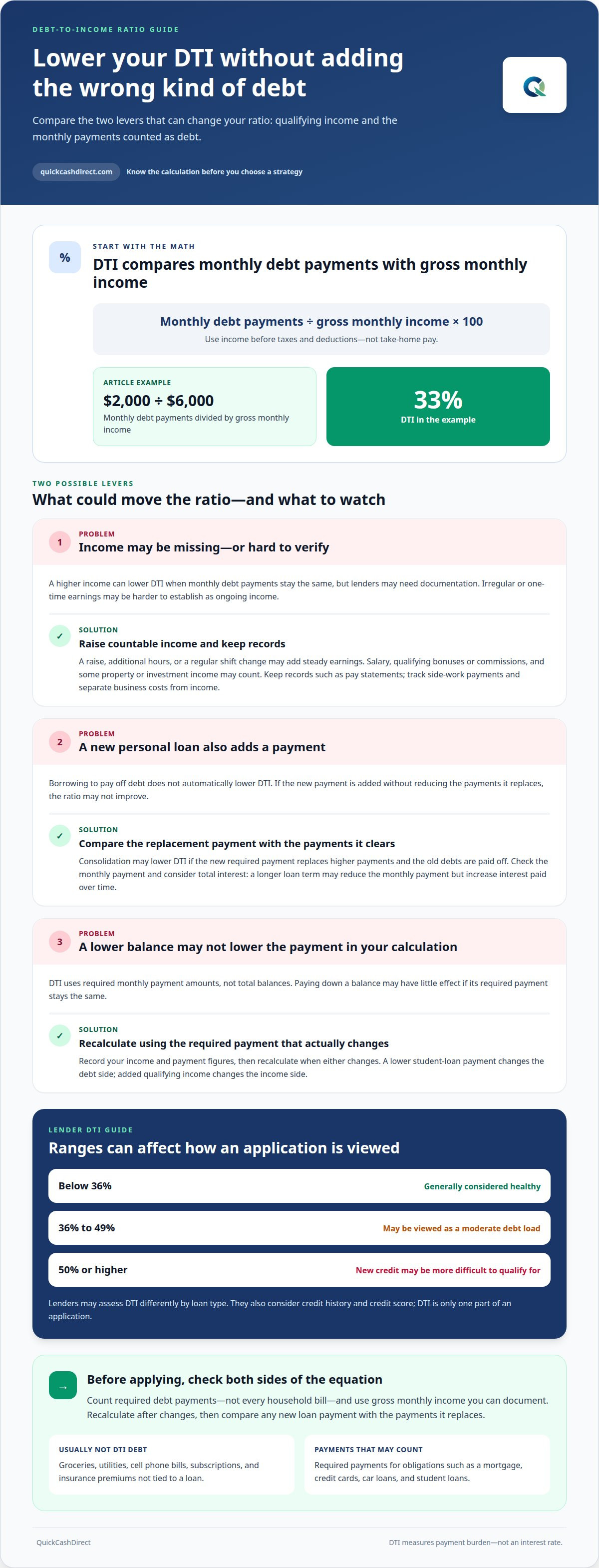
In the U.S., calculate DTI by dividing total monthly debt payments by gross monthly income, then multiplying by 100. The result is a percentage that compares required debt payments with income before taxes.
After paying down debt, your DTI improves when the monthly payment counted in the calculation falls. Paying down a balance may have little effect if its required payment stays the same.
- Determine your gross monthly income. Use income before taxes and deductions, not your take-home pay. Include salary and any qualifying bonuses or commissions. Income from property and investments may also count. Alimony, child support, or separate maintenance income can be included if you want it considered.
- Add the monthly debt payments. Gather required payments for obligations such as a mortgage, credit cards, car loans, and student loans. For a mortgage calculation, include the estimated new mortgage payment if you’re assessing a home purchase. Use the payment amount, not the total balance owed.
- Separate debt from regular expenses. Groceries, utilities, cell phone bills, subscriptions, and insurance premiums not tied to a loan usually don’t count toward DTI. This distinction matters: include obligations connected to debt, rather than every monthly bill in your budget.
- Divide debt payments by gross income. The Consumer Financial Protection Bureau gives an example: $2,000 in monthly debt payments against $6,000 in gross monthly income equals a 33 percent DTI. The calculation is $2,000 divided by $6,000, multiplied by 100.
- Use the percentage to set a baseline. Record the income and payment figures used, then recalculate when either factor changes. For instance, a lower student loan payment affects monthly debt, while added qualifying income changes the denominator. Keep both sides accurate to track your ratio.
How lenders use DTI
- Review DTI alongside your credit profile. Lenders use debt-to-income ratio to assess monthly obligations against gross monthly income. They also consider credit history and credit score when evaluating an application. DTI describes payment burden, while credit history shows how you have managed credit accounts. A strong result in one area does not erase information in the other.
- Use broad DTI ranges as a guide. A ratio below 36% is generally considered healthy. Lenders may view 36% to 49% as a moderate debt load. At 50% or higher, qualifying for new credit may become more difficult. These ranges help you understand how total monthly debt payments can affect an application.
- Separate mortgage housing costs from total debt. Mortgage lenders may assess front-end DTI, which compares housing costs with income, and back-end DTI, which includes all monthly debt obligations. Conventional mortgage lenders commonly prefer front-end DTI below 28% and back-end DTI below 36%. Mortgage DTI parameters are generally around 43%, though they vary by loan type.
- Consider the loan program. Thresholds are not identical across mortgage programs. U.S. Department of Agriculture loans have no DTI limits, while the U.S. Department of Veterans Affairs subjects potential borrowers with DTIs above 41 percent to increased scrutiny. Some mortgage programs can allow higher ratios when other qualifying factors support the application.
- Track what changes your application. A new credit card, car payment, or personal loan can add to monthly debt and raise DTI. Paying down a balance matters most when the required payment used in the calculation falls. Review debt payments and income together before applying, then consider how your credit history and score support the full application.
Increasing income
Raising your income can lower your DTI while your monthly debt payments stay unchanged. To understand how to improve your debt-to-income ratio, calculate the effect of added earnings before applying for credit.
-
Increase Stable, Verifiable Income
Look for a steady increase through a raise, additional hours, or a regular shift change. Keep records, such as pay statements, that show the source and consistency of your earnings. Salary, bonuses, and commissions may count in a DTI calculation, but include only income you can document. Then determine whether the added amount changes the gross monthly income used in your calculation.
-
Add Income Through Side Work
Choose side work that fits your schedule and produces trackable earnings. Keep payment records and separate business costs from the income you receive so you can see what the work actually adds. Freelance assignments or occasional sales can bring in extra money, but irregular earnings may be harder to document as ongoing income. Don’t rely on a one-time payment as continuing earnings.
- Recalculate before applying. Divide total monthly debt payments by updated gross monthly income, then multiply by 100. Compare the result with your previous calculation. If payments stay fixed while documented income rises, DTI falls. To decide how to improve your debt-to-income ratio, check whether the added earnings create a meaningful change in your own calculation.
- Protect your progress. Direct some additional earnings toward existing balances, but first check whether the payment will reduce the required monthly amount. A lower balance may not immediately change the payment. Keep income records current when reapplying, and don’t count uncertain earnings toward a lending decision. DTI measures payment burden, not an interest rate, so higher income alone doesn’t determine a loan’s rate.
Using a personal loan to pay off debt
A personal loan can simplify payments, but it lowers your DTI only if its required monthly payment improves the calculation.
Balance transfers and debt consolidation affect your DTI through the required monthly payments. Consolidation may lower the ratio if the new payment replaces higher payments and the old debts are paid off.
The risk is adding a new payment without reducing the payments it replaces. A longer loan term may lower monthly payments but increase the total interest you pay over time.
- List the payments you plan to replace. Record each debt’s required monthly payment, including credit cards or a student loan. Don’t compare balances alone. DTI depends on monthly payments relative to gross monthly income, so a large payoff may barely change the ratio if the required payment falls only slightly.
- Estimate the new loan payment. Before borrowing, compare the proposed payment with the payments on debts being paid off. Recalculate DTI with the new payment included and the replaced payments removed. If the new payment is not lower, consolidation may not improve the ratio, even if it combines several bills into one.
- Compare the full cost and repayment term. A longer term can reduce the monthly payment, but may increase total interest over time. Include the payment in your regular expenses and confirm it fits your budget. Don’t assume a lower payment means the debt costs less overall.
- Pay off the intended balances and track the change. After consolidation, confirm the old accounts show the expected balances and payments. Avoid running up paid-off credit cards again, which could add debt and erase progress. Recalculate DTI using current payments and monthly income before making another borrowing decision.
If you need short-term funds for an immediate expense, review available loan options separately from a debt-consolidation plan.
QuickCashDirect
QuickCashDirect offers short-term financial options for people facing an immediate cash need, including Payday Loans, Cash Advance, Payday Loans Online, and Loans for bad credit. These options address a different need from a plan to reduce existing debt. A new loan adds a payment, so include its expected monthly obligation when considering your DTI and budget.
Before applying, consider whether a loan payment fits alongside your current debt payments and regular expenses. Borrowing may not improve your debt-to-income ratio, especially if a new payment doesn’t replace a larger one. Keep the purpose of the funds and the repayment commitment in view.
If you need to discuss a short-term financial option, contact QuickCashDirect.
Choose a next step you can sustain
Knowing how to improve your debt-to-income ratio gives you a practical starting point, but lasting progress depends on choices that fit your budget. Track your income and required payments together, then revisit your plan when either changes. This can help prevent a short-term adjustment from becoming a new strain.
Set a calendar reminder to review your budget whenever your income or required payments change. Use the same calculation method each time to compare shifts in debt and earnings. If a lender decision is approaching, consider how any new payment affects your full monthly obligations before borrowing. Choose changes you can sustain while keeping essential expenses covered.
If you’re weighing a short-term option as part of a broader cash-flow decision, discuss your situation and next step directly. Contact QuickCashDirect to discuss your options. Keep your plan focused, realistic, and manageable.
Frequently Asked Questions
Can You Use a Personal Loan to Pay Off Debt?
Yes, a personal loan can pay off existing debts, but its new payment must fit your budget and may affect your DTI. Before using one, compare the required payment with the payments it would replace. Also consider the repayment term and total interest. If you keep using paid-off credit cards, new balances can undermine the plan and leave you with more obligations.
Does My DTI Impact My Credit Score?
DTI doesn’t directly affect your credit score. The two measures can still overlap: credit card balances and payments may influence both your debt burden and credit profile. For example, paying down card balances can reduce what you owe, while payment history remains relevant to your credit record. Track your DTI and credit reports separately, since improving one measure doesn’t automatically improve the other.
How can you lower your DTI?
Lower your DTI by reducing counted monthly payments, increasing qualifying income, or doing both. Direct extra money toward a debt payment that can meaningfully reduce the amount due each month. Keep other accounts current, avoid unnecessary obligations, and recalculate when your income or payments change. If paying off a debt barely changes its required payment, it may have little immediate effect on your ratio.
How do you calculate your DTI?
Divide your total monthly debt payments by your gross monthly income, then multiply by 100. Use income before taxes, and count the monthly obligations included in the calculation rather than every household bill. For a useful comparison, use consistent figures each time you recalculate. Updating only income or only debt payments can make the result harder to interpret.
How does DTI affect mortgage affordability?
Mortgage DTI helps show how a proposed housing payment fits alongside your existing monthly obligations and gross income. Include the estimated new mortgage payment when assessing the possible total. A lower ratio can leave more income available for everyday expenses, but it doesn’t determine affordability on its own. Consider recurring costs and unexpected expenses before deciding what payment is sustainable.
What Is DTI?
DTI, or debt-to-income ratio, expresses monthly debt payments as a percentage of gross monthly income. Lenders use it to assess existing payment obligations in relation to income. For your own planning, use the same calculation consistently and note which payments and income sources you included. That makes it easier to see what changed when your earnings or obligations shift.