
What if the name on a loan website isn’t the company actually making the loan? If you’re searching for how to check if a loan company is licensed in your state, start by identifying the lender named in the offer and loan agreement, not just the brand you first encountered. That distinction matters when a platform connects borrowers with lenders, as QuickCashDirect does.
It’s reasonable to want clear information before relying on a loan offer. State rules and regulator websites vary, so searching under the wrong company name or in the wrong database can leave you with an incomplete picture.
This guide walks through a practical process: identify the lender, search NMLS Consumer Access where relevant, and cross-check the result with your state’s financial regulator. You’ll learn how to compare a record with an offer, what a search can’t establish, and what to do when names or records don’t match. Use official records to make a more informed decision, not as a guarantee of approval or a particular legal outcome.
Key Takeaways
- To learn how to check if a loan company is licensed in your state, search official records using the lender’s exact legal name or license number.
- Start with your state financial regulator. Agency names and search tools vary, so confirm you’re using an official source.
- Compare the record’s entity name, state, loan activity, and status. A similar name or missing result alone doesn’t confirm whether the lender is authorized.
- If company details or license claims don’t match, pause before sharing sensitive information and seek clarification from the regulator.
- Use the license check alongside a careful review of the written offer, including its repayment schedule, total repayment, fees, and stated consequences.
Before you check a loan company’s license, identify who is actually lending
A state license authorizes a company to conduct certain financial activities under applicable state rules. It doesn’t automatically cover every loan type or every business involved in an online application. The company making the loan may need authorization for a specific activity in your state, while a website that refers applicants may have a different role. Requirements and regulator responsibilities vary by state and loan type.
Start with the name on the offer, not the logo or website address. Searching for the wrong business could lead you to miss the relevant record or mistake another company’s license for the lender’s.
Lender, broker, and referral platform: who should you search?
The lender is the company responsible for making the loan and named in the offer or agreement. A broker or referral platform connects applicants with lenders but may not provide the funds itself. As a result, the website’s brand name may differ from the lender’s legal business name.
QuickCashDirect is an online loan referral service and non-direct lender. It connects borrowers with a network of lenders. If you receive an offer through a referral platform, identify the lender responsible for that specific offer before searching licensing records. Don’t assume the platform’s name and the lender’s name refer to the same company.
Find the legal company name before using a database
Check the written offer and loan agreement for the lender’s legal name. Review the company information and disclosures, too. Look for the business making the loan rather than relying only on a brand, website domain, or application-page header.
Compare the names across the documents. Note any alternate business name, trade name, or “doing business as” name shown. These labels can help connect a brand to a legal entity, but a similar name alone doesn’t prove it’s the same lender. Record the exact spelling and any identifying details provided, such as a license number.
- Write down the lender’s full legal name as it appears in the offer or agreement.
- Note any alternate business name and where it appears.
- Keep the platform or website name separate from the lender’s name.
- Flag any difference between the name in the offer and the agreement.
For broader context on online payday loans and short-term funding, see this guide to payday loans and emergency cash. Once you’ve identified the lender, you have a more reliable starting point for checking its record. A clear match between the offer, agreement, and company identity helps you focus on the right business.
How to check whether a loan company is licensed in your state
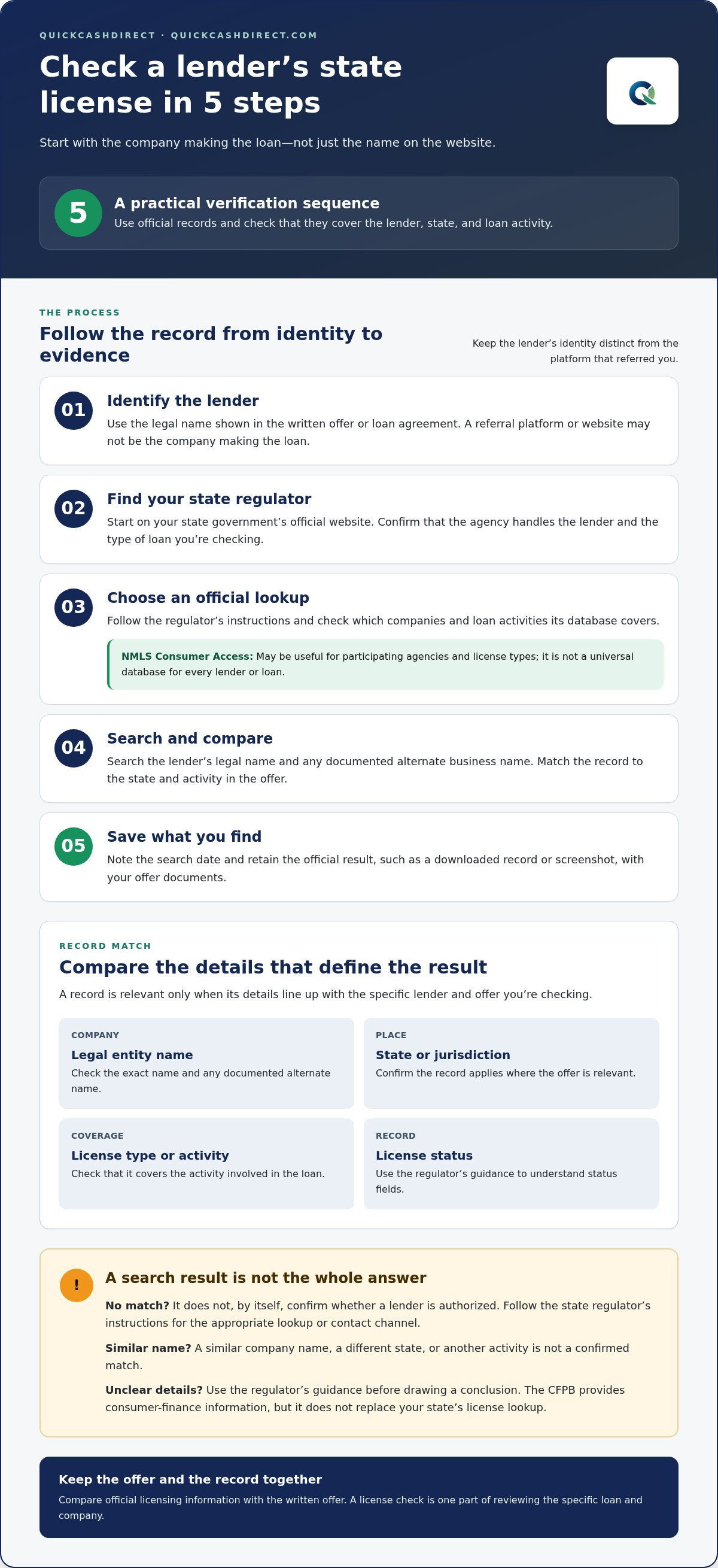
Use official records and follow the details of the specific offer. The right search depends on the lender’s legal name, the loan activity, and which state agency oversees it. Work through these steps in order. A database result is useful only if it covers the company and activity you’re checking.
- Identify the lender. Use the legal name shown in the offer or agreement. Keep the website or referral platform name separate.
- Locate your state regulator. Search your state government’s official website for financial regulation or lender license verification. Confirm that the agency handles the type of loan involved.
- Choose an official lookup tool. Follow the regulator’s instructions and check which companies and loan activities its database covers. NMLS Consumer Access can be useful for participating agencies and license types, but it isn’t a universal database for every lender or loan.
- Search and compare. Search the lender’s legal name and any documented alternate business names. Match the record to the state and activity shown in your offer.
- Save what you find. Record the search date and retain the official result, such as a downloaded record or screenshot. Keep it with the offer documents.
Find the correct state regulator and official lookup tool
Start with your state government’s official site, not an advertisement or unofficial directory. Search for terms such as “financial regulator,” “lender license lookup,” or “consumer credit license.” Oversight may sit with agencies responsible for banking, financial services, or consumer credit. Agency names and responsibilities differ by state, so verify that the page covers the lender and loan activity you need to check.
NMLS Consumer Access may provide a relevant record, but its coverage depends on the participating agency and license type. If the search doesn’t return a match, follow the state regulator’s instructions to find the appropriate database or contact channel. The Consumer Financial Protection Bureau (CFPB) offers consumer-finance information, but it isn’t a substitute for your state’s license lookup.
Compare the license record with the loan offer
Verify the lender’s legal name against the regulator’s record. Then compare any documented alternate name, the state or jurisdiction, license type, and status. “Jurisdiction” identifies where a record applies; “license type” describes the regulated activity it covers. Don’t treat a record for a similarly named company, a different state, or another activity as a confirmed match.
Save the result and note when you searched. If the state site explains a status or field you don’t understand, use that agency’s guidance before drawing a conclusion. QuickCashDirect connects borrowers with a network of lenders. You can explore online loan options, while keeping the lender named in each offer distinct from the referral platform.
How to interpret a lender license search without misreading it
A search result is one piece of information, not a complete answer about a loan. Read the company name, jurisdiction, license type, and status together. A similar name alone doesn’t establish that a record belongs to the lender named in your offer. Check identifying details and use the regulator’s guidance if anything doesn’t line up.
What an active, inactive, or missing result can mean
Use this comparison as a starting point, not a final legal conclusion. Database labels and explanations vary by regulator, so follow the instructions attached to the official record.
| Search result | How to read it | What to do next |
|---|---|---|
| Active | A record appears current for a listed license and jurisdiction. | Confirm the legal entity, state, and loan-related activity match the offer. An active entry doesn’t prove every loan offer meets every applicable requirement. |
| Inactive or expired | The displayed authorization may not currently be active. | Check the regulator’s explanation and ask the agency to clarify the record before relying on it. |
| Not found | The search returned no matching record in that database. | Check spelling and alternate names. The lender may be listed with another agency, or the database may not cover that lender or activity. |
| Ambiguous or conflicting | Names, statuses, or other details don’t clearly match. | Don’t treat a close name as proof. Compare identifying details and seek clarification from the relevant regulator. |
Treat a missing result as a reason to verify further, not automatic proof that a lender is unlicensed. Search the exact legal name and documented alternate names. Then confirm that the database covers the lender type and activity. The NMLS Consumer Access website can help with records for participating agencies and license types, but it may not include every lender or loan activity.
Why license status does not answer every loan question
A license record concerns authorization for a particular activity and jurisdiction. It doesn’t tell you whether an offer’s repayment schedule, fees, or other terms fit your needs. It also doesn’t establish that you’ll qualify or, by itself, settle whether a specific loan complies with every law that may apply.
Take extra care with tribal lending or other arrangements involving complex business or legal structures. The relevant rules can depend on the details and state context, so don’t draw a nationwide conclusion from one lookup. The guide to tribal loans and sovereign funding options provides additional context on why these questions may require closer review. If records conflict or the legal effect is unclear, pause and seek state-specific guidance from the appropriate regulator or a qualified legal professional.
Warning signs and next steps when a lender record is unclear
A mismatch deserves attention, but it doesn’t prove misconduct by itself. A lender may use a documented alternate name, or a database may not cover the loan activity you searched. Focus on whether the offer, agreement, company details, and official record can be reconciled. If essential details don’t match, pause before sharing sensitive information or accepting the offer.
Recognize inconsistencies without jumping to conclusions
Compare the lender name, contact information, stated state coverage, and disclosures across the offer and regulator record. Look for an unexplained company name, a license claim that doesn’t appear in the relevant official source, or documents that identify different businesses as responsible for the loan.
A failed search is a prompt to clarify, not automatic proof of a scam. Check spelling, documented alternate names, and whether you used the right regulator and database. Urgency, an online-only process, or a particular loan category alone doesn’t establish that a company is fraudulent. The concern is stronger when several important details conflict or the company won’t make its role clear.
Document the offer and use official consumer channels
Keep a clear record before you report a concern. Save the advertisement, application page, offer disclosures, loan agreement, messages, and relevant regulator search results. Note the date of each search and the specific details that don’t match. Retain the original copies or screenshots where possible.
For questions about a license entry or the scope of an agency’s records, use the contact information on the regulator’s official state website. If the facts warrant a complaint, follow that agency’s official complaint process and include supporting documents. The Consumer Financial Protection Bureau also provides federal consumer-finance information and resources, but it doesn’t replace a state license lookup or determine what a particular state record means.
Before reporting, document the lender’s stated legal name, the offer and agreement, the license claim, the official search result, the dates checked, and the specific inconsistencies.
Keep your next step simple: clarify the record through official channels, and don’t proceed while key company or offer details remain inconsistent. If you’re exploring short-term loan options, review online loan options and identify the lender named in any specific offer.
Use a license check before comparing an online loan offer
A license search helps you check whether a lender appears in relevant official records. It’s one checkpoint, not a substitute for reading the offer. Connect the record to the lender named in the agreement, then compare the written loan terms with your budget and repayment needs.
A final checklist before you proceed
Use this checklist to bring the verification process and offer review together. Don’t rely on a website name alone or on a result that doesn’t clearly match the lender and loan activity.
- Confirm the lender’s legal name. Make sure the offer and agreement identify the same company responsible for making the loan.
- Identify the relevant state regulator. Check that its official lookup covers the lender type and activity involved.
- Review the license record. Compare the entity, state, license type, and status. Note any uncertainty or mismatch instead of assuming the result settles the question.
- Read the full written offer. Check the payment dates and amounts, total repayment, fees, and stated consequences if you don’t repay as scheduled.
- Assess the repayment schedule. Consider whether the due dates and payments fit your expected income and essential expenses. Don’t accept terms you don’t understand.
Compare offers using the same details. A lower payment at one point in the schedule may not mean a lower total repayment. Read every disclosure and make sure the written agreement matches the offer you reviewed. If the lender identity or terms change, pause and review the updated documents before deciding.
Understand how a loan referral service fits into the process
A referral platform can connect applicants with lenders, but it doesn’t make the loan. QuickCashDirect is an online loan referral service, not a direct lender. The lender named in a specific offer is the company to evaluate for that loan. Review that lender’s identity, relevant license record, and agreement rather than treating the platform and lender as the same business.
This keeps the decision grounded in the actual offer. A license result doesn’t promise approval, confirm that a loan fits your finances, or replace a full review of the contract. If a key detail remains unclear, resolve it through official state channels before sharing sensitive information or agreeing to terms.
Once you’ve checked the lender and reviewed the written terms, you can explore available loan options through QuickCashDirect’s referral service. Review any offer from the lender responsible for it, and make your decision based on the specific agreement.
Make your next loan decision with clarity
Use your verification notes as a reference if an offer changes or you compare another option. A new lender name, updated agreement, or different repayment schedule calls for a fresh review. Keep the company identity and written terms in view, and take time to resolve inconsistencies before deciding.
If you’re still considering how to check if a loan company is licensed in your state, remember that the goal is a better-informed choice, not a shortcut to a guaranteed outcome. QuickCashDirect is a loan referral service, not a direct lender, and connects borrowers with a network of lenders. Review the specific lender and offer tied to any option you consider.
Ready to explore loan options? Explore available loan options, then review any offer carefully before deciding.
Frequently Asked Questions
How do I check if an online lender is licensed in my state?
Start with the lender’s legal name in the offer or agreement. Find the official state agency responsible for that type of lending, then use its license lookup if available. Compare the entity name, license type, status, and state. If there’s no match, check whether the agency lists another database or search method before assuming the lender has no license.
Is a loan company required to be licensed in every state where it lends?
Licensing requirements depend on the state, the company’s activities, and the type of loan. There isn’t one national rule that answers every situation. A requirement for one kind of lending may not apply in the same way to another. Check the relevant state regulator’s current guidance for the specific offer. If the lender’s structure or the state involved makes the answer unclear, consider getting qualified legal guidance.
Can I use NMLS Consumer Access to verify every loan company?
No. NMLS Consumer Access can show records for certain licensees, but it shouldn’t be treated as a complete directory of every lender or loan product. A state regulator may use a different search system or maintain additional records. Check the regulator’s website to learn what its lookup covers. If a company doesn’t appear, try its exact legal name and any documented alternate name, then investigate through the state’s official channels.
What if I cannot find the lender in my state's license database?
First, check that you copied the lender’s legal name correctly and try any alternate business name shown in the offer documents. Then see whether the state directs consumers to another agency or database for that loan activity. A missing result doesn’t explain why no record appeared. If company details still conflict or the license claim can’t be checked, pause before proceeding and use the regulator’s official contact or complaint process.
Does a lender license prove that a loan is legitimate or a good deal?
No. A license record may provide information about a company’s regulatory status, but it doesn’t tell you whether the loan suits your finances or whether its terms are favorable. Read the agreement and disclosures closely. Compare scheduled payments with your budget and check how the lender describes fees and repayment obligations. Also make sure the record identifies the same legal entity named in the offer.
How can I tell whether a loan website is the lender or a referral service?
Look for a clear company description, then check which business the offer and agreement identify as making the loan. A referral service connects applicants with lenders; it isn’t necessarily the business providing the funds. QuickCashDirect is a non-direct lender that connects borrowers with a network of lenders. Review the specific lender’s information and loan documents tied to an offer instead of assuming the website brand is the lender.
Who should I contact if I suspect an online lender is operating improperly?
Start with the official state regulator responsible for the loan activity. Its website should explain how to ask about a record or submit a complaint. The Consumer Financial Protection Bureau also offers a federal consumer complaint resource, but it doesn’t replace a state license lookup. Keep relevant advertisements, messages, offer documents, and search results together. A concise timeline and specific examples can help make your inquiry or report easier to understand.