
The fastest applications are usually the ones with complete, consistent information, but there’s no single processing time for every loan. Understanding how lenders evaluate loan applications helps explain why: they review credit history, existing debt, income, and supporting documents before making a decision. If information needs clarification or more documents are requested, processing can take longer.
It’s natural to want a clear answer about when you’ll hear back. Timing depends on the loan and how quickly the lender can complete its review, so it helps to understand what can affect the process rather than rely on a fixed estimate. This guide explains what lenders may look for in your credit, debt-to-income ratio, and income records, including for self-employed applicants. You’ll also learn what underwriting involves and why an application may need extra review, so you can follow the steps from submission to decision.
Key Takeaways
- Credit history helps lenders assess repayment patterns, while your existing debts show how much room you may have for another payment.
- Compare your monthly debt payments with your gross income to understand how lenders assess your debt-to-income ratio.
- Prepare for income verification with records that reflect how you earn, including self-employment income and business finances.
- Complete, consistent documents can help keep an application moving; underwriting may take longer when the lender needs more information.
Credit history and credit scores
Credit history shows how you’ve managed borrowing, while a credit score summarizes information in your credit profile. Understanding how lenders evaluate loan applications starts with these records, which help lenders assess repayment patterns alongside other details in your application.
Credit Scores and Lender Thresholds
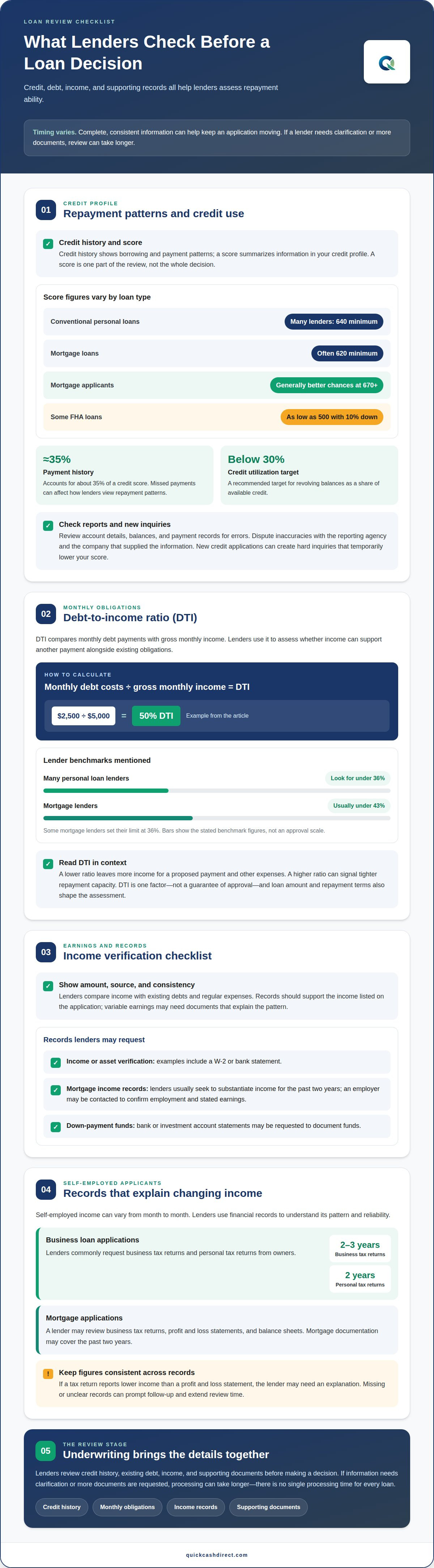
Credit score expectations depend on the loan. Many lenders set a minimum score of 640 for conventional personal loans. Mortgage lenders often require a FICO Score of at least 620, and applicants generally have better chances with a score of 670 or higher. Some FHA loans may allow a score as low as 500 with a 10% down payment.
Payment Patterns and Credit Use
Payment history records whether you’ve paid credit accounts on time, while credit utilization compares revolving balances with available credit. Payment history accounts for about 35% of a credit score. A recommended utilization target is below 30% of available credit. A high balance or missed payment can affect how lenders view repayment patterns and approval risk.
Personal and Business Credit Profiles
Personal credit reflects your borrowing history, while a business credit profile relates to a company’s credit activity. For a personal loan, lenders may focus on your personal credit report, income, employment, and monthly obligations. Business financing can involve both business and personal credit. A strong profile can provide useful context, but lenders may assess each one separately.
Limited or Adverse Credit History
A limited credit file gives lenders fewer repayment records to assess; adverse history may show missed payments or other credit difficulties. This can make approval harder, but a score is only one part of the review. When considering how lenders evaluate loan applications, remember that income records, such as pay stubs or tax returns, and existing obligations can also matter. Some borrowers explore loans for bad credit, but should review the repayment terms before accepting an offer.
Credit Report Errors and Inquiries
Review your credit reports for inaccurate account details, balances, or payment records. If you find an error, dispute it with the reporting agency and the company that supplied the information. Applying for new credit can create a hard inquiry that temporarily lowers your score. Avoid unnecessary applications while a lender reviews your file, since each inquiry may be another factor in the assessment.
Debt-to-income ratio
Debt-to-income ratio compares monthly debt payments with gross monthly income. Lenders use it to assess whether your income can support another payment alongside existing obligations. Understanding how lenders evaluate loan applications means considering this measure in context, not treating it as the sole basis for a decision.
Measuring Debt Relative to Income
Calculate the ratio by dividing monthly debt costs by gross monthly income, then converting the result to a percentage. For example, $2,500 in monthly debt costs divided by $5,000 in gross monthly income equals a 50% ratio. Many personal loan lenders look for a ratio under 36%. Mortgage lenders usually require a ratio under 43%, although some set their limit at 36%.
A lower ratio leaves more income available for a proposed payment and other expenses. A higher ratio can signal tighter repayment capacity, even when income is steady. The ratio is one factor in lending decisions, not a guarantee of approval. The requested loan amount and repayment terms also shape the assessment. This is another part of how lenders evaluate loan applications for different borrowing needs.
Income and Repayment Ability
Income helps lenders assess whether you can make payments while meeting existing debts and regular expenses. They consider the amount, source, and consistency of your earnings, then compare those details with your obligations. A steady salary may be easier to document than variable earnings, but your records should support the income listed on your application.
Include all required income details when you submit an application. If income varies, supporting records can help explain the pattern. Lenders may ask for additional income or asset verification, such as a W-2 or bank statement. That review helps them assess repayment ability rather than relying on a single figure.
Mortgage Income Verification Documents
Mortgage lenders usually seek to substantiate income for the past two years. A lender may contact your employer to confirm your employment and stated earnings. Self-employed applicants and small business owners may need business tax returns, profit and loss statements, and balance sheets covering the past two years. Side-job income may also need two years of documentation.
Submit bank or investment account statements if the lender needs to document funds for a down payment. Consistent records can help explain income and assets. Missing documents can prompt follow-up and extend review time. If you’re weighing borrowing options, explore short-term loan options alongside your budget.
Income verification for self-employed borrowers
Self-employed income can vary from month to month, so lenders use records to understand its pattern and reliability. The application process may take longer if reported earnings need clarification or supporting documents are missing.
Records That Support Self-Employed Income
For business loan applications, lenders commonly request two to three years of business tax returns and two years of personal tax returns from owners. For a mortgage, a lender may review business returns, profit and loss statements, and balance sheets to assess income and financial history. These records can show how revenue, expenses, and earnings change over time.
Keep the figures consistent across documents. For example, if a tax return reports lower income than a profit and loss statement, the lender may need to understand why. Some mortgage applicants may be asked to file IRS Form 4506-T so the lender can receive tax return information directly from the IRS. Lenders may also use the IRS Income Verification Express Service to access that information.
Electronic Verification and Employment History
Electronic verification can support employment checks for some FHA mortgage applications when the loan receives appropriate approval through FHA’s TOTAL Mortgage Scorecard. This option relates to employment verification; it does not replace every income record or guarantee approval. Lenders still assess the borrower’s full documentation and ability to repay.
Employment history also provides context. A lender may consider whether your income comes from an ongoing business, contract work, or a combination of sources. If you recently changed how you earn, clear records can explain the transition. The lender seeks to verify that your reported income reflects a pattern that can support repayment.
Savings and Variable Earnings
Emergency savings may help show that you have a financial buffer for unexpected challenges. Savings don’t replace income verification, but they can provide a lender with additional context about repayment capacity. For example, a borrower with seasonal business earnings may have fluctuating income and funds set aside for slower periods.
Submit complete records when requested, including relevant tax documents, statements, and business financials. Missing or inconsistent documents can prompt follow-up and extend the review. Clear evidence helps lenders assess income stability, employment history, and your ability to manage payments and interest over the loan term.
Why do lenders underwrite personal loans?
Underwriting helps lenders assess repayment risk, verify application details, and decide whether a loan fits your financial situation. Personal loans focus on your finances; auto loans also involve the vehicle, while mortgages involve the home and its value.
Requirements vary by loan type and lender. Conventional and government-backed mortgages can follow different eligibility standards, but both involve reviewing the borrower’s ability to repay.
Co-Signers and Secured Borrowing
A co-signer agrees to share responsibility for repayment, while a secured loan is backed by an asset. A co-signer with strong credit may improve approval odds when an applicant’s credit or income falls short. The lender evaluates the co-signer’s profile as part of the application. Before applying, consider how missed payments could affect both people’s finances.
Collateral and Loan Requirements
Collateral is an asset connected to a secured loan that may be at risk if the borrower doesn’t repay. An auto loan may use the vehicle as collateral; a mortgage is secured by the home. Personal loans may be unsecured, so lenders rely more on the borrower’s credit, income, and repayment capacity. The type and value of collateral shape the review.
Mortgage underwriting also considers the loan structure. A 15-year fixed-rate conventional mortgage generally has a lower interest rate and stricter borrower requirements than a longer-term mortgage. A 30-year fixed-rate conventional mortgage generally has a higher rate and more affordable payments. With an adjustable-rate loan, the interest rate can change under the loan terms, so understand how payment changes could affect your budget.
Prepare complete statements and credit reports before applying. A clear picture of your finances helps the lender assess your situation and make a responsible decision. If you need a short-term option for a different borrowing need, explore loans for bad credit.
QuickCashDirect
QuickCashDirect offers short-term financial options for people reviewing their borrowing choices after learning how lenders assess applications. Its offerings include payday loans, cash advances, online payday loans, and loans for bad credit. These options may be relevant when you need to explore borrowing beyond a conventional personal loan.
Before applying, consider the payment schedule and whether it fits your income and existing obligations. Review the terms carefully so you understand the repayment commitment and can make an informed decision. A loan is not the right fit for every financial situation.
For information about available options, contact QuickCashDirect.
Choose Your Next Step With Confidence
Knowing how lenders evaluate loan applications can help you make a deliberate borrowing choice. Before applying, identify the expense, decide what payment fits your budget, and consider how borrowing could affect upcoming bills. A loan should address a specific need without creating repayment strain.
Processing time can vary depending on the lender’s review and any follow-up requests. Keep your information accurate and respond promptly if the lender needs clarification. Before accepting an offer, read its repayment schedule and terms carefully. Compare the commitment with your expected income and essential expenses, not just the immediate need.
If you’re considering a short-term financial option, take time to decide whether it suits your situation and repayment capacity. Clear questions can help you understand the next step and make a choice that works for your budget.
Contact QuickCashDirect to discuss your options and move forward with clarity.
Frequently Asked Questions
What are the possible underwriting outcomes?
An underwriter may approve an application, decline it, or request more information before deciding. An approval may include loan terms for you to review. A request for documents means the review is still underway, not that the lender has made a final decision. Providing clear, relevant records can help resolve questions about information in your application.
What do underwriters look at?
Underwriters assess whether application details support the requested loan and its repayment. They may review credit reports, income records, existing obligations, and, for secured borrowing, information about the collateral. They also look for inconsistencies, such as income figures that differ across documents. A clear explanation or supporting record can help the lender understand a discrepancy and continue the assessment.
What is loan underwriting?
Loan underwriting is the lender’s review of an application before a lending decision. It brings together the borrower’s financial details and the loan’s requirements to assess repayment risk. For example, an underwriter may compare stated income with supporting documents and consider current obligations. Depending on the application, the review may lead to approval, a request for clarification, or a decline.
What factors do lenders consider when evaluating a loan application?
Lenders may consider your credit profile, income, employment history, current debt, requested amount, and repayment terms. A secured loan can also involve collateral. The weight of each factor depends on the loan type. For example, an auto loan involves the vehicle, while a personal loan may depend more on the borrower’s financial profile and ability to repay.
How do lenders check credit scores and credit history for a loan?
Lenders generally review a credit report and score as part of an application. The report can show account balances, payment history, and recent credit inquiries. Lenders may compare these details with the information on your application. If an account or balance looks unfamiliar, check your records and be ready to explain the difference. Applying for new credit can create a hard inquiry that temporarily lowers your score.
How do lenders calculate debt-to-income ratio, and what limits do they use?
To calculate debt-to-income ratio, divide monthly debt costs by gross monthly income and express the result as a percentage. Many personal loan lenders look for a ratio under 36%. Mortgage lenders usually require a ratio under 43%, while some set a 36% limit. These are common thresholds, not one universal rule for every loan or lender.