
The fastest loan offer isn’t always the safest choice. If an urgent bill can’t wait, emergency installment loans for bad credit may seem practical. But approval alone won’t tell you whether the payments fit your budget.
A low credit score can make eligibility feel uncertain, and limited time can make APRs, fees, and repayment schedules harder to compare. Before accepting an offer, focus on the total repayment and whether you can manage each scheduled payment. Installment loans spread repayment across multiple payments, unlike borrowing that may require repayment in one lump sum.
This guide explains how emergency installment loans work, what to check in an offer, and how to compare repayment terms without assuming approval is guaranteed. QuickCashDirect is a free loan-introduction service that connects applicants with lenders offering online personal loans from $300 to $3,000, with terms from 3 to 36 months and APRs from 5.99% to 35.99% for qualified consumers. Checking rates through QuickCashDirect uses a soft credit check and doesn’t affect your credit score. Lender criteria apply, and approval isn’t guaranteed. Review each lender’s agreement carefully before deciding.
Key Takeaways
- Understand how emergency installment loans move from application and lender review to agreement and repayment.
- Compare APR, payment schedule, term, fees, total repayment, and lender side by side. Don’t judge an offer by its monthly payment alone.
- Before borrowing, confirm the expense, review funds you can use, and see whether each scheduled payment fits alongside essential bills and existing debt.
- Read the lender’s agreement closely to understand the full repayment obligation and any lender-specific fees before accepting an offer.
- Consider a loan introduction as one possible route, while keeping your repayment budget and the possibility of no approval in mind.
What are emergency installment loans for bad credit?
An urgent bill and a low credit score can make every borrowing decision feel rushed. Start by identifying what you would need to repay and when. Emergency installment loans for bad credit are loans repaid through scheduled payments over an agreed term. The schedule and term vary by lender and offer, so the loan type alone doesn’t tell you the payment amount or total cost.
An installment loan is a repayment structure, not a promise that an application will be accepted. Lenders set their own criteria and may assess credit information, income, and ability to repay. A low score can affect the options available, but it doesn’t determine eligibility on its own. Approval, loan amount, rate, and terms depend on the lender’s review.
The loan comes from a lender. A loan-introduction service has a different role: it connects applicants with lenders but doesn’t make lending decisions or set the final agreement. Know which party is offering the loan before you proceed. For broader background, see What is an Installment Loan? QuickCashDirect isn’t responsible for external-site content, and you use external links at your own risk.
How installment payments differ from a payday loan
Installment borrowing generally divides repayment into scheduled payments across a stated term. A payday loan often uses a single-payment structure, with repayment due at a set time rather than spread across multiple installments. Schedules and terms vary, so read the offer and agreement instead of relying on the loan type’s name.
Neither structure is automatically right for every emergency. A single payment may be difficult to manage, while installments can commit part of your future income over time. Compare due dates and repayment requirements with your budget before deciding.
Why bad credit does not guarantee or prevent approval
Lenders may consider more than a credit score. They can review income and ability to repay alongside credit information, using criteria that vary between lenders. No credit profile guarantees approval or a particular rate, loan amount, or payment schedule. An application may also be declined.
Credit inquiries are requests to review information in your credit file as part of an application or account decision. Checking rates through QuickCashDirect uses a soft check and doesn’t affect your credit score. A hard inquiry occurs only if you accept an offer. Review the lender’s disclosures to understand the inquiry process for a specific offer.
Use the repayment plan, not urgency alone, to guide your decision. Make sure you understand how often payments are due, how long they continue, and whether you can meet them alongside essential expenses. If the scheduled payments don’t fit your budget, borrowing could add pressure rather than resolve it.
How emergency installment loans work from application to repayment
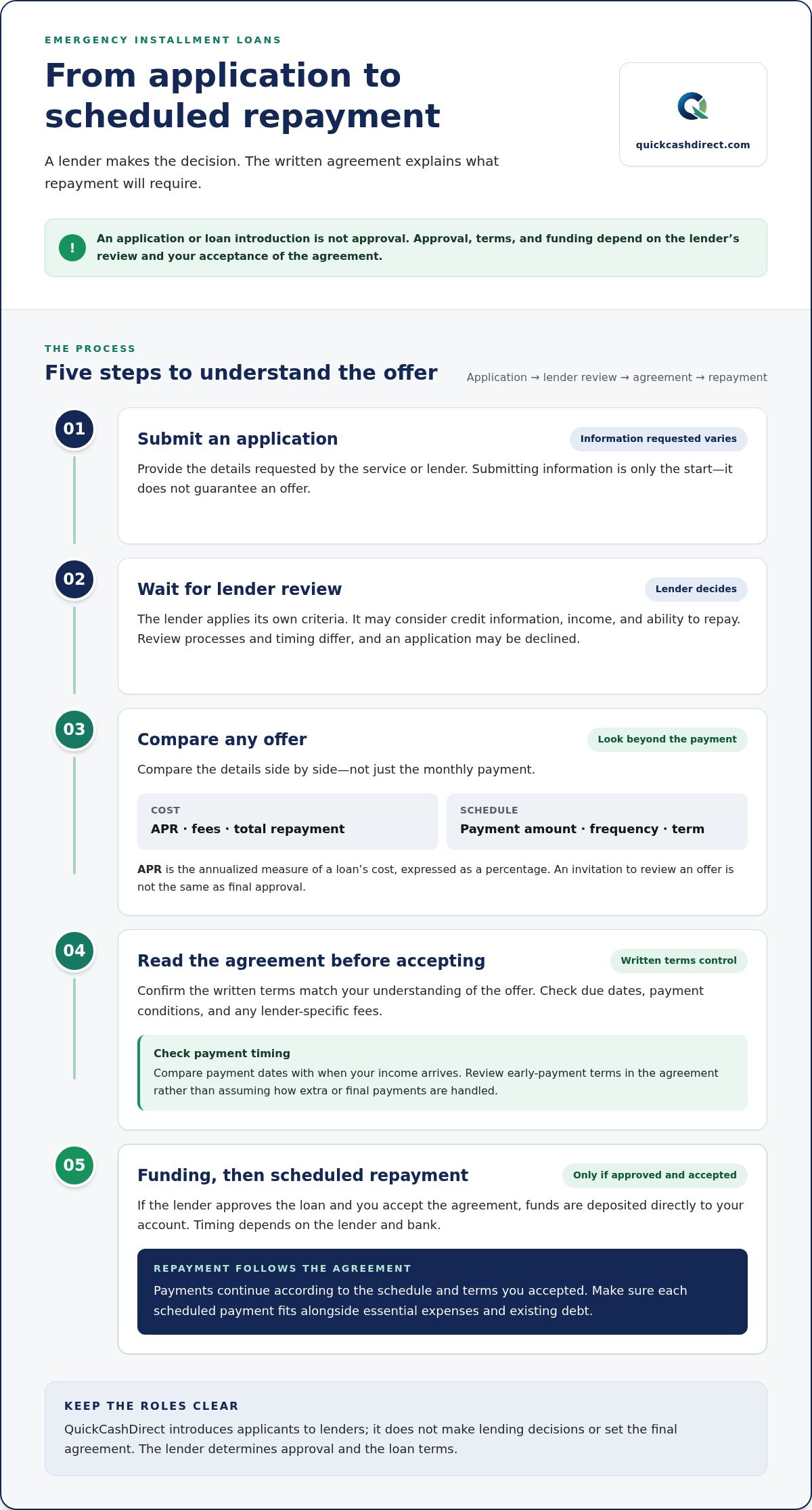
Applying for emergency installment loans for bad credit usually involves several steps. An online application or lender introduction is only the start. The lender makes the decision, and the agreement explains what repayment will require. The information requested and decision timing vary, so don’t assume that an application will produce approval or funds.
- Submit an application. Provide the information requested. Requirements vary, and submitting details doesn’t guarantee an offer.
- Wait for lender review. A lender assesses the application under its own criteria. It may consider credit information, income, and ability to repay. Review processes and timing differ.
- Review any offer. If a lender makes an offer, compare its APR, payment schedule, term, fees, and total repayment. An introduction or invitation to review an offer isn’t the same as final approval.
- Read the agreement before accepting. Check that the written terms match your understanding of the offer. Review due dates and payment conditions, not just the amount you might receive.
- Receive funds if approved and accepted. Funding happens only if the lender approves the loan and you accept the agreement. Funds are deposited directly to your account, with timing depending on the lender and bank. Repayments then follow the schedule in your agreement.
What happens after an application is submitted?
The lender reviews the application and decides whether to make an offer. If you use a loan-introduction service, its role is to connect applicants with lenders, not to approve or fund a loan. Treat an introduction as a possible next step, not a promise. If a lender approves an offer you accept, it deposits funds directly to your account. Timing depends on the lender’s process and bank processing.
What to check in the loan agreement
Read the agreement before accepting. Confirm the APR, payment amount, payment frequency, term, and total repayment. APR is the annualized measure of a loan’s cost, expressed as a percentage. Check any lender-specific fees and conditions that affect payment timing or how payments are made. Compare payment dates with the dates your income arrives so you can spot a timing mismatch before you commit.
Early payoff is generally allowed without a penalty, but the specific agreement controls. Review its early-payment terms rather than assuming how extra or final payments will be handled. If any part of the agreement is unclear, pause before accepting. The written terms determine your obligation.
QuickCashDirect is a free loan-introduction service, not a lender. To explore a possible lender introduction, review loan introduction options. A lender applies its own criteria, and approval isn’t guaranteed.
How to compare emergency installment loans when you have bad credit
Compare the written terms, not just the speed of an offer or the payment that looks easiest today. Use the same checklist for each option. Record the lender’s figures directly from its offer or agreement, and mark anything that isn’t disclosed so you don’t compare incomplete information.
| APR | Payment schedule | Term | Fees | Total repayment | Lender |
|---|---|---|---|---|---|
| Offer A: record disclosed APR | Offer A: amount and due dates | Offer A: stated term | Offer A: listed fees | Offer A: disclosed total | Offer A: lender name |
| Offer B: record disclosed APR | Offer B: amount and due dates | Offer B: stated term | Offer B: listed fees | Offer B: disclosed total | Offer B: lender name |
Compare like with like. If offers have different loan amounts or terms, note that before drawing conclusions. A fast funding estimate doesn’t show what you’ll repay, and a lower scheduled payment doesn’t necessarily mean a lower overall cost.
Which loan details affect the total repayment?
APR, repayment term, and payment frequency help define the full obligation. APR is the annualized cost measure disclosed for a loan. The term shows how long repayment is scheduled to last, while payment frequency shows how often payments are due. The regular payment is only one part of the picture. The lowest monthly payment may not mean the lowest total repayment. Compare the total amount due over the full term, including applicable fees.
Keep the repayment structure clear, too. An installment loan is repaid through scheduled payments over a term. A payday loan commonly uses a single-payment structure. A title loan is secured by a vehicle, while a line of credit lets a borrower draw from available credit and repay under its terms. These are different borrowing arrangements, not interchangeable installment offers. Compare actual due dates and repayment obligations, and don’t assume any type automatically fits an emergency.
How does a soft credit check differ from a hard inquiry?
A soft check used to check rates doesn’t affect your credit score. Checking rates through QuickCashDirect uses a soft check. A hard inquiry occurs only if you accept an offer. Review the disclosures for the specific offer before proceeding, and don’t treat a rate result as approval or a final loan agreement.
After comparing the figures, consider whether the payment dates align with your income and other bills. Keep the lender’s name beside each offer so you know whose agreement sets the terms. If a figure is missing or unclear, don’t rely on assumptions. The written terms are the basis for understanding what you may owe.
How to decide whether an emergency loan payment fits your budget
An urgent expense can make borrowing feel like the only immediate answer. Before considering emergency installment loans for bad credit, check whether the scheduled payments can fit without putting essential expenses at risk. A loan that solves one bill but leaves too little for other obligations may create a new shortfall.
Use this checklist before accepting an offer:
- Confirm the expense. Identify what must be paid, how much is due, and when. Separate the urgent cost from anything that can wait.
- Review available funds. Look at take-home income and money already available for the expense. Account for essential bills such as housing, utilities, food, transportation, and insurance.
- Calculate room for each payment. Include existing debt payments and other regular obligations. Then check whether the proposed payment fits on every due date, not just the first one.
Be realistic about expenses that change from week to week or month to month. A budget that works only if nothing unexpected comes up may leave little room to manage a new payment.
A simple repayment-fit check before accepting
Compare take-home income with essential expenses and current obligations. What remains isn’t automatically available for a loan payment. First account for necessary spending that varies. Then place each proposed payment date beside your expected income date. If a payment falls before income arrives, consider whether you can cover it without delaying an essential bill. If the payment amount or date is unclear, review the agreement again before accepting.
When to pause before taking on new debt
Uncertainty about repayment capacity is a reason to slow down, not rush. Pause if you can’t tell whether every payment will fit, if making one would put essentials at risk, or if the agreement leaves key details unclear. That isn’t a judgment. It’s a practical signal to reassess your options before taking on another obligation.
Consider whether non-loan assistance could address the expense. You might also discuss payment options directly with the company or person you owe. These steps may clarify what’s due and when, without adding a loan payment to your budget. If you’re still comparing borrowing options, review a broader guide to loans for bad credit for additional context, then return to the actual terms of any offer.
If you’ve checked your budget and want to explore a possible lender introduction, review loan options through QuickCashDirect. QuickCashDirect is a free loan-introduction service, not a lender. Lender criteria apply, and approval isn’t guaranteed. Proceed only if the payment schedule fits your budget.
How QuickCashDirect introduces emergency loan options
QuickCashDirect is a free loan-introduction service, not a lender. It connects applicants with lenders offering online personal loans from $300 to $3,000, with terms from 3 to 36 months and APRs from 5.99% to 35.99% for qualified consumers. The lender reviews each application and makes the approval decision. Approval isn’t guaranteed, and the terms you receive depend on the lender.
Checking rates through QuickCashDirect uses a soft check and doesn’t affect your credit score. Review the lender’s disclosures and agreement before deciding, since the lender sets the final terms and discloses any applicable fees in the agreement.
What the QuickCashDirect process includes
The online process has three steps: complete the application, receive an online decision, and receive funds if approved. The application works on mobile devices. If a lender approves your application and you accept its offer, funds are sent by direct deposit. They may reach your bank account in as little as 15 minutes. Most lenders provide funding the same day or next business day after approval. Timing depends on the lender and bank processing, so these are not guaranteed arrival times.
QuickCashDirect may receive a commission if you accept an offer from a partner lender. QuickCashDirect isn’t the lender. The lender’s agreement sets your payment obligations, and any lender-specific fees are disclosed there.
What to know before accepting an introduced offer
Open the lender’s digital agreement and review the APR, any lender-specific fees, payment schedule, and total repayment. Check that the due dates work with your budget. Don’t rely on an initial match or online decision instead of reading the agreement. Early payoff is generally allowed without a penalty, but review your specific agreement for the applicable terms.
For a representative example, a $1,000 loan over 12 months has a 29.82% APR and $1,134.72 total payback. Your offer may differ. Use the example to understand how APR, term, and total repayment appear together, not as a prediction of your own terms. For related information, the guide to “Direct Deposit Loans in Minutes with No Credit” covers that borrowing topic separately.
If the offer fits your needs and repayment budget, Explore loan options through QuickCashDirect. Checking rates won’t affect your credit score, but lender criteria apply and approval isn’t guaranteed. Review the complete agreement before accepting.
Choose your next step with your budget in view
Urgency can make any available offer feel like the answer. Take one final pause before acting. Ask whether the expense must be handled now, whether the proposed payment fits alongside essential bills, and whether the agreement is clear enough for you to commit with confidence. If the numbers don’t work, it’s reasonable to wait or consider another way to address the expense.
If you’re ready to explore emergency installment loans for bad credit, keep repayment fit at the center of your decision. QuickCashDirect can introduce applicants to lenders, but it doesn’t make lending decisions. Checking rates uses a soft check that doesn’t affect your credit score. Read the offer and lender agreement carefully before accepting, and proceed only if the terms make sense for your situation.
Explore loan options through QuickCashDirect as a possible next step. Take your time with the decision. A clear plan can help you move forward with greater confidence.
Frequently Asked Questions
Can I get an emergency installment loan with bad credit?
Possibly, but a low credit score doesn’t guarantee approval or rule it out. Lenders set their own criteria and may consider income and ability to repay alongside credit information. Emergency installment loans for bad credit can have different rates and terms depending on the lender’s assessment. Before applying, consider whether you can provide the requested information and whether a potential payment would fit your budget.
Does checking loan rates affect my credit score?
Checking rates through QuickCashDirect uses a soft check and doesn’t affect your credit score. Review the lender’s disclosures before proceeding. Pay attention to the specific explanation shown with an offer.
How quickly can emergency installment loan funds arrive?
Funding timing depends on lender approval and bank processing. Funds may reach a bank account in as little as 15 minutes, and most lenders provide funding the same day or next business day after approval. These are possible timelines, not a promise of when money will arrive. If the expense has a firm deadline, consider what you’ll do if approval takes longer or funding is delayed.
What information should I compare in two installment-loan offers?
Compare the APR, payment amount and frequency, term, applicable fees, total repayment, and lender. Check that both offers cover the same borrowing amount and compare the complete repayment periods. A lower payment may come with a longer term, so it doesn’t automatically mean you’ll repay less overall. Note differences in due dates, too, and make sure the schedule works with your income timing.
Can I pay off an installment loan early without a penalty?
Early payoff is generally allowed without a penalty, but the specific lender agreement controls. Before making an extra payment or paying the balance in full, review the agreement’s early-payment terms. Check how the lender handles the payoff amount and whether you need to follow a particular process. Don’t assume every lender applies early payments in the same way.
Is QuickCashDirect the lender for an emergency installment loan?
No. QuickCashDirect is a free loan-introduction service, not a lender. It connects applicants with lenders, and those lenders review applications and make lending decisions. The personal loans available through the service are from $300 to $3,000, with terms from 3 to 36 months and APRs from 5.99% to 35.99% for qualified consumers. Approval isn’t guaranteed. Review the lender’s agreement to understand the offer and repayment terms.
What should I do if an emergency loan payment may be unaffordable?
Pause before accepting the offer. Recheck your take-home income, essential bills, existing debt payments, and the dates each loan payment would be due. If making a payment could leave you short for essentials, the loan may not fit your budget. Consider whether you can discuss payment options for the bill or find non-loan assistance. Don’t accept until you understand the terms and can assess the repayment schedule.