
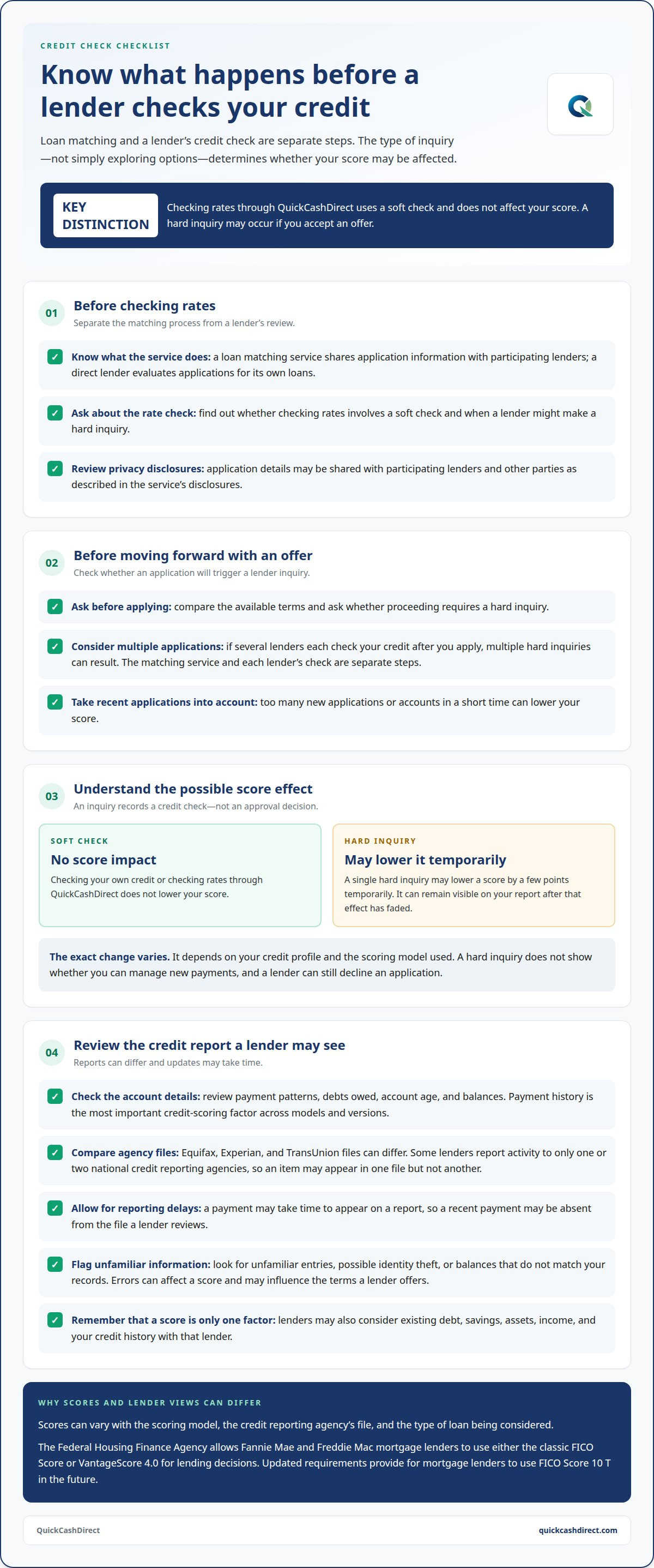
Loan matching and a lender’s credit check are separate steps. Whether loan matching services affect your credit score depends on the credit check involved. Checking rates through QuickCashDirect uses a soft check and does not affect your score. A hard inquiry may occur if you accept an offer.
It’s understandable to worry that exploring loan options could affect your credit before you know whether you’ll be approved. The important distinction is between a soft check and a hard inquiry. Checking your own credit or checking rates through QuickCashDirect doesn’t lower your score.
This guide explains how lender inquiries work, what credit reports and payment history can reveal, and what to expect when seeking a loan match. You’ll learn which steps can affect your score and how to review your options before proceeding.
Key Takeaways
- Loan matching itself and a lender’s credit check are separate steps; the type of inquiry matters when assessing possible score effects.
- Credit scores can vary with the scoring model, the credit bureau’s file, and the type of lending being considered.
- Payment history is a key scoring factor, while credit report updates and errors can affect what a lender sees.
- Learn how hard inquiries may factor into initial approval and when QuickCashDirect’s payday loans, cash advances, or loans for bad credit may fit your needs.
How lenders' credit checks relate to hard inquiries
Whether loan matching services affect your credit score depends on whether a lender makes a hard inquiry. A single hard inquiry may lower a score by a few points temporarily.
Matching Services, Direct Lenders, and Marketplaces
A loan matching service shares application information with participating lenders, while a direct lender evaluates applications for its own loans. A marketplace may also present offers from lenders, but the credit-check process varies. Before submitting details, find out whether checking rates involves a soft check and when a lender might make a hard inquiry.
A consumer score shown for personal use may differ from the score a lender reviews. Scores vary with the model, the credit reporting agency’s file, and the type of loan. The Federal Housing Finance Agency allows Fannie Mae and Freddie Mac mortgage lenders to use either the classic FICO Score or VantageScore 4.0 for lending decisions. The agency’s updated requirements provide for mortgage lenders to use FICO Score 10 T in the future.
Lenders may consider credit scores when assessing an application or deciding what terms to offer. A score is only one part of the information they may review.
Multiple Applications and Hard Inquiries
Sending your information to multiple lenders through a matching service can lead to multiple hard inquiries if those lenders each check your credit after you apply. A lender’s credit check may appear as a hard inquiry on your credit report. The service itself and each lender’s check are separate steps, so understand which action triggers a lender review.
Loan matching services share application details with participating lenders to find potential offers. Information may also be shared with other parties as described in the service’s privacy disclosures. Review those disclosures before submitting personal details. To compare offers while limiting unnecessary applications, first compare the available terms and ask whether moving forward requires a hard inquiry. Checking your own credit does not lower your score. Keep in mind that too many new applications or accounts in a short time can lower it.
Credit report information and payment history
A credit report records account activity that can shape a lender’s view of your credit history. It may include payment patterns, debts owed, and how long accounts have been open. Because credit scores use information in that history, a lender may consider both the report and the score.
Credit files can differ across Equifax, Experian, and TransUnion. Some lenders report account activity to only one or two national credit reporting agencies. As a result, a balance or payment may appear in one file but not another. Lenders may also see different scores if reports contain different information or were updated at different times.
Payment history is the most important credit scoring factor across models and versions. A record of missed or late payments can weigh on a score, while on-time payments contribute to the history that scoring models evaluate. Updates are not always immediate: payments may take time to appear on credit reports after they are made. A recent payment may therefore be absent from a report a lender reviews.
Review the accounts and balances in your reports. Look for unfamiliar entries, signs of identity theft, or balances that don’t match your records. Errors can affect a score and may influence the terms a lender offers. A lender may also consider existing debt, savings, assets, income, and your credit history with that lender. Your score is only one part of the application.
For a clear review, note which agency’s file contains each item and whether the account information looks accurate. Allow for reporting delays before assuming a payment was missed. If an account or balance is unfamiliar, treat it as a possible reporting issue, not proof that the entry is yours. Reviewing your reports can help explain why lender assessments differ.
If you’re exploring borrowing with a challenged credit history, bad credit loan options may offer a relevant next step.
Hard inquiries and initial approval
A hard inquiry can appear when you apply for a new loan or credit card and a lender checks your credit. Lenders may use your application and credit information to assess it.
Hard Inquiries During Initial Approval
A hard inquiry records a lender’s review of your credit during a credit application. It may affect your score while the lender evaluates your application.
Approval also depends on the information a lender considers, including your credit score and existing debt. For example, a mortgage lender may review income, savings, assets, and credit history alongside your score. Student loan or credit card balances may be part of your existing debt picture. An inquiry itself doesn’t show whether you can manage new payments.
Separate the application decision from the credit-score effect. A lender can review an application and still decline it; an inquiry records a credit check, not the decision. Several applications or newly opened accounts in a short time can affect your score, so consider each application before submitting it.
Inquiry Reporting and Credit Score Effects
A hard inquiry is recorded on your credit report after a lender checks your credit for a new application. Its score effect is temporary, and a single inquiry may lower a score by a few points temporarily. The inquiry can remain visible after that effect has faded.
There isn’t one score impact for every consumer. The change depends on your credit profile and the scoring model used. A lender may review a report updated at a different time, so the score you see can differ from the one used in an initial review.
To review your credit without creating a hard inquiry, check your own credit information. This does not lower your score. Then consider whether a new application is necessary, especially if you’re preparing for a mortgage or already have several recent applications. Payment history, debts, and credit history also shape scoring results.
Can submitting information to multiple lenders through a loan matching service cause multiple hard inquiries?
Yes, multiple hard inquiries may appear if separate lenders each check your credit after receiving your application. Sharing your information alone is not the same as a lender making a hard inquiry. The key is what happens after a matching service sends your details and lenders review them.
For example, you submit one application, and the service shares it with several lenders. If two lenders each make a hard inquiry while considering your application, both checks may appear on your credit report. The service’s submission and the lenders’ checks are separate actions. A match or offer alone doesn’t tell you whether a lender has already checked your credit.
Before submitting, look for an explanation of whether your information goes to multiple lenders and when a lender may make a hard inquiry. Identify whether a credit check applies to the matching step, a lender’s review, or both. This helps you understand which action could create an inquiry. Don’t assume every service follows the same process.
Compare the offer details before moving forward with an application. Focus on terms that matter to your decision, such as the payment schedule and borrowing conditions. If you proceed with a lender, a new loan application may result in a hard inquiry. Applying for or opening several new accounts in a short time can affect your score.
Keep the sequence clear: the service shares information, a lender evaluates an application, and a credit check may follow. Checking your own credit doesn’t lower your score and is separate from applying. Understanding the distinction helps you compare options without assuming every information submission creates an inquiry.
If you’re considering borrowing with a challenged credit history, explore loans for bad credit as a possible option.
QuickCashDirect: Loans for bad credit
QuickCashDirect offers loans for bad credit for people exploring borrowing options with a challenging credit history. If you need short-term financial assistance, its payday loans, cash advances, and online payday loans provide options to consider alongside your budget and repayment obligations.
Credit inquiries and approval are separate considerations. Before proceeding, understand whether a lender will check your credit and review the repayment terms carefully. Choose an option that fits your needs and your ability to make payments.
For help exploring available borrowing options, contact QuickCashDirect.
Choose your next borrowing step with clarity
Before moving forward, decide what repayment commitment fits your budget and what information you’re comfortable sharing. Review the application process and the terms attached to any offer. This preparation can help you make a deliberate choice rather than rushing into another application.
If you’re still wondering whether loan matching services affect your credit score, focus on the specific credit check and the decision you’re being asked to make. Consider both your immediate need and the payments that follow.
QuickCashDirect offers payday loans, cash advances, and payday loans online. For questions about your options, contact QuickCashDirect. Take the next step when you’re ready, with a clear view of what you need and what you can manage.
Frequently Asked Questions
Do loan matching services perform a hard or soft credit inquiry?
It depends on the service and the stage of your application. When you check rates through QuickCashDirect, a soft check is used and your credit score is not affected. A hard inquiry may occur if you accept an offer. This distinction matters when comparing options: checking rates is separate from accepting an offer and proceeding with a lender.
Does checking loan offers through a loan matching service affect your credit score?
Checking rates through QuickCashDirect doesn’t affect your credit score. The service connects borrowers with lenders and uses a soft check when showing rates. Accepting an offer is a separate step and may involve a hard inquiry. If you’re reviewing potential options, distinguish that from accepting an offer and proceeding with a lender.
When does a loan application trigger a hard credit inquiry?
A hard inquiry may occur when a lender checks your credit while evaluating a new loan application. Viewing possible rates through QuickCashDirect is different from accepting an offer and proceeding with a lender. Keep track of when you move from comparing options to accepting an offer, and review the lender’s credit-check terms.
How can I tell whether a loan matching service will run a hard credit check?
Read the credit-check information before deciding whether to accept an offer. QuickCashDirect uses a soft check when you check rates, which does not affect your score. The service shares information only with chosen lenders. If you accept an offer, a lender may make a hard inquiry as part of its application review.
How long do hard inquiries stay on a credit report and affect a credit score?
A hard inquiry’s effect is temporary and may lower a score by a few points. It can remain visible on your credit report after that effect has faded.