
An unpaid debt should not control your life or your peace of mind. You are likely dealing with relentless collection agents and the looming fear of a court date. Many borrowers ask, can a payday lender sue you? While a lender can legally file a civil lawsuit, they must follow strict federal and state regulations before they ever touch your paycheck. In 2026, many states have introduced even tighter restrictions to protect consumers from aggressive tactics. You are not alone in this situation, and there are structured ways to resolve this debt without losing your financial stability.
You need to understand your rights to stop the cycle of stress immediately. This article provides a professional breakdown of the legal risks and the exact steps to protect your wages from garnishment. We cover everything from the four year statute of limitations in Texas and California to the specific prohibitions on garnishment in North Carolina. Learn how to identify empty threats, navigate the court process, and find a fast way to settle or refinance your debt for good. Follow this guide to move from a state of urgent need to a state of total resolution.
Key Takeaways
- Identify the legal triggers and specific conditions regarding when a payday lender can sue you for outstanding debt.
- Secure your income by learning the federal laws that restrict wage garnishment and require formal court judgments.
- Master the 90-day collection timeline to anticipate lender actions before they reach third-party agencies.
- Execute proactive resolution strategies like Extended Payment Plans to stop legal threats and aggressive calls immediately.
- Explore structured installment options to refinance your debt and exit the high-interest cycle for good.
The Legal Reality: Can a Payday Lender Sue You?
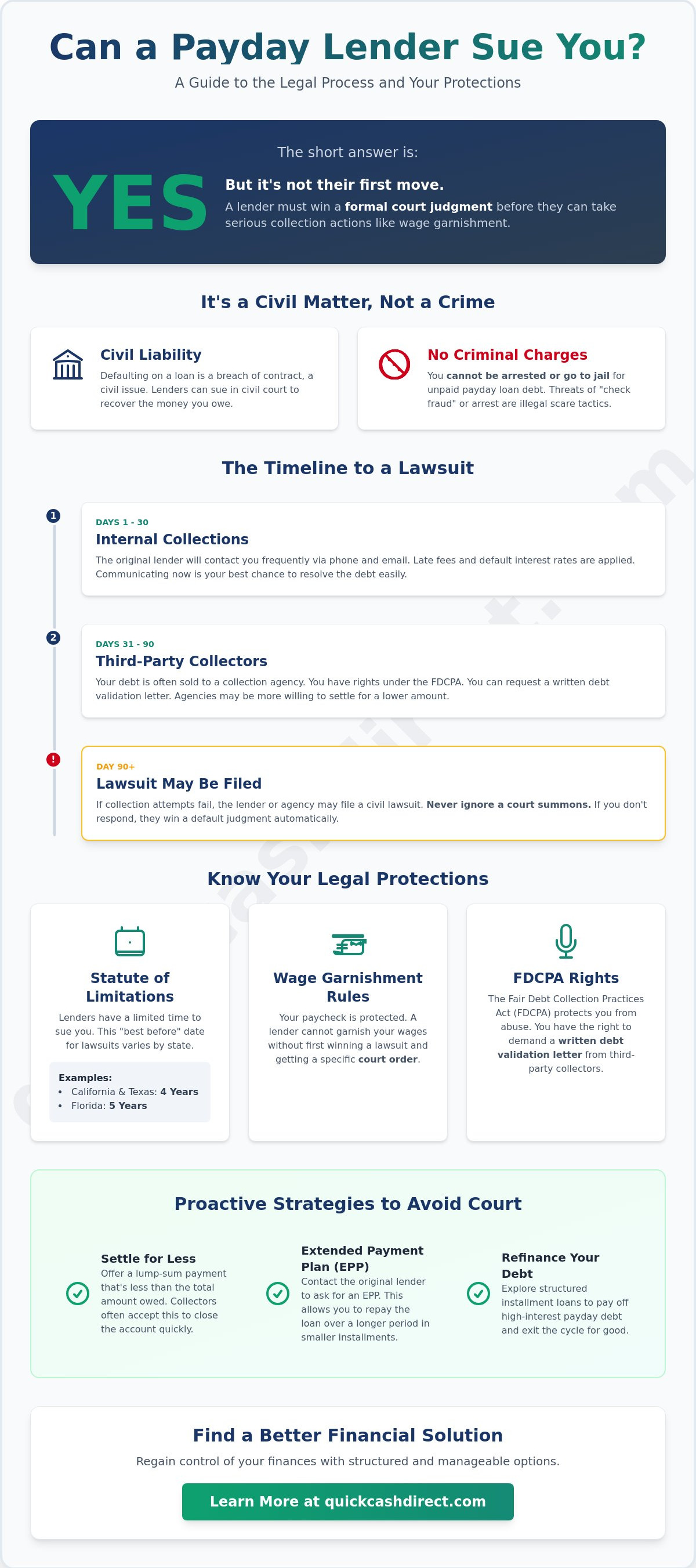
Stop the panic and focus on the facts. You need to know exactly where you stand. The most urgent question on your mind is likely: can a payday lender sue you? The short answer is yes. A payday loan is a legally binding contract. When you signed that agreement, you gave the lender the right to pursue the debt through the court system if you fail to pay. However, a lawsuit is rarely a lender's first move. Litigation costs money and takes time. They prefer to resolve the debt through phone calls and emails before involving a judge.
Lawsuits typically occur after internal collection attempts fail. Most lenders will spend 30 to 60 days trying to reach you directly. If you remain unresponsive, they may escalate the situation. They might sell your debt to a third-party agency or hire a law firm to file a civil complaint. In 2026, lenders are increasingly willing to take legal action for smaller amounts to discourage defaults. You must understand the difference between a threat and a formal legal proceeding to protect your financial future.
Civil vs. Criminal Liability
Defaulting on a loan is a civil matter. It is not a criminal offense. You cannot go to jail for failing to repay a payday loan. Debtors' prisons do not exist in the United States. In 2026, some aggressive debt collectors still use illegal scare tactics. They may threaten you with "check fraud" charges or police intervention. These threats are often empty and violate federal law. If a collector tells you that you will face arrest, they are likely lying to pressure you into a payment. Document these interactions immediately. Report any lender who suggests criminal charges for an unpaid civil debt.
The Role of the Court Judgment
A lender cannot seize your property or touch your paycheck just because you missed a payment. They must win a court judgment first. A judgment is a formal ruling from a judge confirming that you owe a specific debt. This document is the lender's ultimate goal because it unlocks powerful collection tools. Once a judge signs off, the lender can legally pursue wage garnishment or bank levies.
The statute of limitations also plays a critical role in 2026 legal realities. In California and Texas, lenders generally have 4 years from the date of the breach to sue you. In Florida, that window is 5 years. If they wait too long, they lose their right to use the court system. Never ignore a court summons. If you do not show up, the lender wins a default judgment automatically. This gives them the immediate power to pursue your assets. Act fast to respond and defend your rights.
The Timeline of a Payday Loan Lawsuit
Lenders follow a predictable sequence before they ever step into a courtroom. They want to recover their funds with the least amount of resistance and expense. Understanding this timeline allows you to intervene at the most effective moments. While you may wonder can a payday lender sue you the moment a payment is missed, the reality is that legal action is usually the final resort in a months-long process.
- Day 1-30: The lender manages the debt internally.
- Day 31-90: The account moves to third-party collection agencies.
- Day 90+: The lender or agency may file a civil lawsuit in small claims court.
Legal action is expensive for lenders. They must pay filing fees and legal representation, which often cost more than the original loan. Because of this, most lenders prefer a settlement over a trial. Act during the early stages to secure the best resolution terms.
Phase 1: The Internal Collection Cycle
Expect frequent phone calls and emails from the original lender immediately after a missed deadline. During this first month, the lender will likely assess late fees and high default interest rates. Review your original contract now to identify these specific penalties. This is also the period where a "charge-off" occurs. This means the lender has written the debt off as a loss on their books, but you are still legally responsible for the balance. Open lines of communication early to prevent the account from leaving the lender's office.
Phase 2: Third-Party Debt Collectors
If the debt remains unpaid after 30 days, it is often transferred or sold to a collection agency. You have specific rights under the Fair Debt Collection Practices Act (FDCPA) during this phase. Demand a debt validation letter in writing to ensure the amount is accurate. Collectors are often more willing to settle for a lump sum that is significantly lower than the total balance. If you are struggling to manage these calls, consider a fast loan to settle the high-interest debt and regain control of your schedule.
Phase 3: The Tribal Loan Distinction
The rules change if you are dealing with tribal loans. These lenders operate under sovereign law rather than state regulations. Because of this sovereign status, tribal lenders typically handle disputes through mandatory arbitration rather than state courts. Arbitration is a private process that happens outside of the public court system. Verify the specific dispute resolution clauses in your loan agreement immediately. You may find that the lender cannot sue you in your local small claims court, but they can still pursue you through these private legal channels. Knowing these distinctions is vital to your defense strategy.
Wage Garnishment and Your Rights in 2026
Protect your income immediately. You must understand that a lender cannot simply call your boss to demand your wages. If you are asking, can a payday lender sue you, the answer is yes, but that lawsuit is only the first step in a long legal chain. A lender must win their case in court before they can even think about touching your paycheck. In 2026, federal and state laws provide a structured shield for your earnings. You have rights that prevent collectors from leaving you with nothing.
A payday lender must obtain a specific court order known as a writ of garnishment. This happens only after they have secured a formal judgment against you. Without this document, any threat to "take your pay" is empty. Stay informed about these boundaries to reduce your stress and plan your next move. Knowing the limits of their power is your best defense against aggressive collection tactics.
How Garnishment Actually Works
The process is clinical and strictly regulated. Once the lender wins the lawsuit, they apply for the writ. The court sends this order directly to your employer. Your employer is then legally required to comply. They must withhold a portion of your earnings and send it to the creditor. However, federal law protects you from being fired because of a single garnishment. Most lenders are limited to taking 25% of your disposable earnings. This is the amount remaining after mandatory deductions like taxes and Social Security. If your income is low, the amount they can take may be even smaller or zero.
State-Specific Protections
Your location determines your level of safety. As of June 2026, several states offer protections that exceed federal standards. Texas, Pennsylvania, North Carolina, and South Carolina prohibit wage garnishment for almost all consumer debts, including payday loans. If you work in one of these states, your paycheck is effectively off-limits to payday lenders. Other states have unique caps. California limits garnishment to the lesser of 25% of disposable earnings or 50% of the amount by which your earnings exceed 48 times the state minimum wage. New York caps it at 10% of your gross wages. Verify your state's specific rules to see how much of your income is protected.
Income That Cannot Be Touched
Certain types of money are completely exempt from debt seizure. Federal law ensures that your basic survival funds remain in your hands. These protected sources include:
- Social Security and Supplemental Security Income (SSI)
- Veterans Affairs (VA) benefits
- Disability payments
- Federal student loan disbursements
Be careful with "commingled" funds in your bank account. If you deposit your paycheck into the same account as your Social Security benefits, the bank may struggle to identify which money is protected. Keep these funds in separate accounts to maintain their exempt status. Exempt income is funds protected by federal law from debt seizure.
Effective Strategies to Avoid Legal Action
Speed is your greatest asset. If you are worried that can a payday lender sue you, the best defense is a proactive resolution. Lenders view litigation as a costly last resort. They would much rather receive a partial payment today than wait months for a court date. You must act before the account leaves their internal collection department. Taking control of the narrative now prevents the stress of a process server appearing at your door.
Focus on structured relief. You have several tools to halt the legal process and protect your credit. Use these strategies to move from a state of emergency to a state of stability.
- Open immediate lines of communication.
- Request an Extended Payment Plan (EPP).
- Negotiate a lump-sum settlement.
- Consolidate the debt into a manageable installment structure.
The Power of Proactive Communication
Never ignore a lender. Silence is often the primary trigger for a lawsuit. If a lender cannot reach you, they assume you have no intention of paying. This forces them to escalate the matter. Call them today and use the term "financial hardship." Many lenders offer hardship programs that include temporary interest freezes or reduced monthly payments. Keep a detailed written log of every interaction. Record the date, the time, and the name of the representative you spoke with. This documentation serves as evidence that you are acting in good faith if the case ever reaches a judge.
Negotiating a Debt Settlement
Lenders often accept less than the full balance to avoid the high costs of legal fees and court filings. Start by offering 40% to 50% of the total amount owed as a one-time lump sum. You might say: "I cannot pay the full balance, but I have [Amount] available today to close this account permanently." If they agree, you must receive the settlement offer in writing before you send any money. Ensure the document states the debt is "settled in full." This prevents them from selling the remaining balance to another collector later.
Strategic Refinancing
Predatory debt cycles require a structural exit. You can pay off high-interest payday loans by using easy loans for bad credit. These installment options provide longer terms and lower monthly payments. This strategy stops the immediate threat of a lawsuit by satisfying the original lender in full. Compare the cost of a potential judgment, which includes court costs and interest, against the interest rate of a new loan. Often, a new installment loan is the more affordable path to safety. Apply for an emergency loan now to settle your outstanding balances and stop the collection calls for good.
Finding Better Financial Solutions with QuickCashDirect
Transition from a state of fear to a state of resolution today. You've learned the legal realities and the specific timelines lenders follow. The answer to can a payday lender sue you is a clear yes, but that outcome is not inevitable. You can stop the escalation before a process server arrives. QuickCashDirect acts as your bridge to structured relief. We connect you with a network of versatile lenders who understand urgent financial distress and offer pathways out of the debt cycle.
Our platform prioritizes speed and efficiency. We recognize that you need a solution now, not next week. By accessing our network, you can find installment options designed specifically to break the high-interest payday loan loop. Bad credit is not a barrier. Our partners focus on your current ability to pay rather than past mistakes. Secure a more manageable loan structure today to satisfy your original creditors and regain your peace of mind.
The Advantage of Our Referral Network
Searching for the right lender is exhausting when you are under the stress of collection calls. We streamline this entire process for you. Our system matches your requirements with transparent partners who offer payday loans and more sustainable installment alternatives. You don't have to vet dozens of websites. We do the heavy lifting to ensure you find a reliable partner fast.
Efficiency is built into our framework. If you need immediate funds to settle an outstanding debt and avoid a lawsuit, our network provides direct deposit loans for rapid relief. These options ensure that money reaches your account quickly, allowing you to address emergencies before they spiral into court judgments. We prioritize clear terms and straightforward processes so you can navigate your recovery without confusion.
Secure Your Financial Future Today
Act now to prevent legal headaches tomorrow. Silence and hesitation only give lenders more reason to file a lawsuit. By using our platform, you take the offensive. You can settle your predatory debts and replace them with a structured payment plan that fits your actual budget. This is the fastest way to stop the aggressive calls and protect your wages from future garnishment.
Don't let an unpaid balance dictate your future. You have the tools to resolve this situation before it reaches a courtroom. Take control of your debt and move toward financial safety with a partner you can trust. Get the funding you need to resolve your debt today.
Take Control of Your Financial Recovery Today
Stop the cycle of debt before it reaches the courtroom. You now have the facts about the lawsuit timeline and your federal rights regarding wage garnishment. The answer to can a payday lender sue you is clear. However, you also have the tools to intervene. Proactive communication and strategic refinancing are your best defenses against aggressive collection tactics. You can resolve these issues today by choosing a structured path forward. Every minute you wait gives lenders more time to escalate their claims. Act now to secure your income and your future.
Don't wait for a summons to arrive. Our network specializes in connecting users with lenders who accept bad credit and offer transparent terms. We provide a secure referral process to help you find direct deposit loans in minutes. This speed allows you to settle predatory debts before they ever turn into legal judgments. Secure a manageable loan to resolve your debt now and protect your income. You have the power to fix this situation. Start your transition to financial safety immediately. You are one step away from a permanent resolution.
Frequently Asked Questions
Can I go to jail for not paying a payday loan in 2026?
No, you cannot be arrested or jailed for failing to repay a payday loan. This is a civil matter, not a criminal one. Debtors' prisons do not exist in the United States. If a collector threatens you with arrest, they are likely violating federal law. Document these threats immediately and report them to the Consumer Financial Protection Bureau to stop the harassment.
What happens if I ignore a lawsuit summons from a payday lender?
Ignoring a summons results in a default judgment against you. This means the lender wins the case automatically because you didn't defend yourself. A judgment gives the lender the legal power to garnish your wages or levy your bank account. Always respond to court papers within the specified timeframe, usually 20 to 30 days, to protect your assets.
Can a payday lender take money directly from my bank account without a court order?
Lenders cannot seize funds from your bank account without a formal court judgment and a writ of execution. They may attempt to use the ACH authorization you signed during the application process. However, you can revoke this authorization at any time by notifying your bank. If the lender persists without a court order, they are operating outside of legal boundaries and federal regulations.
How long does a payday lender have to sue me (Statute of Limitations)?
The timeframe depends on your state's laws for written contracts. In California and Texas, the statute of limitations is 4 years from the date of the breach. In Florida, lenders have 5 years to file a lawsuit. If you are asking can a payday lender sue you after these dates, the answer is generally no. The debt still exists, but they lose the right to use the court system.
Will a payday loan lawsuit show up on my credit report?
A lawsuit itself may not appear, but the resulting court judgment will likely damage your credit score. Most payday lenders do not report to the three major credit bureaus. However, if they sell your debt to a collection agency or win a judgment, it becomes part of your public record. This can lower your score significantly and make it harder to secure future housing or employment.
Can a tribal lender sue me in my home state court?
Tribal lenders usually operate under sovereign law and include mandatory arbitration clauses in their contracts. This means they typically handle disputes through private arbitration rather than your local state court. While they rarely sue in state courts, they can still pursue you through the arbitration process to obtain a settlement. Review your contract to identify the specific dispute resolution venue and your rights.
What should I do if a debt collector threatens to call my employer?
Stop the harassment by asserting your rights under the Fair Debt Collection Practices Act (FDCPA). Collectors are generally prohibited from telling your employer about your debt. They can only contact your workplace to verify employment or location. If they threaten to reveal your financial status to your boss, record the call and contact a legal professional immediately. This tactic is often an illegal scare tactic.
Is it possible to settle a payday loan for less than I owe?
Yes, you can often settle for 40% to 60% of the total balance. Lenders prefer a quick lump sum over the high costs of a legal trial. Start the negotiation by offering a realistic amount you can pay immediately. Always get the final agreement in writing before sending any funds. This ensures the account is closed permanently and prevents further collection actions or potential lawsuits.